Last verified: August 8, 2026. Government travel advice is rewritten without notice, and reporting on crime and harassment shifts with it, so a safety page is only as good as its last check. I re-read the UK, US and Canadian advisories and the reporting behind every claim here, and update the date above each time.
Disclosure: Some links in this guide may earn us a commission, at no extra cost to you. It never changes what we recommend.
Type is Morocco safe into Google and you’ll mostly get answers from companies that need you to say yes. We checked. On the year-qualified search most people actually type, is Morocco safe to visit in 2026, seven of the top eight results were tour operators.
That’s the problem with this question. It’s the single most common worry people have before booking Morocco, and almost every page answering it has a financial stake in the answer.
So here’s the version from a site with no tours to sell. What the indices say, what the advisories say, what the casualty numbers say, and which risk is actually worth your attention. Every figure is dated and linked.
I’m not a resident and I don’t pretend to be. What I do is make the trip repeatedly and check the practical claims against official sources rather than against the last blog post that said them.
Key Takeaways
- Morocco scored zero on the 2026 Global Terrorism Index, joint 100th of 163 countries (Institute for Economics & Peace, March 2026).
- Marrakech’s crime index is 44.6 against London’s 55.2 on the same Numbeo scale, mid-2026.
- The real risk is the road. 4,577 people died in Moroccan traffic in 2025.
- No mainstream destination carries a travel warning. The only exception is the Western Sahara buffer zone.
- Harassment of women is a frequency problem, not usually a danger problem, and it varies sharply by city.
Table of Contents
Is Morocco safe to visit in 2026?
Yes. In 2026 Morocco scored zero on the Global Terrorism Index, ranking joint 100th of 163 countries as one of roughly 25 with no recorded incidents (Institute for Economics & Peace, Global Terrorism Index 2026, March 2026). The UK advises against travel to no part of the country outside one militarised zone in the Western Sahara.
Morocco also placed 65th of 163 on the 2026 Global Peace Index with a score of 1.895, up 20 places in a year. That puts it first in the Maghreb, seventh in Africa and fourth in the Arab world (Institute for Economics & Peace via Morocco World News, June 2026).
But asking is Morocco safe hides four different questions. Is there a terrorism risk? Will I get robbed? Will I be harassed? Will I get hurt? The answers aren’t the same, and one of them is considerably worse than the other three.
The rest of this answers is Morocco safe one layer at a time.
What do the US and UK governments actually say?
The US State Department places Morocco at Level 2: Exercise Increased Caution, citing terrorism, in an advisory issued 21 April 2025. That’s the same tier as France, Germany, Italy, Spain and the United Kingdom. The UK’s Morocco page was last updated on 17 February 2026 and carries no advisory against travel to any Moroccan tourist destination (GOV.UK).
If you are asking is Morocco safe according to your own government, the answer is the one it also gives about France. Level 2 sounds more alarming than it is. Four of the five most-visited countries in Europe sit at exactly the same level.
| Country | US State Dept level | Advises against travel to tourist areas? |
|---|---|---|
| Morocco | Level 2: Exercise Increased Caution | No |
| France | Level 2: Exercise Increased Caution | No |
| Spain | Level 2: Exercise Increased Caution | No |
| Italy | Level 2: Exercise Increased Caution | No |
| United Kingdom | Level 2: Exercise Increased Caution | No |
It’s worth knowing what the levels mean, because the number gets quoted without its scale. The State Department runs four. Level 1 is Exercise Normal Precautions, the baseline for places like Japan and Iceland. Level 2, where Morocco sits, means be more aware of your surroundings than usual, for a stated reason. Level 3 is Reconsider Travel. Level 4 is Do Not Travel, which is where Afghanistan, Syria and North Korea sit. Morocco is one step above the floor, on a scale that runs four deep, in the same band as most of Western Europe.
The one real exception is geographic and narrow. The UK advises against all travel within 40km north and west of the Berm, the militarised sand wall running through the Western Sahara, including the town of Es Semara, and against all travel to the territory south and east of it (GOV.UK, Western Sahara). Militarised zones 30km deep run along either side, they contain landmines, and cross-border rocket fire has happened before.
You will not go near this by accident. It’s roughly a thousand kilometres from Marrakech and nothing on a normal itinerary points that way. It matters mainly because travelling against your government’s advice can void your travel insurance.
How does Morocco’s crime rate compare to where you live?
Marrakech scores 44.6 on Numbeo’s crime index against London’s 55.2 on the same scale, using mid-2026 data. On perceived safety walking alone in daylight, Marrakech scores 67.5 to London’s 63.3; at night, 43.7 to London’s 37.3 (Numbeo, mid-2026).
That comparison needs a caveat, and we’d rather give it than have you find it later. Numbeo is crowdsourced perception collected from users over a rolling five-year window. It isn’t police-recorded crime, and people’s sense of safety in an unfamiliar city behaves differently from their sense of safety at home. Treat it as a useful signal, not a measurement.
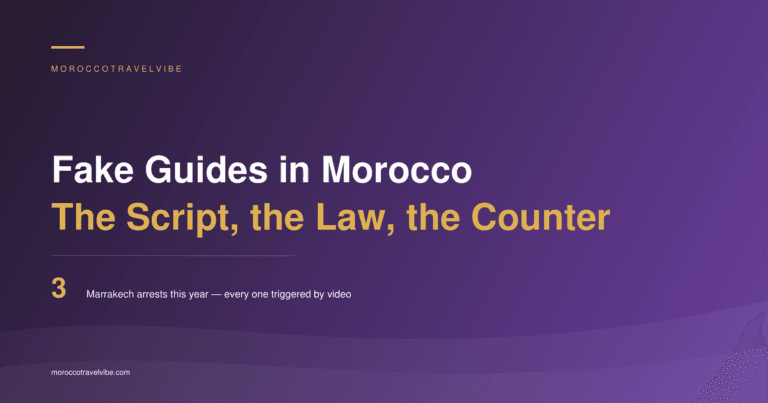
What does the crime actually look like? Petty and opportunistic. The UK names pickpocketing, bag-snatching and theft of jewellery and handbags by riders on motorbikes, concentrated in medinas, on beaches and around crowded tourist sites. It also names credit card fraud, bogus guides working the historic districts, marriage fraud arranged through online introductions, and methanol poisoning from unregulated alcohol (GOV.UK, February 2026). The bogus-guide problem has its own page: the script, the badge law and the three 2026 Marrakech arrests.
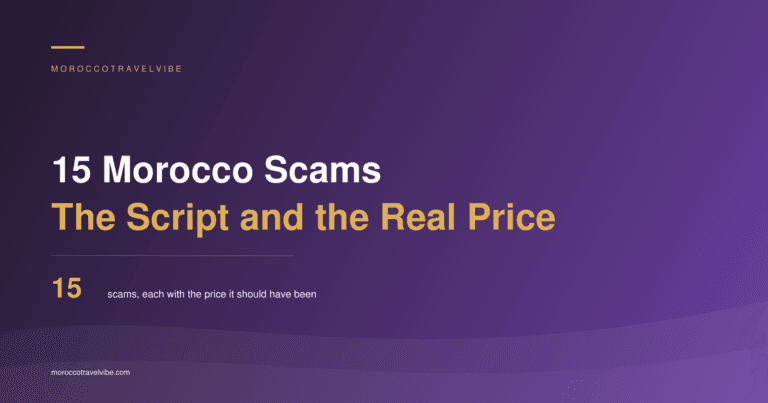
Violent crime against visitors is uncommon, though not zero. The same page notes occasional knife attacks against tourists in major cities and on beaches. Morocco’s homicide rate is around 1.7 per 100,000. None of this changes the headline answer to is Morocco safe. It changes what you watch for. We keep the fifteen scams worth recognising on sight in their own guide, each with its opening script and the price it should have been. What it should have been comes from the Morocco Price Index, which we collect and date ourselves.
What’s the real risk in Morocco?
The road. In 2025 Morocco recorded more than 160,000 traffic accidents and 4,577 deaths, against zero terrorism deaths in the same year. Between January and May 2025 alone, 1,624 people died on Moroccan roads, up 20.9% on the same period the year before (NARSA via Express TV, July 2025).
This is the part almost nobody leads with, and it’s strange that they don’t. The risk people ask about isn’t the risk that hurts them. Read a dozen Morocco safety guides and you’ll get terrorism in the first section and driving somewhere near the bottom, if at all. That is precisely backwards relative to the numbers.
The 2025 figure follows 4,024 deaths and 143,272 injury accidents in 2024, itself up more than 16% on 2023 (Morocco World News, July 2025). Pedestrians and motorcyclists make up over 70% of the dead (SSATP, Africa Status Report on Road Safety 2025). A national strategy for 2026–2030 targets halving the toll. The same deadline is rebuilding rail, airports and stadiums nationwide. what’s changing before the World Cup is tracked separately, monthly.
So what does that mean for anyone asking is Morocco safe? Four things, and they’re duller than anything in the scam guides.
- Don’t drive the Atlas at night. Unlit roads, livestock, and vehicles without working lights. The Marrakech–Merzouga run is eight to nine hours; do it in daylight.
- Take the train where a train exists. ONCF rail between Casablanca, Rabat, Tangier and Fes is comfortable, cheap and far safer than the equivalent road.
- Wear the seatbelt in the back of the grand taxi. Six passengers in an old Mercedes is normal and legal. Sit somewhere you can belt in.
- Treat the cheapest desert tour as a driving decision. The operator saving money on your €69 tour is saving it on the vehicle and the driver’s hours, and what else that saving buys is its own subject.
Has there been a terrorist attack in Morocco?
Not in the 2026 index period. Morocco recorded no terrorist incidents, deaths or injuries and scored zero on the Global Terrorism Index published in March 2026. The last mass-casualty attack on tourists was the Argana café bombing in Marrakech’s Jemaa el-Fnaa on 28 April 2011, which killed 17 people, many of them European visitors (Al Jazeera, April 2011).
One correction, because it circulates widely. Several Moroccan outlets and travel sites currently state that Morocco “has not recorded any attacks since 2007.” That isn’t true. The Argana bombing was in 2011 and killed 17, most of them foreign visitors (Human Rights Watch, April 2011). The murders of two Scandinavian hikers near Imlil in December 2018 were prosecuted and sentenced as terrorism (Al Jazeera). The honest framing is fifteen years without a mass-casualty attack, which is a genuinely strong record and doesn’t need improving on.
Here’s the tension worth naming. The UK’s own guidance still says terrorists “are likely to try to carry out attacks” in Morocco, naming transport hubs, tourist sites and crowded areas. That sits alongside a zero score without contradicting it. One describes outcomes, the other describes intent. The accurate summary is prevented, not absent.
Why has the record held? Morocco rebuilt its counter-terrorism apparatus after the Casablanca bombings of May 2003, and again after Argana in 2011, and the country now sits geographically close to the Sahel, one of the most terrorism-affected regions on earth, while recording nothing. That gap between neighbourhood and outcome is the actual story, and it’s why Morocco appears among the roughly 25 countries scoring zero rather than merely low.
For a traveller this resolves into something fairly unglamorous. The security presence around major squares, transport hubs and tourist sites is heavy and visible, and you will be waved through metal detectors at museum and hotel entrances without anyone explaining why. That’s the system you’re seeing. It’s also the reason terrorism belongs near the bottom of your list of things to plan around, not the top.
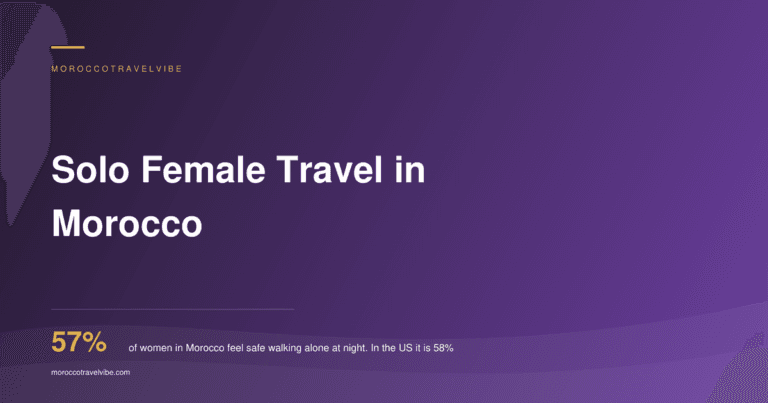
Is Morocco safe for solo female travellers?
This is the version of the question I get asked most. Mostly yes, with a caveat that is about wear rather than danger. US State Department security reporting lists harassment of women among the most frequently reported issues for visitors to Morocco, alongside pickpocketing and bag-snatching. That ranking is the honest answer: verbal harassment is common enough that most women travelling alone will meet it, and escalation to physical danger is rare.
Whether is Morocco safe for a woman alone comes down to numbers nobody reliable has published. I’m not going to give you a percentage here, and it’s worth saying why. The figure that circulates most widely, a claim that 62% of solo female travellers feel safe, is attributed to a 2024 Moroccan tourist office survey. It traces back only to a tour operator’s blog with no primary source behind it. The same page also states Morocco is at US advisory Level 1, which it isn’t. So I’ve left the number out rather than launder it.
What does help, consistently, across a lot of traveller reporting:
- The city gradient is real. Essaouira, Chefchaouen, Rabat and Agadir are noticeably calmer than the Marrakech and Fes medinas. If a first Morocco trip alone feels daunting, start on the coast.
- Walk like you know where you’re going. The single most repeated piece of advice from women who’ve done it. Hesitation in a medina reads as an invitation to help you, and help is rarely free.
- Covered shoulders and knees reduce attention markedly in medinas and smaller towns. Gueliz in Marrakech and the coastal towns are more relaxed.
- The Brigade Touristique is real recourse. Tourist police operate in Marrakech, Fes, Agadir and Casablanca, and reports can be filed in French or English.
One thing operator guides tend to do here is minimise it, then conclude that you should book with a professional. I don’t have a tour to sell you. So: it happens, it’s tiring, and for most women it isn’t a reason not to go. For the numbers behind that, the law that makes street harassment a crime and the phone numbers that actually work, here is what solo women actually experience in Morocco.
Is Morocco safe after the 2023 earthquake?
Yes. The magnitude 6.8 Al Haouz earthquake struck on 8 September 2023, around 72km southwest of Marrakech, killing more than 2,900 people and damaging or destroying close to 60,000 homes (Britannica). What it hit hardest were remote High Atlas villages built from unreinforced masonry. Marrakech’s medina, its riads and the routes tourists use came through largely intact.
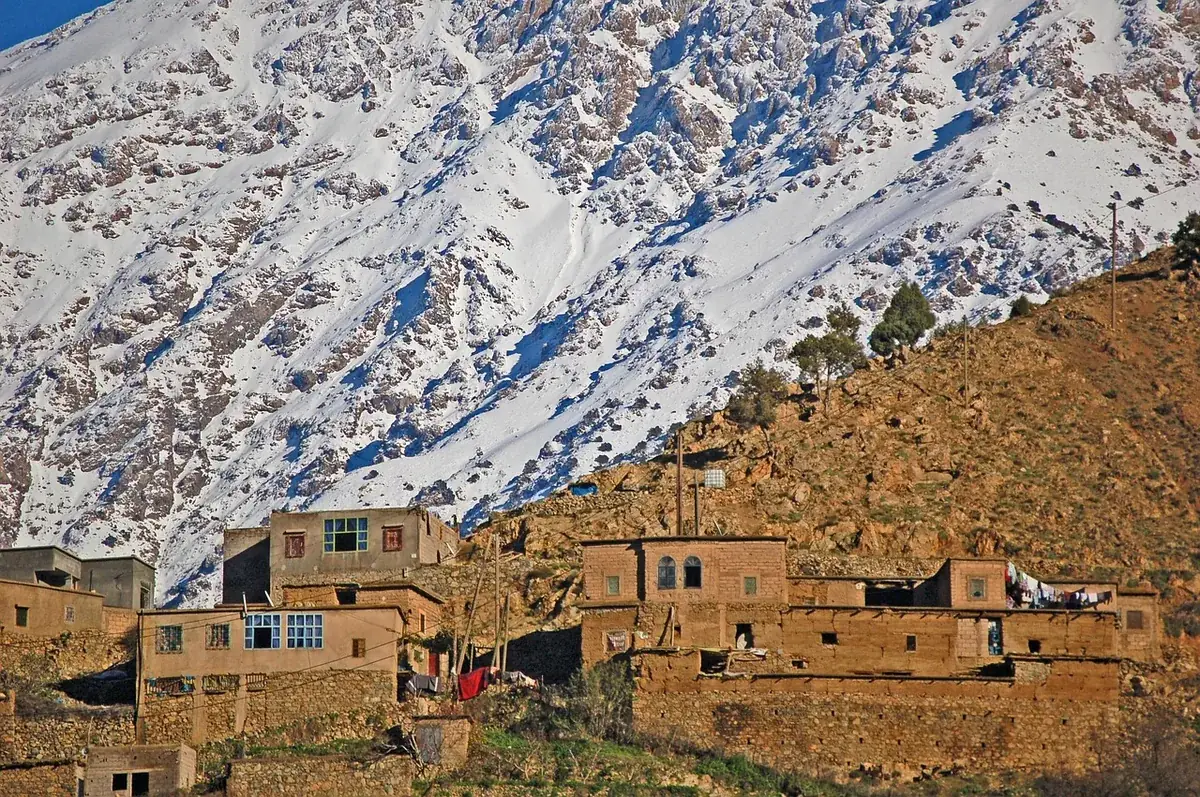
The Tizi n’Tichka pass, which every Marrakech-to-Merzouga tour crosses, is open and running normally. On the narrow question is Morocco safe in the mountains, the answer is the same as anywhere else in the country.
The uncomfortable part isn’t a safety problem, it’s a distribution one. Morocco took a record 19.8 million visitors in 2025, up 14% (ATTA, January 2026), yet the valleys hit hardest (Imlil, Ourika, Azzaden) still report empty guesthouses nearly three years on. Reconstruction has been slow and uneven; one 2025 assessment found 16% of affected families had received no assistance at all.
Those valleys ran on trekkers. So when is Morocco safe narrows to should I avoid the High Atlas, the honest answer runs opposite to what the question expects: it’s the part of the country where your money currently does the most, and skipping it is a decision with a cost attached to somebody else.
What should you actually do to stay safe in Morocco?
Asking is Morocco safe is really asking what to do differently once you are there. Ranked by how likely each is to affect you, which is not the order most guides use. Traffic first, theft second, scams third, harassment fourth. Terrorism doesn’t make the list on frequency, and hasn’t for fifteen years.
- Sort out transport before anything else. Daylight for long road legs, trains where they run, seatbelts in grand taxis. This is the whole ballgame and it takes one decision at booking.
- Carry less. Pickpocketing and bag-snatching in medinas is the realistic property risk. A cross-body bag on the wall side of the lane, and no phone out while walking, removes most of it.
- Learn the three standard approaches. Someone attaching themselves as a guide; being told your riad’s street is closed; the driver’s “quick stop” at a shop where he earns commission. Recognising them is the entire defence.
- Cash and cards. Card fraud is specifically named in UK guidance. Use ATMs attached to banks, and expect cash to be necessary outside hotels and modern retail.
- Don’t drink unregulated alcohol. Methanol poisoning is on the UK’s Morocco list. Buy from licensed premises.
- Know the numbers. 190 for police in cities, 19 for urban police, 177 for the Royal Gendarmerie in rural areas. Reports can be filed in French or English at tourist police stations.
And one last thing about the sources you’ll read on the way to deciding. We ran the search ourselves on 8 August 2026, from clean logged-out sessions, and classified who publishes the top results.
The head term is genuinely contested: large brands and long-standing independent bloggers hold most of it. But add the year, which is exactly what someone planning a 2026 trip types, and the page fills with tour sellers. That’s the search most people actually run.
It isn’t only a bias problem, either. Those same pages carry decaying facts. One states Morocco is at advisory Level 1 (it’s Level 2, and has been since April 2025). Arrival figures on them appear as “over 16 million”, “over 18 million” and “17.4 million in 2024”, against a verified 19.8 million for 2025.
Common questions
Is Morocco safe for American tourists?
Yes. The answer to is Morocco safe does not change with a US passport. The State Department places Morocco at Level 2, Exercise Increased Caution, the same level as France, Germany, Italy, Spain and the United Kingdom. No mainstream Moroccan destination carries a warning against travel. Verify the current advisory yourself at travel.state.gov before you go; it’s a thirty-second check.
Is Marrakech safe at night?
Reasonably. Marrakech scores 43.7 for walking alone at night on Numbeo’s mid-2026 data, above London’s 37.3, though both sit in the moderate band. Main squares and lit arteries stay busy and policed well past midnight. Unlit medina side streets are where the reported incidents cluster.
Do I need a guide to visit the medinas safely?
No. The UK specifically names bogus guides harassing visitors in historic districts as a common problem, which makes an unsolicited “guide” a risk rather than a fix. Official guides carry photo ID cards. If you want one, arrange it through your riad rather than accepting an approach in the street.
Which parts of Morocco should I avoid?
Only the Western Sahara buffer zones. The UK advises against all travel within 40km north and west of the Berm, including Es Semara, and to all territory south and east of it, because of landmines and past cross-border rocket fire. No mainstream destination carries an advisory.
Is Morocco safer than other North African destinations?
By the standard measure, yes, which is the cleanest way to answer is Morocco safe against its neighbours. Morocco placed 65th of 163 on the 2026 Global Peace Index with a score of 1.895, up 20 places in a year. That’s first in the Maghreb, seventh in Africa and fourth in the Arab world, and it scored zero on the 2026 Global Terrorism Index.
Where to start
So, is Morocco safe? On every measure that can be checked, yes. Short version, if you skipped down:
- Every international measure puts Morocco in the safe band, and the trend is improving.
- No mainstream destination carries a travel warning from the US or UK.
- The risk that actually injures people is traffic. Plan transport accordingly.
- Petty theft in medinas is the realistic property risk, and it’s avoidable.
- Harassment of women is real and wearing, varies sharply by city, and is rarely dangerous.
- The High Atlas is safe, and the earthquake-hit valleys could use the visitors.
The two things worth reading next are the ones that turn this into decisions. The scams piece gives you the actual scripts and the real prices, so you recognise an approach before it costs you anything. And once you’re going, the Price Index is where you find out what things should cost. Every figure is collected directly, with the date attached.
Advisory levels, index scores and casualty figures on this page were verified on 8 August 2026. Advisory and index claims are on a 90-day re-verification cycle; next due 9 October 2026.
What next: if is Morocco safe was your last open question, start with the Morocco trip planning guide. The scam scripts and the real prices behind them are already live, and the Morocco Price Index follows on 31 August.
More in Safety and Scams, or read how we verify what we publish and what we don’t sell. Had a different experience, or spotted a figure that has moved? Tell us what it should have been. Corrections go into the next verification pass.