Last verified: August 27, 2026. Two of the numbers on this page come from surveys that are re-run on multi-year cycles, and the third comes from a law that could be amended. Every 60 days I re-read the Georgetown index entry, the HCP survey text and the State Department advisory feed, and re-run the search audit at the bottom.
Search solo female travel in Morocco with next year attached to it, and every answer on the first page is published by a company that sells Morocco tours. All of them conclude that you should book one.
Disclosure: Some links in this guide may earn us a commission, at no extra cost to you. It never changes what we recommend.
I should say the obvious thing first. I’m a man, and I have never travelled Morocco as a woman alone. So I’m not going to tell you what it feels like. What I can do is the part that the women who have done it keep saying nobody bothers with: find the actual numbers, read the actual law, and check the phone numbers.
That took a day. Here’s what came out of it, including one statistic that surprised me and one that I’d argue you should distrust.
Key Takeaways
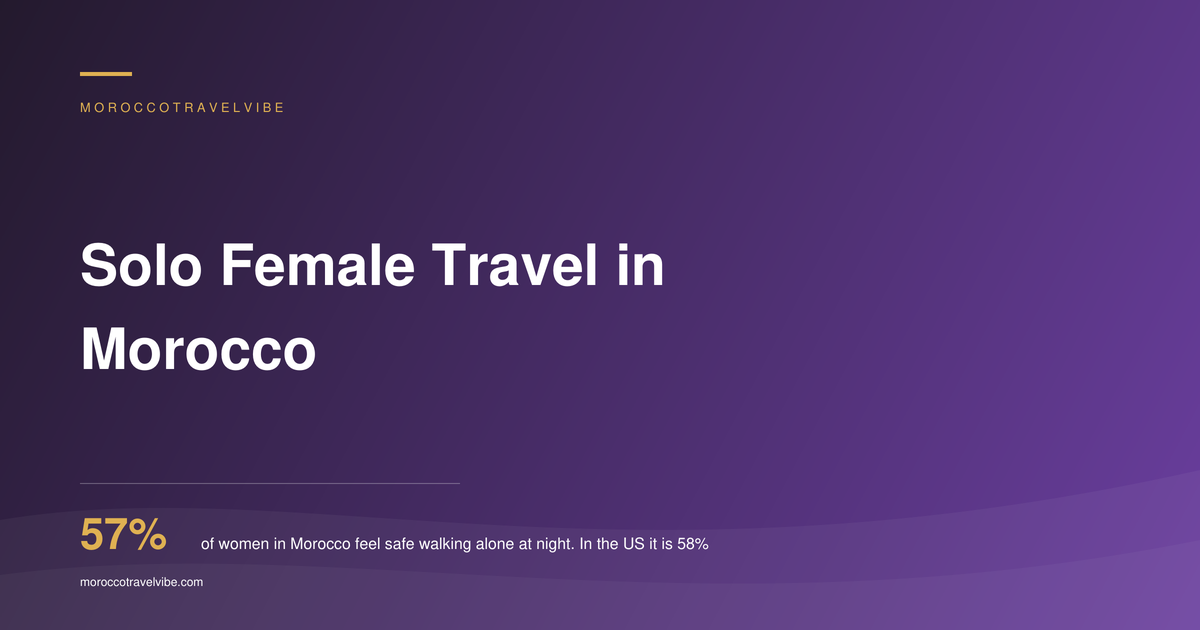
- 57% of women in Morocco say they feel safe walking alone at night. The United States figure is 58%. Gallup World Poll data for 2022 to 2024, via the Georgetown WPS Index
- Street harassment is a crime. Article 503-1-1 of the Penal Code carries one to six months in prison and a fine of 2,000 to 10,000 dirhams
- Violence against women in Moroccan public spaces fell from 32.9% to 12.6% in ten years, on Morocco’s own national survey. No English-language guide I found cites it
- Only 3% of sexual-violence victims file a complaint. Same survey. The law and the reporting rate are two different facts
- Police is 19 in cities, 177 outside them, 112 from any mobile. 15 is the ambulance, whatever your search results told you
Table of Contents
What do the numbers say about solo female travel in Morocco?
57% of women aged 15 and over in Morocco say they feel safe walking alone at night where they live. In the United States, the figure is 58%. Both come from the same instrument, the Gallup World Poll, pooled over 2022 to 2024 and published in the Georgetown Institute’s Women, Peace and Security Index for 2025/26.
I’ll be honest that I expected a bigger gap. Anyone researching solo female travel in Morocco has read a lot of prose about how different it is. On this one measure, the difference between Morocco and the country a large share of its worried visitors fly in from is one percentage point.
Morocco ranks 102nd of 181 countries on the index overall, with a score of 0.668. That’s the part the single number hides.
Look at Egypt. It reports the highest night-safety figure of the six, 76%, and sits 125th of 181 overall. Spain reports 75% and sits 25th. The two measures barely relate.
So here’s the caveat on my own headline number, and I think it matters more than the number. This indicator does not measure how safe a country is for women. It measures what women there have come to expect of a street at night. A place where women rarely go out after dark can report high confidence, because the women who answer are the ones who stay in. Morocco’s 57% is worth knowing. It is not worth building a decision on by itself. The site’s full risk picture, ranked by what actually happens sets it against the crime and road numbers, which behave differently.
Is it getting better or worse?
Better, sharply, and by Morocco’s own measurement. The Haut-Commissariat au Plan, the national statistics office, found that violence against women in public places fell from 32.9% in 2009 to 12.6% in 2019, a drop of 20 points in a decade.
That 12.6% is women aged 18 and over reporting one or more forms of violence in a public place in the previous twelve months. In absolute terms it’s 1,693,622 women. The survey ran February to July 2019, nationwide, and it’s the second of its kind after the 2009 baseline. UN Women’s Morocco office summarised the first results on release.
Within that 12.6%, the survey is specific about what kind of violence. Sexual violence is the most common form in public places, at 77 women per 1,000. Rape is 4 per 1,000. Sexual and physical violence together account for 9.8%. Those categories overlap, so they don’t add up to the total, and I’d be careful with any page that presents them as a tidy breakdown.
You may have seen a figure claiming that 73% of Moroccan women report street harassment. I couldn’t source it to anything, and the real number is both lower and more useful. What you should take from the HCP survey isn’t a single percentage, it’s the direction: this got substantially better while nobody writing English-language travel content noticed. The travel internet is still describing 2009.
Is street harassment actually illegal in Morocco?
Yes, and it has been since August 2018. Article 503-1-1 of the Moroccan Penal Code makes it a crime to harass someone in a public place by words, acts or signals of a sexual nature, and it carries one to six months in prison plus a fine of 2,000 to 10,000 dirhams.
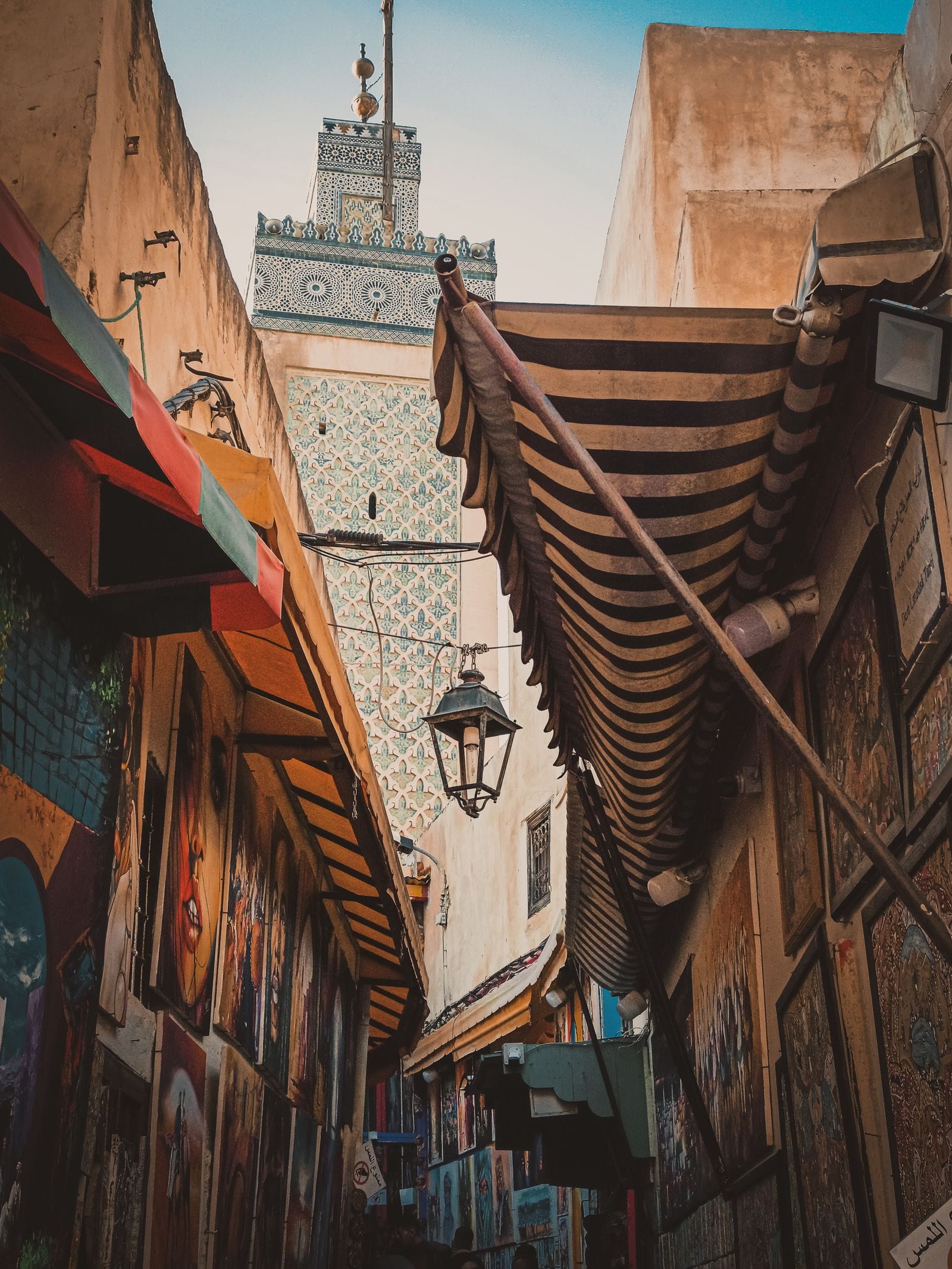
Fes medina. Photo: Med Rofka.
The article was inserted by Loi 103-13 on combating violence against women, promulgated by dahir 1-18-19 on 5 March 2018 and published in the Bulletin Officiel two months before it took effect. The penalties double where the offender is a work colleague, or a person responsible for keeping order and security in a public place. A separate article, 503-1-2, covers aggravated cases at three to five years and 5,000 to 50,000 dirhams.
I checked six of the pages currently ranking for this question. Not one of them mentions that this law exists.
It isn’t a perfect law and I’d rather say so than sell it. Human Rights Watch called it an initial positive step and criticised it in the same breath, mainly because protection under it requires a prosecution and a conviction rather than a civil order.
So is it enforced? Here’s the honest limit, from the same survey that produced the good news. Across all contexts, 10.4% of women who suffered physical or sexual violence took legal action or filed a complaint. For physical violence it’s 13%. For sexual violence it’s 3%. Outside a marriage the physical figure rises to 22%, and the sexual figure stays at 3%.
A statute and a reporting rate are two different facts, and you need both. The law means a complaint has somewhere to go. The 3% means most complaints are never made, in Morocco as in most countries, for reasons the survey lists as social, psychological and a lack of confidence that the authorities will act.
Who do you actually call?
Four numbers, and one of them is wrong on a page currently ranking for this exact question.
1. 19 for the police, in cities and towns 2. 177 for the Gendarmerie Royale, which covers rural areas and the roads between towns 3. 112 from any mobile, which routes you 4. 15 for ambulance and fire
That fourth one is the problem. NomadSister’s Morocco guide tells readers to “keep 19 (emergencies) and 15 (tourist police) in your contacts.” 15 is not the tourist police. It’s the ambulance and the fire brigade. Another page in the same set of results, from CityTours Morocco, lists all three correctly, which is what makes this a checkable error rather than a difference of opinion.
The Brigade Touristique is real and it’s separate. It’s a DGSN unit that works tourist routes, monuments, markets, hotels and riads, and takes complaints from visitors. Fes opened a new brigade headquarters near Bab Boujloud on 31 July 2026, a 291 square metre building chosen for its position so that visitors can walk in. City brigade numbers vary and I’m not going to publish one I can’t stand behind, so get it from your riad or the nearest station on day one. Reports can be filed in French, and at tourist stations usually in English.
Which Moroccan cities are easiest to travel alone in?
The gradient is real, and it’s about medina density and tout economics rather than culture. Chefchaouen, Essaouira and Rabat come up again and again as calmer; the Marrakech and Fes medinas come up as the demanding ones.
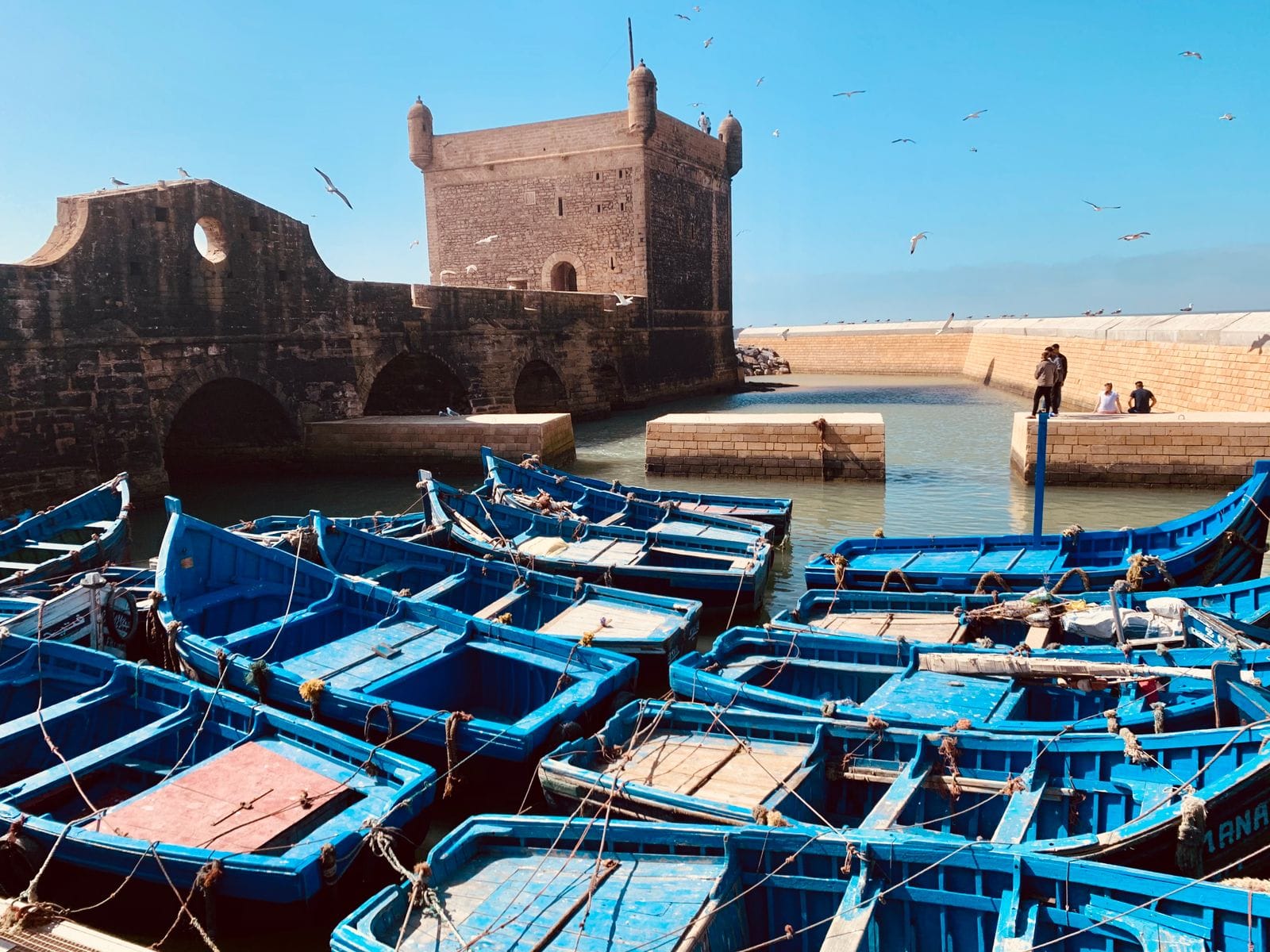
Essaouira harbour. Photo: Sarah Hall.
Why would that be? Because the pressure a solo traveller feels in Jemaa el-Fnaa or Fes el-Bali is mostly commercial. It’s a dense warren, you’re visibly lost, and there’s an established local economy in helping lost visitors for money. Essaouira’s medina is a grid on the sea with a fraction of the footfall. Rabat is a working capital where tourists aren’t the main event.
For a hard number rather than a vibe, Marrakech scores 43.7 on Numbeo’s mid-2026 index for walking alone at night, against London’s 37.3. Both sit in the moderate band. I’d treat that as one more data point and not a ranking, because it’s a crowdsourced perception index and it has the same problem as the 57%.
The practical version: if this is your first solo trip anywhere, don’t open with four nights in the Fes medina. Open with Essaouira or Rabat, then take Marrakech with your bearings. Which cities an itinerary should actually string together is a separate question with a separate answer.
Where you sleep changes your day more than what you wear
The one booking decision that does the most work is a small family-run riad with a staffed door. It does more for a solo trip than any packing choice.
So what are you actually buying? The host knows your face by the second day. They’ll call a taxi rather than sending you to hail one. They’ll write your address in Arabic for the driver, which matters because medina addresses defeat mapping apps and a wrong drop-off after dark is the single most common way a fine day turns bad. And they give you a phone number that answers.
That last point is the one people underrate. A riad with six rooms and a family behind the desk is a local contact with a stake in your week going well. A 200-room hotel on the ring road is a front desk.
It isn’t free. When I priced the Marrakech medina in August, the median advertised riad night for two was 973 dirhams for a late-September stay, and what a medina riad actually costs by season moves by 70% between January and New Year. Budget for the neighbourhood and the door, not the thread count.
One thing to be clear about: an unsolicited “guide” who attaches himself outside your riad is not a safety upgrade. He’s the fake guide script, step by step, and the UK Foreign Office names bogus guides harassing visitors as a common problem in historic districts.
On clothing, which is the question that dominates every other page: it gets its own post on 2 September, city by city, and it deserves more than a line here. The short version is that loose and covered draws less attention and the FCDO says so too, and that it changes the volume rather than the existence of the attention.
Getting around after dark
Take the petit taxi and watch the meter. After 8pm the legitimate surcharge is Tarif 2, which is 50% on the metered fare and shows on the meter itself.
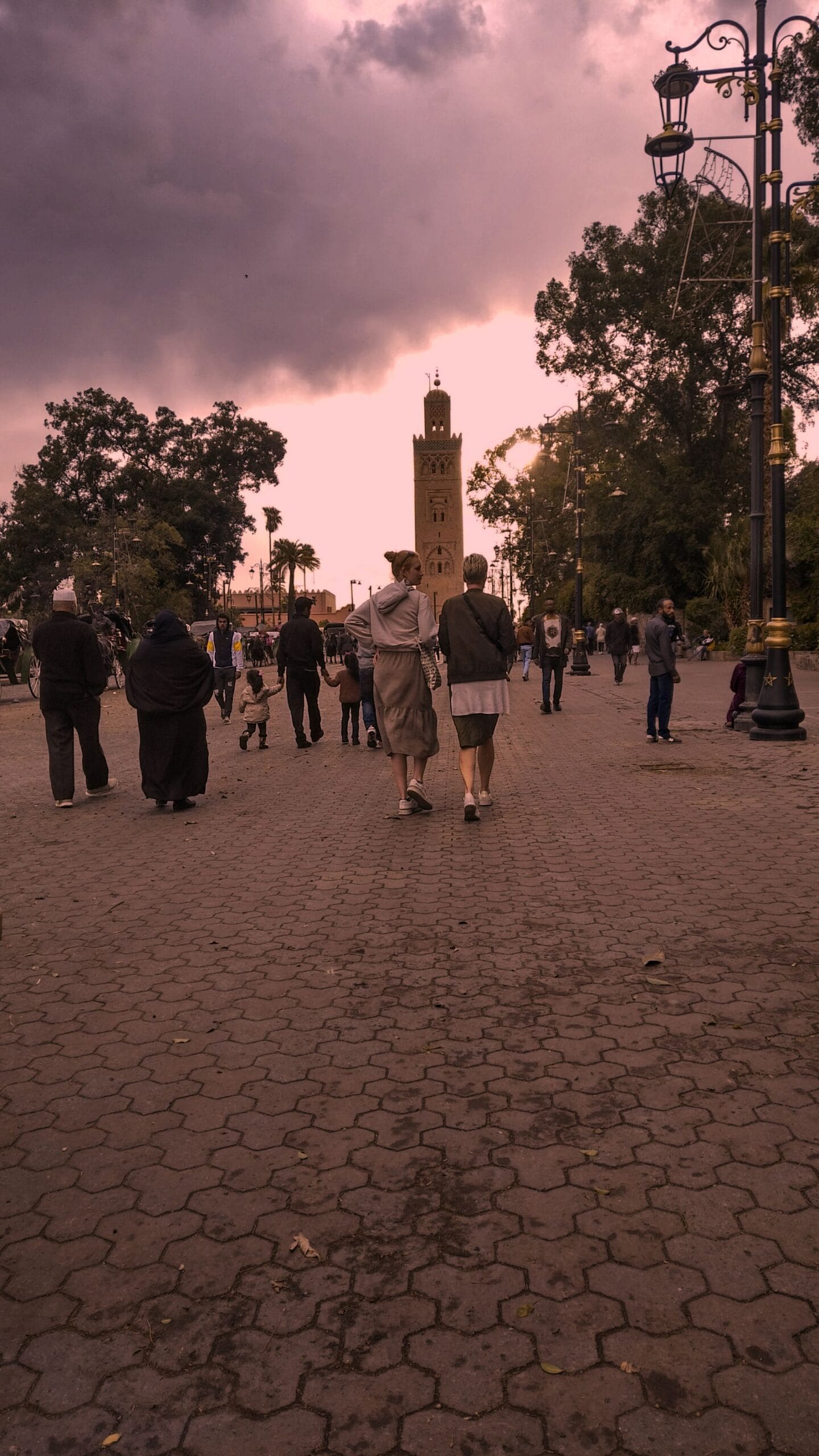
Marrakech at dusk near the Koutoubia. Photo: Mhamed Ouhassou.
In central Marrakech that puts a normal night trip at roughly 23 to 60 dirhams. Anything quoted as a flat fee before you get in is a negotiation, not a fare, and the meter rules and the airport run are worth reading before your first one rather than after.
The arrival gap is the real risk and it’s boring rather than sinister. Late train into Marrakech or Fes, taxi to the medina edge, then a walk you didn’t plan through lanes with no lighting and no signage. Fix it in advance: give your riad your arrival time and let them meet you or send someone. Most will. It costs a tip.
Beyond that, the approaches you’ll meet after dark are commercial rather than dangerous, and they’re the same ones you meet at noon. The fifteen scams and what each one actually costs covers them with the scripts and the real prices, which is more useful than a warning.
Who is selling you the answer to this question?
Add “2026” to a search for solo female travel in Morocco and the results change hands completely. On 27 August I ran the unqualified query and the year-qualified one, logged out, and classified every publisher.
| Query | Results | Sell Morocco tours | Independent writers | Other |
|---|---|---|---|---|
is morocco safe for solo female travellers | 9 | 2 | 5 | 2 |
| the same query, with 2026 added | 7 | 7 | 0 | 0 |
The two in the “other” column are a women’s travel network, which sells a product but not tours. Somebody planning a trip for next year types the year, so the bottom row is the version of this question most people actually ask.
Then I opened six of those pages and checked four things.
Zero of the five checkable pages name the law. Zero cite a government or primary source on safety. One states a US advisory level, and states it wrongly: Moratra says Morocco is “Level 1, Exercise Normal Precautions.” The State Department’s own advisory says Level 2, Exercise Increased Caution, dated 21 April 2025, because of terrorism. Moratra is also the operator whose desert-tour cost guide claims a 200 to 350 dollar band against a surveyed middle half of 102 to 137. Second time, different claim.
And the recommendation converges. Book a guided tour. Hire a licensed guide for your first day. Join a group. I’m not saying a guide is a bad idea, and in Fes el-Bali it’s often a good one. I’m saying that when every page a worried woman finds is published by someone who sells guided tours, and every page recommends guided tours, she has no way to tell advice from inventory.
This site takes affiliate commission on some bookings, and says so at the top of every page. It doesn’t sell tours, doesn’t take operator commission on this one, and has no reason to prefer any answer here to any other.
Common questions
Is Morocco safe for a woman travelling alone?
On the closest comparable measure, 57% of women in Morocco say they feel safe walking alone at night, against 58% in the United States. The realistic expectation is persistent commercial attention in the big medinas rather than danger, and it varies sharply by city.
Is street harassment illegal in Morocco?
Yes. Article 503-1-1 of the Penal Code, added by Loi 103-13 and in force since August 2018, punishes harassment in public places by words, acts or signals of a sexual nature with one to six months in prison and a fine of 2,000 to 10,000 dirhams.
What number do you call for police in Morocco?
19 for police in cities, 177 for the Gendarmerie Royale in rural areas, and 112 from any mobile. 15 is the ambulance and fire service, not the tourist police, despite what several travel guides say.
Do solo women need to book a guided tour in Morocco?
No. It’s a reasonable choice for the Fes medina and for desert trips, but note that on the year-qualified search for this question, seven of seven results are published by companies selling guided tours, and all of them recommend guided tours.
Which Moroccan city is easiest for a first solo trip?
Essaouira or Rabat. Both are lower-density and lower-pressure than the Marrakech and Fes medinas, which is a function of footfall and the local tout economy rather than of culture. Take Marrakech second, once you’ve got your bearings.
Where this leaves you
The short version, in numbers rather than reassurance:
- Morocco’s night-safety figure for women is one point below the United States, and that figure measures expectation as much as danger
- Public-space violence against women fell 20 points in the decade to 2019, on Morocco’s own survey
- Harassment is criminal under a named article with published penalties, and 3% of sexual-violence victims report it
- 19, 177, 112. Not 15
- Every page answering solo female travel in Morocco for 2026 is selling you something
None of that adds up to “go” or “don’t go”. It adds up to a realistic picture, which is what I’d want before spending money on a flight. If you want the wider risk assessment that this sits inside, including the thing in Morocco that’s genuinely more likely to hurt you than any of the above, that’s the full risk picture, ranked by what actually happens.