Last verified: August 14, 2026. Enforcement against unlicensed guides comes in waves, and the official licensing position changes with it. I re-check the licensing rules and the current enforcement reporting, and update the date above each time.
In 2026, Marrakech police arrested three different men for extorting tourists while posing as guides. Every one of those cases started the same way: somebody filmed it. Fake guides in Morocco have run the same script for decades, and the thing finally breaking it isn’t better advice. It’s the camera already in your hand.
Disclosure: Some links in this guide may earn us a commission, at no extra cost to you. It never changes what we recommend.
Almost everything written about this scam stops at “be firm and walk away.” Fine advice, and useless at the moment it matters. How do you get firm about something you haven’t recognised yet? The approach doesn’t feel like a scam. It feels like a helpful stranger.
So this page does the other half. The script line by line. What the man saying it is actually working toward. The law that makes his job a criminal offence, and the two-second move that ends the encounter before it starts.
Key Takeaways
- Fake guides in Morocco run one funnel: unsolicited help, a redirect away from where you were going, and a destination that is always a shop or a payment demand
- Paid guiding is a licensed profession under Law 05.12 and its 2015 implementing decree. A real guide carries a numbered Ministry of Tourism badge, and will show it
- Enforcement is real: three separate Marrakech arrests between March and August 2026, each reported by two independent outlets
- All three cases came to light through video, two of them filmed by the travellers themselves. Documenting works; arguing doesn’t
- The counter is two seconds long: “no, thank you,” and keep walking. Never follow someone who approached you
Table of Contents
What do fake guides in Morocco actually want?
Money, and almost never directly at first. The funnel has three exits. A commission from whichever shop you’re delivered to. A “guiding fee” demanded once you’re deep enough in the medina to feel stuck. Or an invented entry price at a site that has a real ticket desk, or no ticket at all. In one 2026 case a man demanded MAD 1,000, about $110, for an unrequested walk through the old medina (Morocco World News, July 2026).
Notice what’s missing from that funnel? Any point at which you agreed to anything. That’s the design. By the time money is mentioned, you’ve accepted a favour, followed someone through unfamiliar lanes, and been introduced to a shopkeeper as a guest. Refusing now feels rude. Rude is the lever the whole thing rests on. Fake guides in Morocco are one entry in a longer list, and our full catalogue of the fifteen scams with the price each should have been shows where this one sits among the rest.
The script, line by line
There are perhaps five sentences in the entire repertoire, and each does a specific job. “That street is closed today” is the redirect, and the single most common opening. “The tannery is free this morning” is bait for a place that has a real entrance and a real price. “I’m not a guide, I’m a student, I just like practising English” is pre-emptive denial, aimed exactly at the advice you read before you flew.
Then two closers. “Come, it’s just here” moves you before you’ve decided anything. And, at the end, “for my time” is the reveal, delivered somewhere you’d struggle to leave quickly.
Fes runs a specialised version around the tanneries. The offer is to walk you past the main entrance to a “better” terrace where you supposedly won’t need a ticket. The price appears once you’re upstairs, with the view in front of you and the man between you and the stairs. Marrakech’s version orbits Jemaa el-Fna and the streets feeding it, where crowd density does the work the terrace does in Fes.
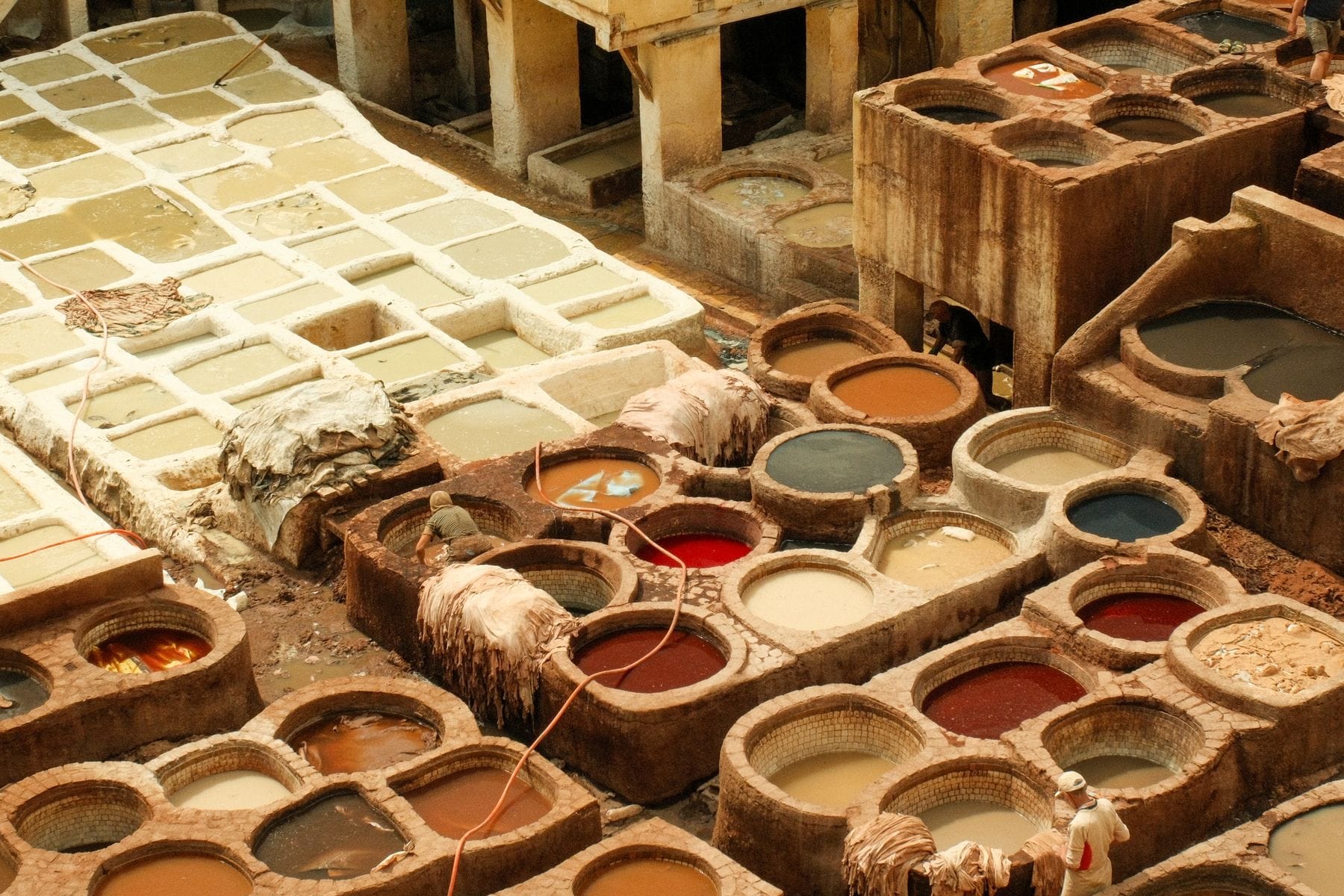
One honest note about geography, since this post carries both cities in its subject: every arrest documented below happened in Marrakech. That reflects where cases got filmed and reported, not where the practice exists. The Fes tannery variant turns up consistently in traveller accounts, and the UK Foreign Office’s Morocco guidance notes that people posing as official guides commonly harass tourists. It simply hasn’t produced a public arrest record the way Marrakech has this year.
The 2026 case file: three arrests, three videos
Between March and August 2026, Marrakech police arrested three men in separate incidents involving unlicensed guiding and extortion of tourists. Each case was reported independently by two Moroccan outlets. The August arrest, for example, was covered by both Barlamane Today and Yabiladi. In each one the investigation began with video footage rather than a walk-in complaint.
The March case involved a British man and a Filipino woman, pressed for money in the medina under threat of violence. A video of the encounter circulated online. The Tourist Police Unit identified and arrested a suspect with prior convictions, and officers went to the couple’s hotel to take statements (Morocco World News, March 2026). The couple later posted a second video thanking the police.
In July, a man demanded MAD 1,000 for an unrequested medina tour and slapped the tourist who refused. The traveller posted a video describing it. Police reviewed the footage and arrested a suspect who already had a criminal record for unlicensed guiding (Yabiladi, 21 July 2026). In August, two foreign tourists appeared in footage being pressed for an unauthorised payment. Investigators identified the man and held him for the public prosecutor (Hespress, 5 August 2026).
| Date | What was demanded | How police learned of it | Outcome |
|---|---|---|---|
| March 2026 | Money under threat of violence, from a British and Filipino couple | Video circulated online | Suspect with prior convictions arrested by the Tourist Police Unit; statements taken at the couple’s hotel |
| 21 July 2026 | MAD 1,000 (~$110) for an unrequested medina tour; tourist slapped when he refused | Video posted by the tourist himself | Man with a record for unlicensed guiding arrested in a medina alley; held for the judicial police |
| 5 August 2026 | An unauthorised payment from two foreign tourists | Video circulating on social media | Suspect identified and placed in custody pending judicial investigation under the public prosecutor |
Every row above is corroborated by at least two independent Moroccan outlets. Reports that look like a fourth case in August are the same 5 August arrest covered by three publications, which is worth saying out loud: the number here is three, not four.
Three cases, three videos, three arrests. That pattern is the most useful thing on this page, and no other guide to fake guides in Morocco has assembled it. It also quietly inverts the standard advice: the recommended posture used to be avoid, disengage, tell nobody. In 2026 the thing that produced consequences was a phone.
Is unlicensed guiding illegal in Morocco?
Yes, and this is the part almost every competing page omits. Paid tourist guiding is a regulated profession under Law 05.12, which organises the guide sector. It’s implemented by decree 2.14.553 of 18 June 2015, amended by a further draft decree approved in December 2021 (Morocco World News, December 2021). Guiding you for money without that licence isn’t a grey area. It’s the offence in every case above.
Two practical consequences follow for anyone dealing with fake guides in Morocco. First, a legitimate guide carries a numbered Ministry of Tourism credential and will produce it without drama, because producing it is the job. Asking to see the badge is not rude and it is not a negotiation. It’s the single question the entire scam can’t survive.
Second, and more usefully: in that encounter, you are not the one with legal exposure. The standard framing has tourists as prey, quietly hoping to get away. The law reads the other way round. The man working you toward a carpet shop is committing an offence in front of witnesses. His city’s police made three public arrests for it this year. Carry that asymmetry with you. It changes how the moment feels.
We publish no figure for fines or sentences here. None of the sources we could reach state one, and inventing a number to sound authoritative is exactly the habit this site exists to correct.
What actually ends the encounter?
Two seconds and four words: “no, thank you,” and keep walking. Fake guides in Morocco need your participation to work, and those four words withhold it. All three of the 2026 arrests above happened after the fact, which tells you where the real leverage sits: not in winning the conversation, but in never entering it. Don’t slow down, don’t explain, and don’t answer the follow-up question. The follow-up is the script’s second line, and it only works on someone who stopped.
Three rules do the rest of the work:
- Never follow someone who approached you. Reverse the polarity entirely: help you asked for is fine, help that found you is not.
- Decide in five seconds whether it’s money or safety. If a situation turns physical, pay small and leave. No principle on this page is worth a fight in an alley, and the July case shows a refusal can escalate.
- If it goes wrong, document rather than argue. All three 2026 arrests began with footage. A dated, factual account of what was demanded, where and when, does more than any street argument. Morocco’s tourist police are reachable through any hotel, or on 112 from a mobile and 19 for police in cities.
That last point opens onto a bigger question: what’s genuinely risky in Morocco, versus what merely feels it. That’s the whole subject of our honest safety assessment.
When you actually want a guide
Sometimes you do, and Fes is the strongest argument for it. In a medina of thousands of lanes, a licensed half-day guide turns a stressful morning into the best part of a trip. Book through your riad or a licensed operator, agree price and duration in advance, and check the badge at the start rather than the end.
We don’t publish a going rate for guide hire yet. It’s a collection category in our price index and it’ll appear here with a date and a sample size when it’s actually been collected, not before. Meanwhile the honest baseline: on a first trip, in most of Morocco, most travellers need no guide at all. Getting lost in a medina for an hour is not a failure of planning. It’s the thing you came for.
Mapping out where those days go? The 10-day Morocco itinerary covers the Fes stretch where guide pressure peaks, and the complete Morocco trip planning guide runs the earlier decisions in order.
Common questions
How do you spot a fake guide in Morocco?
Two signals, and you only need the first. He approached you, rather than you seeking him out. And he has no numbered Ministry of Tourism badge, or won’t show it when asked. Licensed guiding is regulated under Law 05.12; a real guide produces credentials without hesitation because doing so is routine.
Are unlicensed guides illegal in Morocco?
Yes. Paid guiding is a licensed profession under Law 05.12 and its 2015 implementing decree, so guiding for money without authorisation is an offence, not a grey area. Marrakech police made three separate arrests for it between March and August 2026, each following video evidence of tourists being extorted.
What if a fake guide won’t leave me alone?
Keep walking and stop answering; the script needs your participation. If it turns physical, pay small and leave rather than escalating. In July 2026 a Marrakech tourist who refused a MAD 1,000 demand was slapped. Afterwards, document it. Tourist police are reachable via any hotel, or 112 from a mobile.
Should you hire a guide in Fes?
It’s the one city where most travellers benefit. Fes el-Bali is among the largest car-free urban areas anywhere, thousands of lanes deep, and guide pressure there is heavy enough that a licensed guide is worth the fee. Book through your riad, agree price and duration in advance, and check the badge before you start walking.
Does filming a fake guide actually help?
On the 2026 record, yes. All three Marrakech arrests between March and August began with video, two of them filmed by the travellers involved, rather than with an in-person complaint. Police reviewed circulating footage, identified suspects, and referred them to prosecutors. Documenting has a track record that arguing does not.
The short version
Fake guides in Morocco, reduced to what’s useful:
- One funnel, four steps: unsolicited approach, a redirect away from your route, a walk you didn’t choose, and a destination that is always a shop or a demand.
- The badge is the whole test. Licensed guiding is regulated under Law 05.12; a real guide shows the numbered credential without being pushed.
- You’re not the one breaking the law, and Marrakech police arrested three men for it between March and August 2026.
- Every one of those cases started with video. Document, don’t argue.
The companion piece to this one is the full scam catalogue with the real price beside each, and everything in this category lives at Safety and Scams.
If a detail here doesn’t match what happened to you, tell us what and when. A different script, a different city, a different outcome at the police station: all of it useful. Dated reader corrections beat confident guesses, and they go into the next verification pass.
Cases, legal references and enforcement reports on this page were verified on 14 August 2026. Claims here are on a 30-day re-verification cycle; next due 13 September 2026.