Last verified: August 12, 2026. Taxi tariffs are set locally and revised without announcement, so a fare that was right in one city last season can be wrong in the next. I re-check the published tariffs and the meter rules city by city, and update the date above each time.
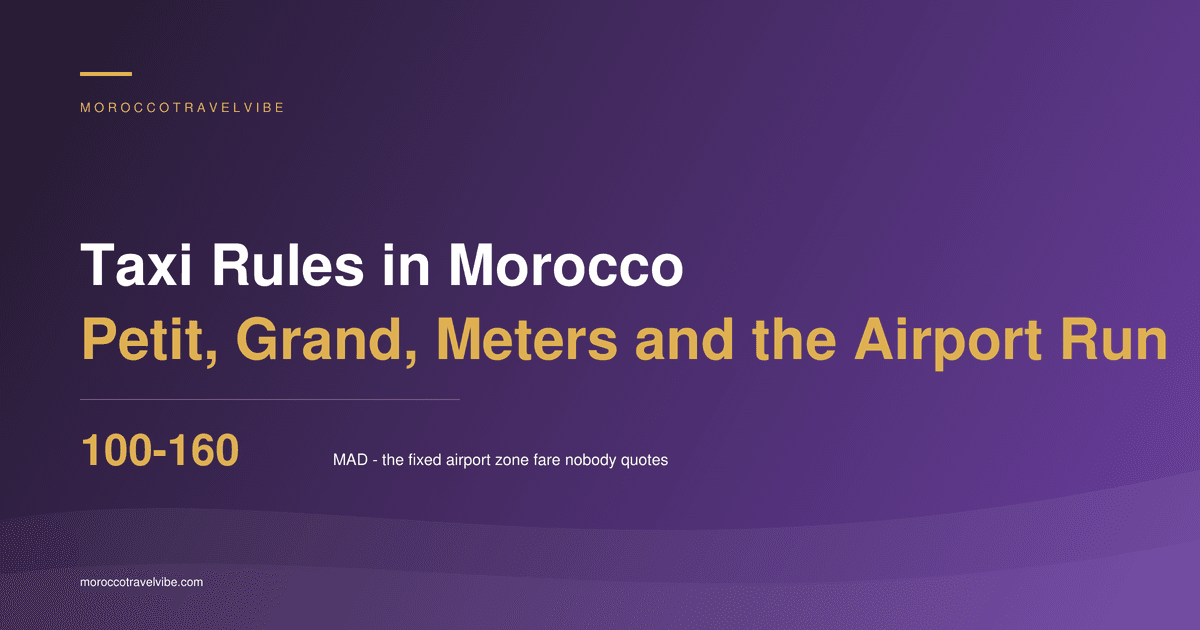
Every Morocco guide gives you the same taxi advice: insist on the meter. Here’s what none of them mentions. At Marrakech airport, the single most complained-about taxi location in the country, the meter legally doesn’t apply. The fare there is fixed, published, and zoned: 100 to 160 dirhams by distance. A prefectural decision set it in December 2023. Most “taxi scams” live in the gap between those two facts.
Disclosure: Some links in this guide may earn us a commission, at no extra cost to you. It never changes what we recommend.
Taxis are one mode among several, and which one to use on a given leg is answered in how to get around Morocco. So this page does the Morocco taxi rules properly, with the documents. Which taxi is which. What the meter should say. What the airport actually costs, decision number included. Which apps work since Uber came back, and which side of the law they’re on. And what to do when a driver ignores all of it.
Key Takeaways
- The Morocco taxi rules start with the meter. Petit taxis are metered by law, an obligation that traces to a 1963 royal decree, and a metered trip across central Marrakech runs 15–40 MAD (published fare guides, collected August 2026).
- The Morocco taxi rules change at the airport, which is not a metered zone: Marrakech-Menara runs fixed zone fares of 100–160 MAD plus a desk fee (prefectural Decision n°6260, December 2023). Casablanca bars petit taxis from the airport entirely. Take the 43 MAD train.
- Uber returned to Morocco in November 2025, in Casablanca and Marrakech only, through licensed taxis, weeks after the ministry rejected ride-hailing licences outright.
- A grand taxi sells seats, not rides. Six of them.
Table of Contents
What are the actual Morocco taxi rules?
The Morocco taxi rules run on two systems and two rulebooks. The meter obligation for petit taxis is not a custom. It traces to a royal decree of 12 November 1963, reinforced by city tariff orders and an Interior Ministry circular as recently as December 2024 (legal analysis, Village Justice, 2026). The rules are real and written down. What’s inconsistent is enforcement, and that gap, not the rulebook, is where every taxi dispute on our scams list actually happens.
The Morocco taxi rules in one breath. A petit taxi is small, colour-coded by city, limited to the city line, and metered by law. It carries a maximum of three passengers. A grand taxi is shared, runs fixed routes between towns, and sells six seats individually. You’re buying a seat, not a car. Everything else on this page is detail on those two sentences.
Know which of the two you’re standing in front of, and which fare regime you’re standing in. That second part is the one every other guide skips, and it’s where the money goes.
How does a petit taxi actually work?
On the meter, in small numbers. A metered trip across central Marrakech runs 15–40 MAD (five independent published fare guides, collected 12 August 2026). Jemaa el-Fnaa to Majorelle sits around 15–20; Medina to Guéliz around 20–30; the train station to the square about the same. Guides consistently report the meter starting near 7 MAD and adding roughly 5 MAD per kilometre. No city publishes an official schedule online, so treat those two components as reported, not gazetted.
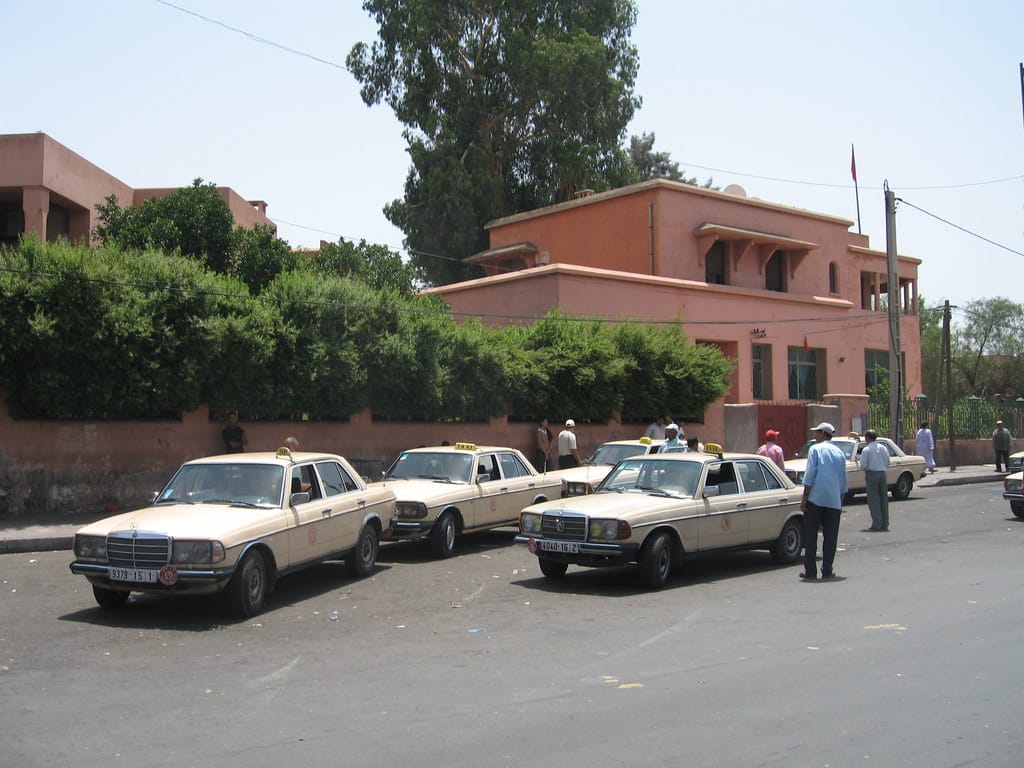
Two surcharges are legitimate and routinely mistaken for scams. At night, roughly 8pm to 6am, the meter switches to “Tarif 2” and the fare rises 50%. French-language guides consistently report the same 50% applying on Sundays and public holidays. We haven’t seen the tariff order itself, so treat that one as reported. An evening fare higher than the afternoon one is the rule working, not breaking.
For scale: Moroccan press puts a local’s ordinary hop at about 10 MAD, and documented a driver demanding 40, meterless, for exactly that trip (Telquel, 27 April 2026). “The meter is broken” is the oldest line in the book, and it gets one paragraph here because the scams post owns the full script. The counter is six words: meter, or I take the next one. At a rank, you’re the scarce resource.
How does a grand taxi work?
You’re buying a seat, one of six. Grand taxis run fixed intercity and suburban routes, charge per seat at a rate fixed for the route, and leave when full. The layout is traditional: two passengers up front, four in the back. Want space, or a departure now? Buy two seats, or all six. Agree the per-seat price before you get in; on common routes it’s a known number the other passengers are already paying.
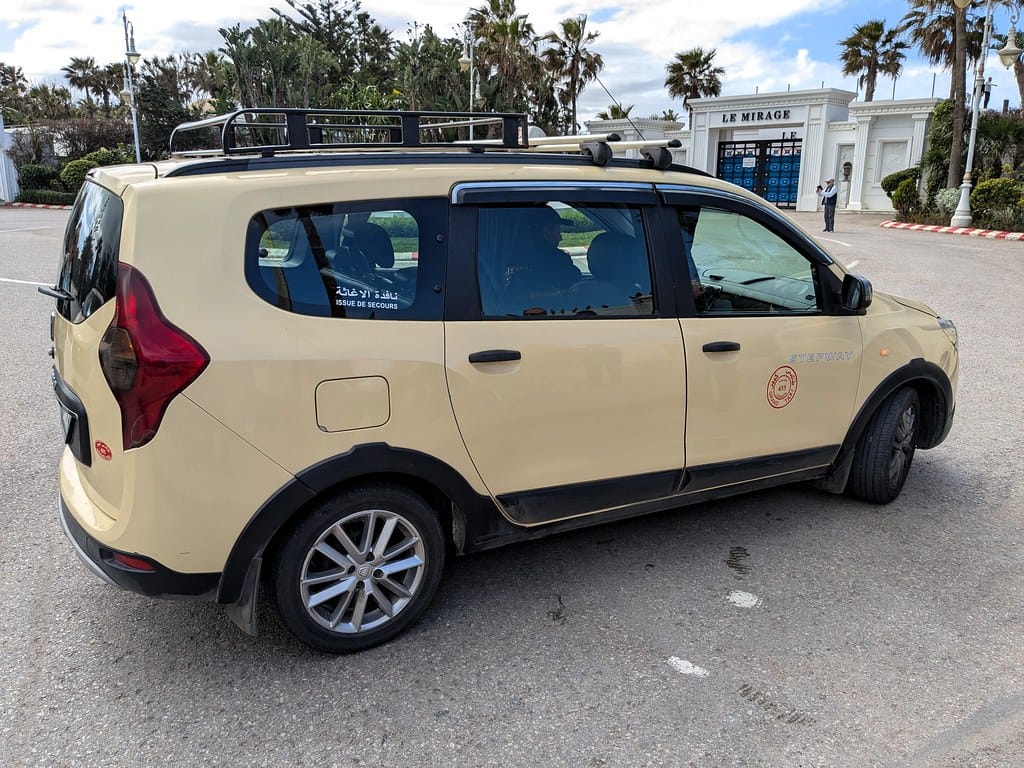
If the car confuses you, there’s a reason. The state has spent a decade subsidising owners, at around 80,000 MAD per vehicle, to swap the old six-passenger Mercedes 240 sedans for Dacia Lodgy vans (Morocco World News, programme running since 2015). Both are on the road; both are grand taxis; both sell seats.
Fares on the routes these taxis share with trains and coaches, Marrakech to Essaouira among them, are priced in what Moroccan trains and coaches actually cost. Grand taxi seat prices themselves have no published tariff and are not collected there yet, so treat the per-seat number you are quoted as the local going rate rather than a published one. This page’s job is the system; if you’re building the whole route, start with the 10-day itinerary that these taxis connect.
What are the rules at the airport?
The Morocco taxi rules stop at the airport kerb, and this single fact explains most airport “scams”. At Marrakech-Menara, taxi fares are fixed by zone under prefectural Decision n°6260 of 29 December 2023 (Al3omk, January 2024). Seven zones by distance: 100 MAD under 3 km, rising to 160 MAD at 13–15 km, paid at the desk plus a small booking fee. Casablanca goes further: petit taxis are barred from Mohammed V airport entirely. Your options there are a grand taxi near 250–300 MAD, or the ONCF train at 43 MAD, about 40 minutes to Casa-Voyageurs.
Now the advice everyone gives you, “insist on the meter”, collides with the actual rule. At the airport there is no meter to insist on. Demand one and you’ve told the driver exactly how little you know. The move is different: use the desk. Marrakech-Menara has run a single-window taxi counter, kech.cab, since May 2023, installed by ONDA, the national airports authority (ONDA, May 2023). Pay card or cash, scan the receipt, take the ticket with your taxi’s number. Anyone offering a taxi inside the terminal is not the desk.
Why did the desk appear? December 2022: a Welsh YouTuber filmed a Menara driver keeping the change from 400 MAD. The clip went viral; the driver lost his licence and was remanded in custody; the desk followed within months (France 24 Observers, January 2023). Reporting works better here than the internet believes.
One honest caveat from our own checking. The desk’s online booking address now redirects to a privately branded platform that publishes no price list at all. Quotes appear only after phone signup (checked 12 August 2026). The printed zone fare lives at the physical counter, not on the web. Which is this site’s whole argument in one sentence: the number exists, and still nobody puts it where you can check it.
Going to the airport is a different tariff again, priced by taxi category rather than by the same zone table, roughly 80–150 MAD by day. “The fare there” and “the fare back” genuinely differ. No, you didn’t get scammed on one of them; you crossed regimes.
Which taxi apps work in Morocco, and are they legal?
Uber returned to Morocco in November 2025, after seven years away, in Casablanca and Marrakech only, and exclusively through licensed taxis (Morocco World News, November 2025). The model matters: weeks earlier, in October 2025, the Transport Ministry had rejected licence applications for ride-hailing services outright (Morocco World News, October 2025). Uber’s comeback works because it dispatches the regulated fleet instead of private drivers.
That ruling splits the app map into two lanes. The compliant lane: apps that hail licensed taxis, meaning Uber’s return model, and local equivalents built the same way. The grey lane: platforms connecting you to private drivers, inDrive most prominently, where you negotiate the fare in-app. Widely used, openly operating, and unlicensed. Drivers risk fines and impoundment. Moroccan press describes the whole VTC question as stuck at a legislative wall (Telquel, April 2026).
The UK Foreign Office’s standing line predates Uber’s return and still earns its place: “Many taxis booked through phone apps may be unregulated and unlicensed” (GOV.UK, Morocco safety and security, retrieved August 2026). The update the FCDO hasn’t written yet: since November 2025 there is a licensed app lane. Prefer it.
App availability and legality in this section verified 12 August 2026; this is the fastest-moving fact set on the page and it sits on a 30-day re-check cycle.
What should you actually pay?
Here’s the whole page in one table, and the one rule that matters for each ride.
| Petit taxi | Grand taxi | Apps | |
|---|---|---|---|
| Where it runs | Inside city limits | Fixed intercity routes | Casablanca + Marrakech (Uber); wider (grey-lane platforms) |
| How it’s priced | Meter, by law: central Marrakech 15–40 MAD; night +50% | Per seat, fixed per route; six seats | Fare shown or negotiated in-app |
| Passengers | 3 max | 6 (buy extras for space) | Per vehicle |
| Legal basis | Metered under a 1963 decree + city tariff orders | Route licences | Licensed-taxi apps: compliant. Private-driver apps: unlicensed (ministry refusal, Oct 2025) |
| The rule that matters | Meter on, or next taxi | Agree the seat price before departure | Prefer apps that dispatch licensed taxis |
| The airport exception | Menara: fixed zones 100–160 MAD, no meter. CMN: barred, so train (43 MAD) or grand taxi | CMN airport runs ~250–300 MAD | Pickup rules vary by airport |
Every figure carries its collection date, 12 August 2026 unless marked otherwise, and the airport band carries its decision number. For what the rest of the trip should cost, the Morocco Price Index is the companion page.
What do you do when the driver breaks the rules?
Four moves, in order:
- Meter refusal: say meter, or I take the next one, then actually take the next one. At a rank the driver needs you more than you need him.
- At the airport: walk back to the desk. Setting the fare is literally what it’s for.
- Already overcharged: photograph the door number and plate, and report it to the tourist police (Brigade Touristique) via any hotel, or the nearest commissariat. Emergency numbers: 112 from any mobile, 19 for police in cities.
- Know that reporting isn’t theatre. The documented penalties run from permit suspension and fines to impoundment (Village Justice, 2026), and in the 2022 viral case, full licence revocation.
One more thing worth carrying in your head, because it changes the tone of the whole encounter. This isn’t a tourist tax. Telquel’s reporting from April 2026 documents Marrakech drivers refusing rides and demanding meterless fares from Moroccans. One driver told the paper he’d rather carry a foreigner for 50 dirhams than a local for 10. You’re not being hunted; you’re standing in an enforcement gap that residents stand in daily. Most drivers, it should be said plainly, run the meter without being asked. For where taxis sit in the broader picture, meaning which risks in Morocco are real and which just feel real, see our honest safety assessment.
Common questions
Is there Uber in Morocco?
Yes, again, since November 2025, after a seven-year absence. It operates in Casablanca and Marrakech only, exclusively through licensed taxis, following the Transport Ministry’s October 2025 refusal to license ride-hailing services (Morocco World News, November 2025). Coverage is limited; don’t build an itinerary on it.
How much is a taxi from Marrakech airport to the medina?
It’s a fixed zone fare, not a metered trip: 100–160 MAD depending on distance, plus a small booking fee, under prefectural Decision n°6260 of December 2023 (Al3omk, January 2024). Pay at the kech.cab desk in arrivals and keep the ticket. Nobody legitimate quotes you a metered airport fare.
How many people can share a taxi in Morocco?
Three passengers in a petit taxi, and it’s a hard rule, not driver preference. A grand taxi sells six seats: two front, four rear, each paid separately. Solo travellers wanting space can buy two seats; a group can buy all six and turn a shared taxi into a private one.
Are inDrive and other ride-hailing apps legal in Morocco?
The Transport Ministry rejected ride-hailing licence applications in October 2025 (Morocco World News), so private-driver platforms operate without authorisation and their drivers risk fines. Apps that dispatch licensed taxis, the model Uber returned with in November 2025, are the compliant lane. Use them where they exist.
What do I do if a taxi driver refuses the meter?
Take the next taxi. Refusal is the whole negotiation, and at a rank it costs the driver more than you. Already paid? Photograph the door number, report to the Brigade Touristique or nearest commissariat, and keep the reference. Documented penalties run from suspension to, in one 2022 case, revocation. Emergencies: 112 from any mobile, 19 in cities.
The short version
- The Morocco taxi rules make the meter the law in a petit taxi, and the metered number is small: 15–40 MAD across central Marrakech. Night +50% is legitimate.
- The airport is a different regime: fixed zones at Menara (100–160 MAD, Decision n°6260), no petit taxis at all at Casablanca, where the 43 MAD train wins outright.
- Under the Morocco taxi rules a grand taxi sells seats, six of them, at fixed route prices. Agree the seat price before departure.
- Since November 2025 there’s a legal app lane: apps that dispatch licensed taxis. The private-driver apps everyone uses sit outside the law, by ministry decision.
- Report the bad ones. Suspension, fines and one famous revocation say it isn’t futile.
The fourteen other scripts you’ll meet, and what each should cost, are in the full Morocco scams list. The trip these taxis belong to starts with the complete Morocco trip planning guide, and everything in this category lives at Safety and Scams.
And the standing request, same as every priced page on this site: if you paid something different, tell us the fare, the city and the date. A dated correction from a reader beats a confident guess from anyone.
Fares, tariff decisions and app-legality claims on this page were verified on 12 August 2026. Priced claims are on a 30-day re-verification cycle; next due 11 September 2026.