Last verified: October 4, 2026. On 4 October I read ONCF’s own journey planner for 30 station pairs on three dates (13 October, 16 October and 15 December 2026), downloaded all 14 of its published timetables, read its conditions of sale and service pages, and routed every main station to its old town on OpenStreetMap. I re-check all of it every 30 days, because the timetable is changing while the new high-speed line is built, and I move the date each time.
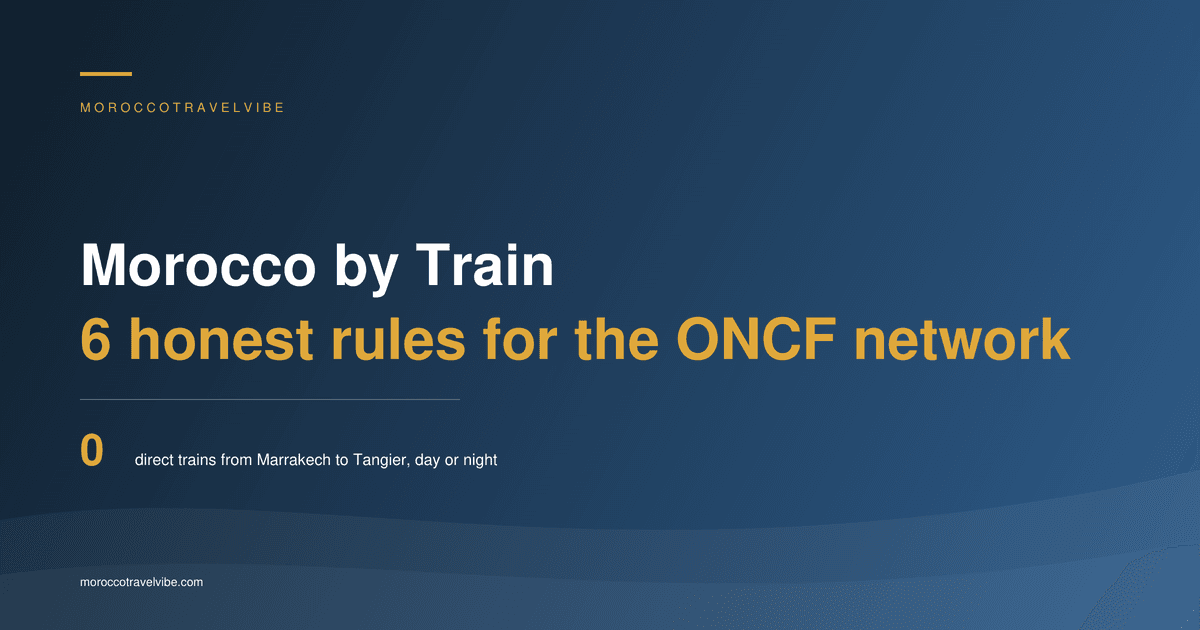
Morocco by train runs from Tangier to Marrakech and out to Oujda, and right now it isn’t the network most guides describe. Since 14 September 2026 the famous night train from Marrakech to Tangier stops at Kenitra just before one in the morning. No train links the two cities without a change, day or night.
Disclosure: Some links in this guide may earn us a commission, at no extra cost to you. It never changes what we recommend.
The trains are still fast, frequent and reserved. You just need to know which station, which change and which rule. Here’s how the network actually runs this autumn, read from the railway’s own systems.
Key Takeaways
- No train runs Marrakech to Tangier without a change right now. ONCF’s timetable from 14 September 2026 ends the night train at Kenitra; the fastest trip is 5h42 with a change to Al Boraq at Casa Voyageurs
- Every long-distance seat is reserved, in first and second class, on Al Atlas and Al Boraq
- Use Casa Voyageurs in Casablanca, including for the airport train. Al Boraq stops at Rabat Agdal, not Rabat Ville
- Luggage has no weight limit, only a size limit of 1.2 x 0.6 x 0.4 m and the rule that you carry it yourself
- An e-ticket on your phone is valid with your passport; a photo of a paper ticket isn’t
Table of Contents
How does Morocco by train actually work?
One company, ONCF, runs every passenger train in Morocco: Al Boraq high-speed trains, Al Atlas intercity trains and TNR shuttles around Casablanca and Rabat. In 2025 it carried 55.6 million passengers on 2,295 km of line, 5.6 million of them on Al Boraq (ONCF in figures).
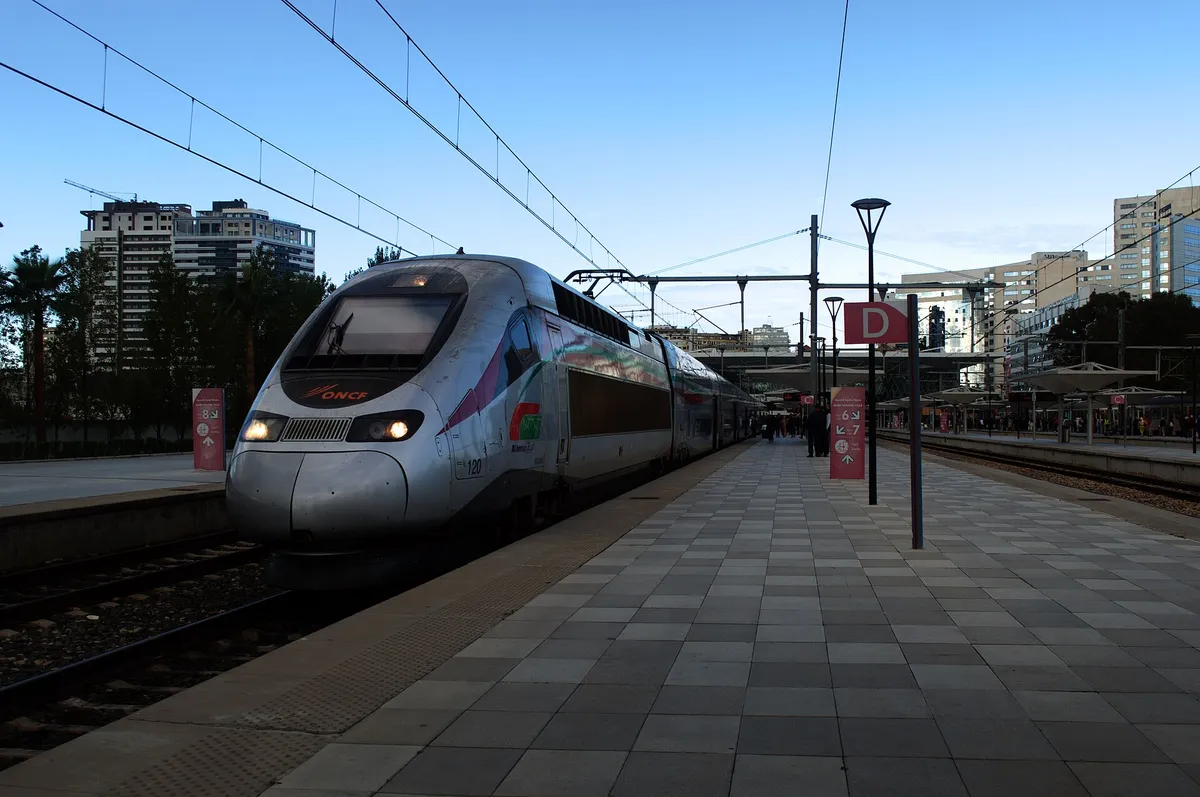
Al Boraq at Tanger Ville. Photo: Phil Richards, CC BY-SA 2.0, via Wikimedia Commons.
The three products, and the night train, behave differently, and that’s most of what you need to know.
| Train | Where it runs | Classes | Seat reserved? |
|---|---|---|---|
| Al Boraq | Casa Voyageurs, Rabat Agdal, Kenitra, Tanger Ville | 1st and 2nd | Yes, always |
| Al Atlas | Marrakech, Fes, Meknes, Oujda, Nador, Tangier, Safi and the rest | 1st and 2nd | Yes, in both classes |
| TNR shuttle | Casablanca to Rabat and Kenitra, El Jadida, Settat, the airport | Not published | No seat choice offered |
| Night train | Casablanca to Oujda and Nador | Seats, plus berths ONCF lists | See below |
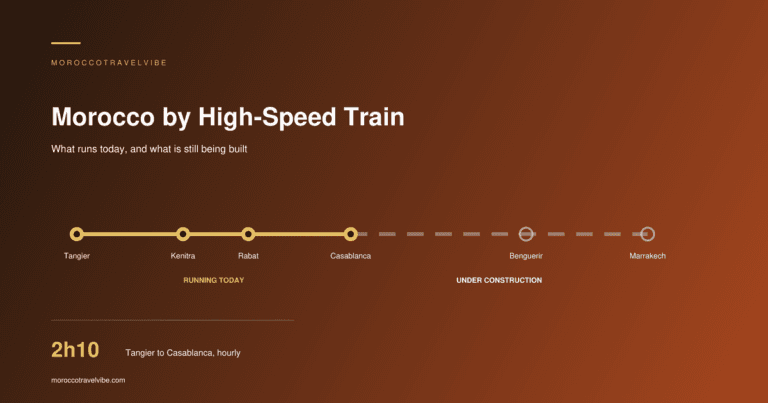
Al Boraq runs Casablanca to Tangier in 2h17, roughly hourly from 06:00 to 21:00, on the timetable in force since 14 September. That’s 14 trains each way on a Tuesday and 15 on a Friday. ONCF’s booking system offers a window or aisle seat on every Al Atlas train I checked, and no seat choice at all on the shuttles. Its FAQ makes reservation compulsory “aussi bien en 2ème qu’en 1ère classe” on the long-distance axes and Al Boraq, and doesn’t name the shuttles.
Where doesn’t the train go? Essaouira, Agadir, Chefchaouen, Ouarzazate and the desert have no railway. Which mode fits each of those legs is the subject of how to get around Morocco.
Look at the Tangier to Fes rows. The direct train is the slow option. The fastest trip with a change at Kenitra beats the fastest direct train by 45 minutes. It isn’t a law of the network, though: from Rabat Ville to Fes the fastest option is the direct train, at 2h52.
The longest direct run most visitors take is Marrakech to Fes: 14 trains a day, each taking about 7 hours. That day on the train is one of the honest costs of splitting a trip between the two cities, which Marrakech vs Fes weighs against everything else.
First or second class on Moroccan trains?
Pick first class for space: both classes are reserved seats, so a guaranteed seat isn’t the difference. ONCF’s 2026 statistics yearbook shows first class on Al Boraq ran 49% full in 2025, against 71% in second, and on conventional trains 49% against 70% (ONCF, Recueil statistique 2026).
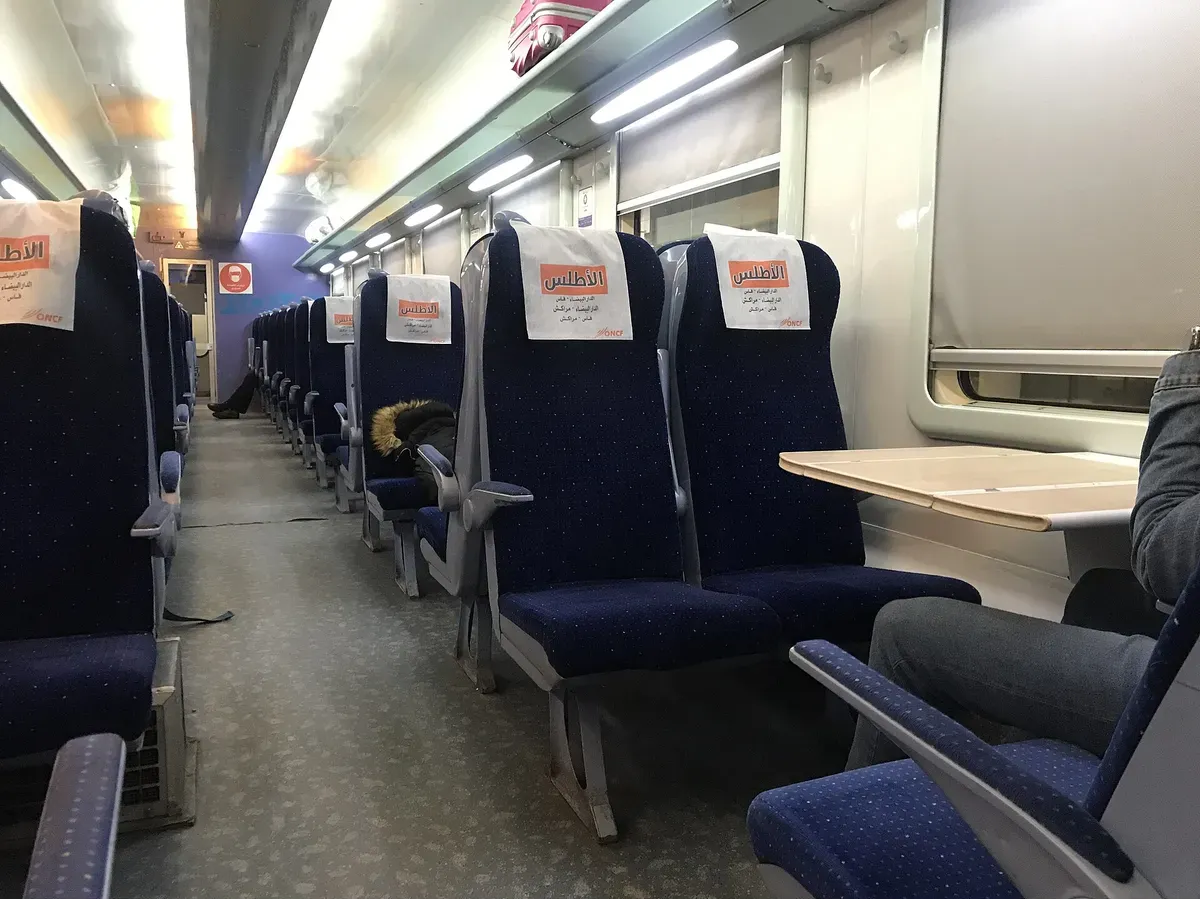
Inside an Al Atlas carriage. Photo: Hamza Izourane, CC BY-SA 4.0, via Wikimedia Commons.
That half-empty first-class carriage is the real argument: in second class expect a neighbour, while in first there’s a fair chance the seat beside you stays free all the way.
On Al Boraq the seat layout changes with the class. ONCF’s reservation page lists “Carré”, four seats facing each other, in second class. First class adds “Club 4” groups and an “Isolé solo” single window seat. ONCF’s Al Boraq guide puts power sockets at the seats, and first-class Al Boraq passengers can use lounges at Casa Voyageurs, Rabat Agdal, Kenitra and Tanger Ville.
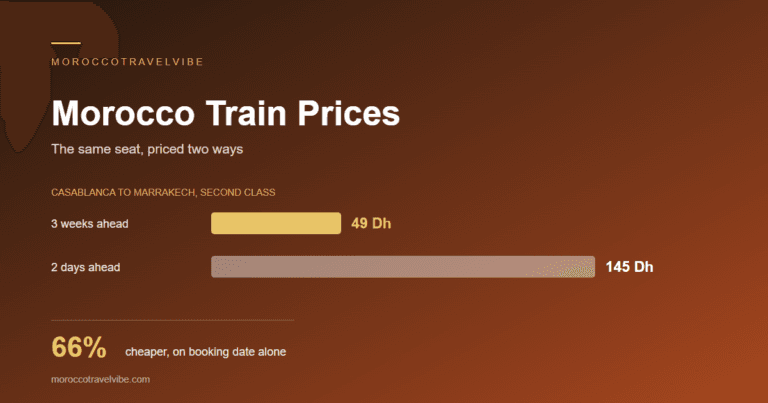
Is first class worth it? On a three-hour Al Atlas leg with luggage, I’d say yes if the gap is small. The gap moves with demand, and sometimes first booked early costs less than second booked late. What the same seat costs two days out and three weeks out is where I measured that.
Do you need to reserve a seat, and how do you buy the ticket?
Yes. On Al Atlas and Al Boraq the ticket is the reservation, and ONCF’s conditions of sale, updated 16 December 2025, say it’s valid only for the train, date, time, class and route printed on it. You can buy at the counter, the ticket machine, the ONCF Voyages site or its app, and its FAQ says sales close 3 minutes before departure.
That rule matters more than it sounds. The ticket doesn’t roll onto the next train by itself. If you miss yours, ONCF’s after-sales rule gives you 30 minutes after departure to move to a later train on the same route, which I cover under the gate rules below.
ONCF sells three fare types, and the difference is all in the small print (conditions of sale):
| Fare type | Exchange | Refund |
|---|---|---|
| Non-flex | Not exchangeable | Not refundable |
| Semi-flex | Once, before departure | 50% before departure |
| Flex | Up to five times, before departure | 100% to 24 hours out, 80% inside 24 hours |
E-tickets can be cancelled on the site up to 30 minutes before departure. Only tickets bought online can be exchanged online; a ticket from a counter is changed at a counter. Children under 4 travel free on a lap, and from 4 to 15 they pay the child fare.
Paying with a foreign card online has its own quirks, covered in the Al Boraq guide. How far ahead you can book, and whether booking early saves anything, is in my train price round. I won’t repeat a booking window here, because ONCF’s own pages and its booking system don’t agree on one.
Which station do you need in each city?
Doing Morocco by train, the station name decides your day in four cities: Casablanca, Rabat, Fes and Marrakech. On 4 October 2026, ONCF’s journey planner returned no trains at all from Casa Port to Mohammed V Airport on any of three dates; the airport shuttle runs from Casa Voyageurs, 18 a day, in 43 minutes.
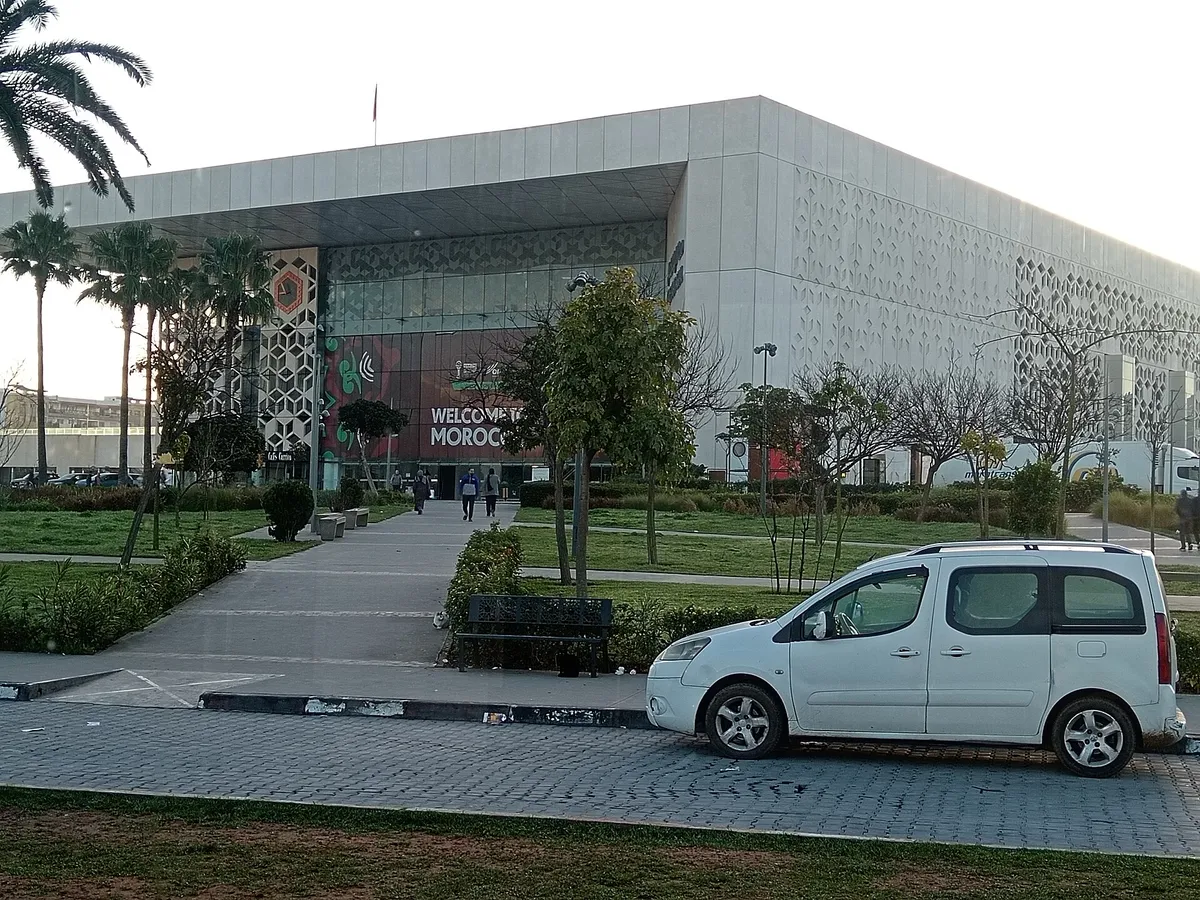
Rabat Agdal, the Al Boraq stop for the capital. Photo: Captain Raju, CC0, via Wikimedia Commons.
I routed each main station to its old town on OpenStreetMap, using ONCF’s own station coordinates. These are modelled walking times with no stops, so treat them as a floor; the pattern is still clear.
| City | Station | Use it for | To the old town on foot | By car, no traffic |
|---|---|---|---|---|
| Casablanca | Casa Voyageurs | Al Boraq, Al Atlas, airport train | 42 min, 3.2 km | 6 min |
| Casablanca | Casa Port | Shuttles to Rabat, Kenitra and El Jadida | 6 min, 0.5 km | 1 min |
| Rabat | Rabat Agdal | Al Boraq, Al Atlas | 55 min, 4.1 km | 8 min |
| Rabat | Rabat Ville | Al Atlas, shuttles | 15 min, 1.1 km | 5 min |
| Marrakech | Marrakech | Every train | 46 min, 3.5 km | 5 min |
| Fes | Fes | Every train | 46 min, 3.4 km | 6 min |
| Tangier | Tanger Ville | Every train | 44 min, 3.3 km | 5 min |
| Meknes | Meknes Al Amir | Al Atlas | 32 min, 2.4 km | 4 min |
Casablanca catches the most people. Casa Port is beside the old medina and the port, and it’s where the Rabat shuttles start, 27 a day on the timetable from 14 September. But Al Boraq, every Al Atlas train and now the airport train use Casa Voyageurs, 3 km inland. ONCF’s own airport page says the station sits about 5 minutes on foot from the terminal (ONCF airport train).
Rabat has the same trap. Al Boraq stops at Rabat Agdal, nearly an hour’s walk from the medina, while Rabat Ville is 15 minutes away. Al Atlas trains call at both. In Marrakech, Fes and Tangier, the station sits in the new town, about 45 minutes on foot from the gate you’re aiming for. That’s a petit taxi with a bag, and how the meter works is worth knowing before you step outside.
The works also close stations. ONCF announced the progressive closure of Facultés and Ennassim in Casablanca from 14 September (ONCF, 31 August 2026). Neither is a tourist stop, but check your ticket’s station name against the timetable.
Is there still a night train in Morocco?
Yes, on two corridors, but not to Tangier right now. Casablanca to Oujda leaves Casa Voyageurs at 21:07 and arrives at 07:11, and Casablanca to Nador leaves at 22:10 and arrives at 08:14. The Marrakech night train leaves at 20:00 and terminates at Kenitra at 00:39, on ONCF’s timetable from 14 September 2026.
ONCF’s published sheet for the “Tanger – Marrakech” axis shows one train each way, and neither reaches Tangier (ONCF timetables). Northbound, the MT leaves Casa Voyageurs at 22:53 and Rabat Ville at 00:04, then stops at Kenitra. Southbound, the TM leaves Kenitra at 04:50 and reaches Marrakech at 09:30.
I didn’t take the sheet’s word for it. I searched every Marrakech to Tangier journey for 13 October, 16 October and 15 December. The planner returned 15 or 16 options a day, every one with a change, and nothing overnight. ONCF’s announcement for the second phase of works on the new Kenitra to Marrakech line lists “limitations de parcours”, shortened routes, among the changes.
Here’s the awkward part. ONCF’s own night-train page still says berths run “between Marrakech and Tangier” (ONCF Train-hôtel). The page and the timetable disagree, and the timetable is what runs. If a guide promises you a couchette into Tangier this autumn, it’s out of date.
What does the night train offer where it does run? ONCF lists single sleepers on Casablanca to Oujda and Nador, double sleepers on Casablanca to Oujda, and four-berth couchettes on Casablanca to Oujda. Breakfast is served at the arrival station, and pets aren’t allowed in sleeper cars. On 4 October ONCF’s booking system offered only seats on the 20 October Oujda train, with no berth product. Its two higher comfort levels returned a technical error, so I couldn’t confirm that berths are on sale online.
It’s a niche product. ONCF’s 2026 yearbook counts about 30,000 couchette and 31,000 sleeper journeys in 2025, against 50 million on its conventional trains. Why the line is being rebuilt, and what ONCF has announced for it, is in the high-speed train guide.
Where do you change trains?
At Casa Voyageurs for Marrakech, and at Kenitra for almost everything else in the north. On Tuesday 13 October 2026, 14 of the 18 Tangier to Fes options and 20 of the 23 Tangier to Rabat Ville options changed at Kenitra, and 11 of the 15 Marrakech to Tangier options changed at Casa Voyageurs.
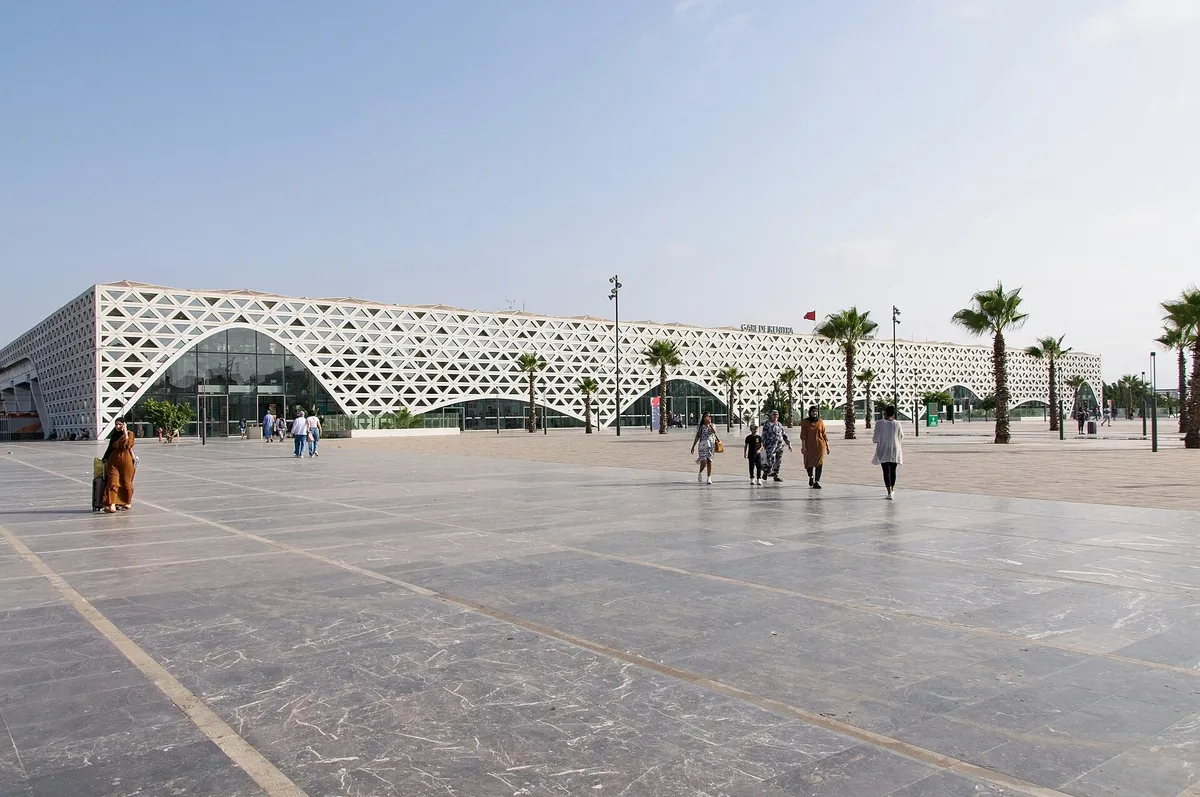
Kenitra station, where the high-speed line meets the network. Photo: Bertrand Soubeyrand, CC BY-SA 4.0, via Wikimedia Commons.
For anyone crossing northern Morocco by train, Kenitra is where Al Boraq meets the conventional network, and ONCF’s own Al Boraq pages name it as the connection for Meknes, Fes, Taza, Oujda and Nador. Casa Voyageurs is the connection for Marrakech. Every one of these numbers comes from the planner for a single weekday; Friday added one option on some routes and changed nothing else.
| Journey, 13 Oct 2026 | Options | Direct | Where you change | Fastest |
|---|---|---|---|---|
| Marrakech to Tangier | 15 | 0 | Casa Voyageurs 11, Kenitra 3, Sidi Kacem 1 | 5h42 |
| Tangier to Fes | 18 | 4 | Kenitra 14 | 3h27, against 4h12 direct |
| Tangier to Rabat Ville | 23 | 0 | Kenitra 20, Sidi Kacem 3 | 1h39 |
| Rabat Ville to Fes | 33 | 18 | Kenitra 15 | 2h52 direct |
| Casablanca to Safi | 3 | 1 | Benguerir 2 | 4h18 direct |
So when the planner shows both a direct train and a change via Al Boraq, compare the two times before you pick the direct one. Connections can be tight, though. At Kenitra the planner allowed as little as 18 minutes between Al Boraq and the Fes train, so travel light enough to cross a platform quickly.
Watch for nonsense routings, too. For Casablanca to Marrakech the planner also offered two trips via Fes taking more than 30 hours. Ignore anything that looks absurd and pick the direct train, which runs hourly in 2h54 on the timetable from 14 September.
If you’re building a whole route around these changes, the 10-day itinerary puts the rail legs in order. Beyond the railway, ONCF sells Supratours coach seats on the same system, which is how a ticket to Essaouira or Merzouga works; CTM vs Supratours compares the two coach networks.
What luggage can you take on Moroccan trains?
ONCF sets no weight limit and no bag count. Its conditions of sale, updated 16 December 2025, accept only hand luggage “que peut porter et placer le voyageur lui-même aisément”, up to a maximum of 1.2 m x 0.6 m x 0.4 m. The kilogram limits quoted online aren’t ONCF’s.
So the real limit is you. If you can lift it onto the rack yourself, it’s allowed, and if you need someone’s help to get it there, by the letter of the rule it isn’t.
You can also bring one extra object each, on every train including Al Boraq:
- a folded bicycle in a cover up to 1.2 m x 0.9 m
- skis, or a board in its bag
- a folded pushchair
- a folding wheelchair
Electric scooters are the exception. They’re banned outright on Al Boraq and Al Atlas, with a fine of 300 dirhams, and allowed folded on the shuttles. Only small cats and dogs travel, in a cage, on an animal ticket that gives no seat. Flammable, corrosive and sharp items are banned, and so are goods for sale.
At the gate, on board and when things go wrong
Platforms open up to 40 minutes before departure and close 2 minutes before, according to ONCF’s conditions of sale. Show your e-ticket on a phone with your passport; ONCF refuses “copies ou photos du billet physique”. In 2025 Al Boraq ran a 95.9% regularity rate and conventional trains 86%, by ONCF’s own count.
That two-minute rule is real: the gate shuts, and the 30-minute after-sales rule below is what’s left. ONCF’s own timetable page asks you to be on the platform at least 10 minutes before departure.
What if you board without a ticket? You pay the highest fare for the journey plus up to 20%, with a minimum surcharge of 20 dirhams. Refuse, and ONCF writes an infraction notice with 15 days to pay and a processing fee of up to 200 dirhams.
Missed your train? ONCF’s after-sales page lets you swap to a later train on the same route “jusqu’à 30 minutes après le départ du train initial”, as long as seats remain (ONCF after-sales). Don’t confuse that with online cancellation, which closes 30 minutes before departure.
Delay compensation comes as a free ticket. If Al Boraq arrives an hour or more late, or Al Atlas two hours or more, ONCF gives you a free ticket in the same class on the same route. You claim it at the arrival station with your original ticket. If a delay of an hour or more is announced before departure, you can choose a free exchange within a month or a full refund, whatever your fare type.
On board, Al Boraq has a café-bar in the middle of the train. ONCF advertises free wifi in its high-speed stations and lounges; I found no promise of wifi on the trains themselves. Smoking is banned on trains, in stations and on platforms. For assistance with reduced mobility, call ONCF on 2255 at least 48 hours ahead and arrive 30 minutes early; the service is free (ONCF reduced mobility).
Frequently Asked Questions
Is there a night train from Marrakech to Tangier?
Not right now. On ONCF’s timetable from 14 September 2026, the Marrakech night train leaves at 20:00 and terminates at Kenitra at 00:39. Its journey planner showed no overnight Marrakech to Tangier option on 13 October, 16 October or 15 December. The fastest daytime trip is 5h42, changing to Al Boraq at Casa Voyageurs.
Is first class worth it on Moroccan trains?
Often, for space. ONCF’s 2026 statistics yearbook shows first class ran 49% full in 2025, against about 70% in second, so there’s a fair chance of an empty seat beside you. Both classes are reserved seats. The price gap moves with demand, and first class booked early can cost less than second booked late.
Which Casablanca station do I use?
Casa Voyageurs for Al Boraq, every Al Atlas intercity train and the airport shuttle, which runs 18 times a day in 43 minutes. Casa Port, next to the old medina, now serves only shuttles to Rabat, Kenitra and El Jadida. On 4 October 2026 the planner returned no Casa Port to airport trains.
Can I show my ONCF ticket on my phone?
Yes. ONCF’s conditions of sale, updated 16 December 2025, allow e-tickets to be printed or downloaded to a smartphone. You must also show valid ID, such as your passport. Copies or photos of a paper ticket bought at a station are refused at the gate and on board.
Do I need to book in advance for Morocco by train?
You always need a reserved seat on Al Atlas and Al Boraq, but ONCF sells tickets until 3 minutes before departure if seats remain. How far ahead you can book, and whether booking early saves anything, is in my train price round.
Six rules for Morocco by train
- Reserve a seat. Every long-distance ticket is a reservation for one train.
- Know your station. Casa Voyageurs, not Casa Port; Rabat Agdal for Al Boraq, Rabat Ville for the medina.
- Know where you change. Casa Voyageurs for Marrakech, Kenitra for the north.
- Don’t plan around the Tangier sleeper while the works timetable runs.
- Pack what you can lift yourself, inside 1.2 x 0.6 x 0.4 m.
- Carry the e-ticket on your phone and your passport in your pocket.
When the train isn’t the right answer for a leg, how to get around Morocco covers the coach, the grand taxi and the car.