Last verified: August 23, 2026. Al Boraq fares are demand-based, and the Marrakech line is an unfinished project whose completion dates are targets rather than facts. I re-check the ONCF tariff panel and every milestone in the status table against ONCF, ministry and trade-press statements every 60 days, and update the date above each time.
The Morocco high-speed train has been running since 2018, it was the first in Africa, and it carried 5.6 million people last year. It still does not go to Marrakech.
Disclosure: Some links in this guide may earn us a commission, at no extra cost to you. It never changes what we recommend.
That gap is the whole story, and almost nothing you’ll find when you search for it says so plainly. Page one is split between ticket resellers and pages written before the Marrakech line broke ground. One of the top results still calls that line a plan in “various stages of development” that could transform travel “within the next decade”. Land acquisition finished a while ago. Twenty million cubic metres of earth have been moved.
Whether the train is the right mode for a given leg at all is answered in how to get around Morocco. So this page does two jobs. It tells you what the fast train is today, what it costs, and how to actually get a ticket. Then it gives you a dated, attributed status on the line being built to Marrakech, and re-checks it every 60 days.
Key Takeaways
- Al Boraq runs Tangier to Casablanca in 2h10, hourly from 06:00 to 19:00 with a 21:00 departure, at up to 320 km/h on the purpose-built section. On the summer 2026 engineering-works timetable ONCF is publishing right now, every service runs 2h17, read from its own transport plan on 30 August 2026
- ONCF’s own advertised fare into Tangier starts at 89 dirhams. Observed second-class fares on the route run roughly 99 to 224 dirhams, so the same seat can swing more than twofold on booking date alone
- It carried 5.6 million passengers in 2025, a record, against 55.6 million across ONCF’s whole network
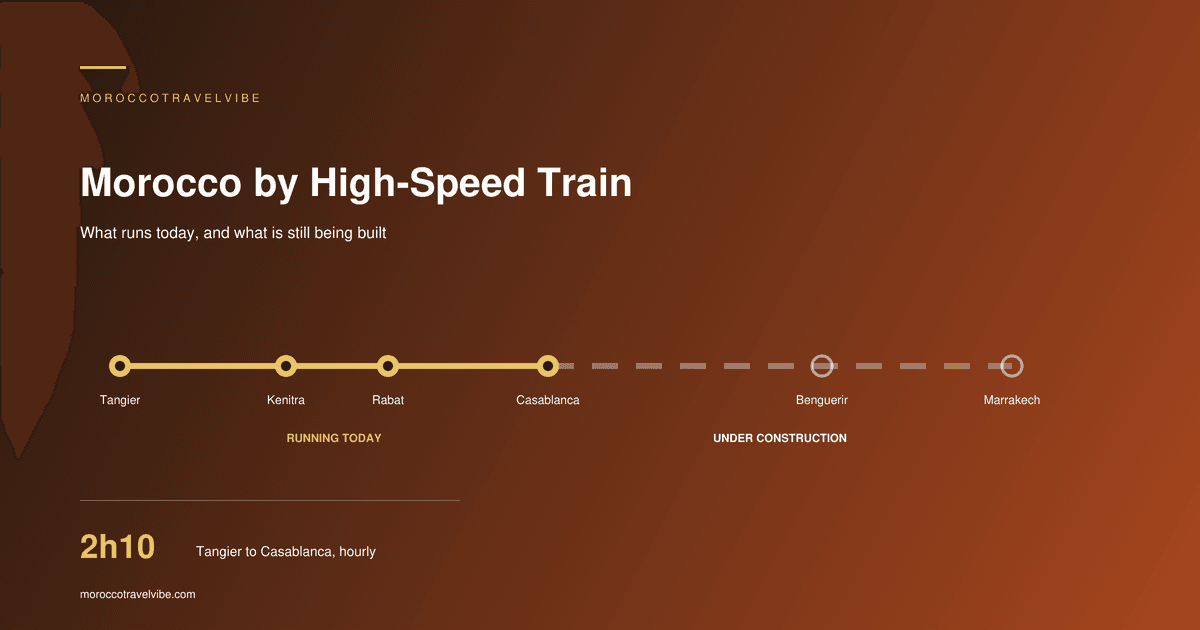
- There is no fast train south of Casablanca. The 430 km Kenitra to Marrakech line is past 30% built with commissioning targeted for late 2029, per the transport minister
- Book direct at oncf-voyages.ma, and check how far the calendar really goes. The stated limit is three months, but on 28 August 2026 nothing was bookable beyond 31 October. Foreign cards are the common failure point, and the station counter is the fallback that always works
Table of Contents
What is the Morocco high-speed train, and where does it actually go?
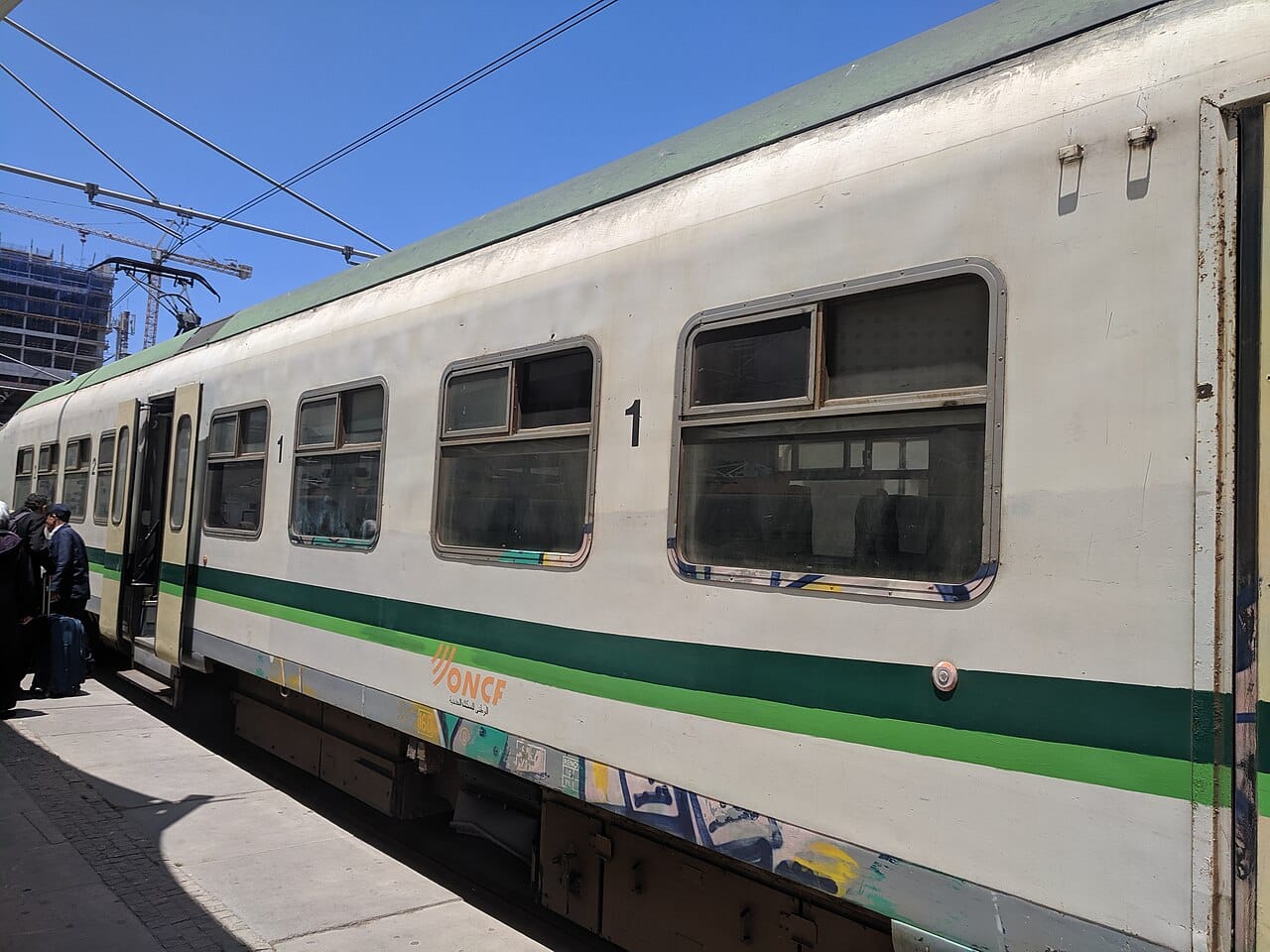
Al Boraq is Africa’s first high-speed rail service, and it links four cities: Tangier, Kenitra, Rabat and Casablanca. End to end the trip takes 2 hours 10 minutes, with departures from Tangier hourly from 06:00 to 19:00 plus a 21:00 service (The Man in Seat 61, retrieved 23 August 2026). It opened in November 2018.
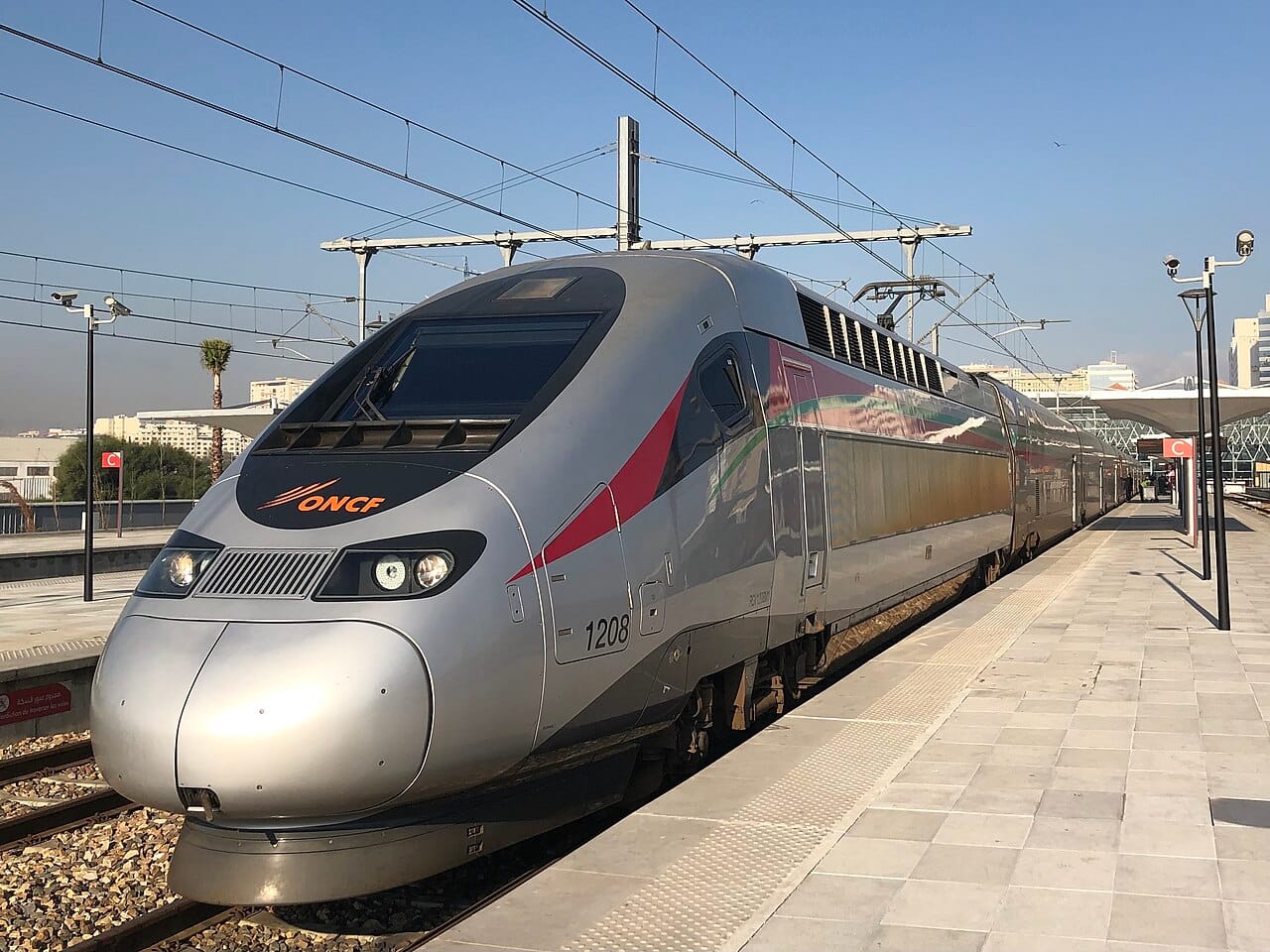
Here’s the part that gets flattened everywhere else. Only 186 km of the route, Tangier down to Kenitra, is purpose-built high-speed track where the train runs at up to 320 km/h (Plasser & Theurer). South of Kenitra it joins the classic network and slows down. The service is high-speed; the whole line is not.
Get the station names right, because two of them catch people out. Tangier is Tanger Ville. Rabat is Rabat Agdal, not Rabat Ville. Casablanca is Casa Voyageurs, not Casa Port.
The scale is real, and it is worth stating because it explains why the extension exists. In 2025 Al Boraq carried 5.6 million passengers, a record and up 3% on 2024 (Hespress). Across its whole network ONCF carried 55.6 million and posted record revenue of 5 billion dirhams (Morocco World News, April 2026).
What does an Al Boraq ticket cost?
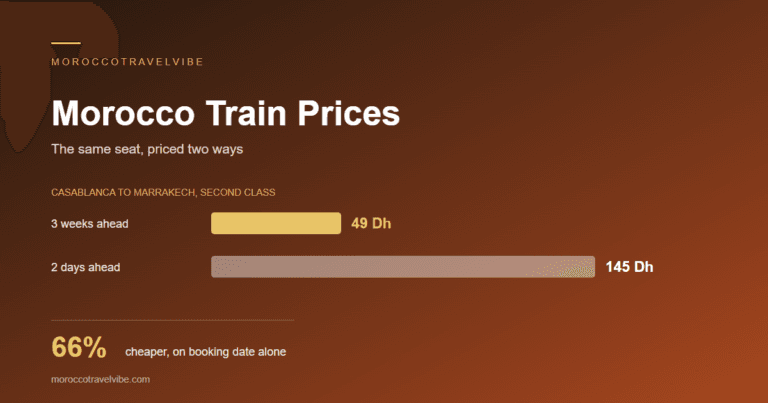
ONCF advertises Tangier from 89 dirhams, and I measured second class on that route at 129 dirhams booked three weeks out against 270 booked two days out (own round, 28 August 2026). Seat 61 gives a broadly similar band of 99 to 224 in second class and 129 to 292 in first (Seat 61, retrieved 23 August 2026). Where you land is set almost entirely by how far ahead you book.
I read ONCF’s own tariff panel on 23 August 2026 to pin the floor down. Its advertised lead-in fares into Tangier are 89 dirhams from Kenitra, from Rabat and from Casablanca alike. The same panel offers Marrakech from Casablanca at 49 dirhams and Mohammed V Airport from Casablanca at 50. Treat 89 as a promotional floor rather than a published tariff, because it moves without notice, but it is ONCF’s own number and it is dated.
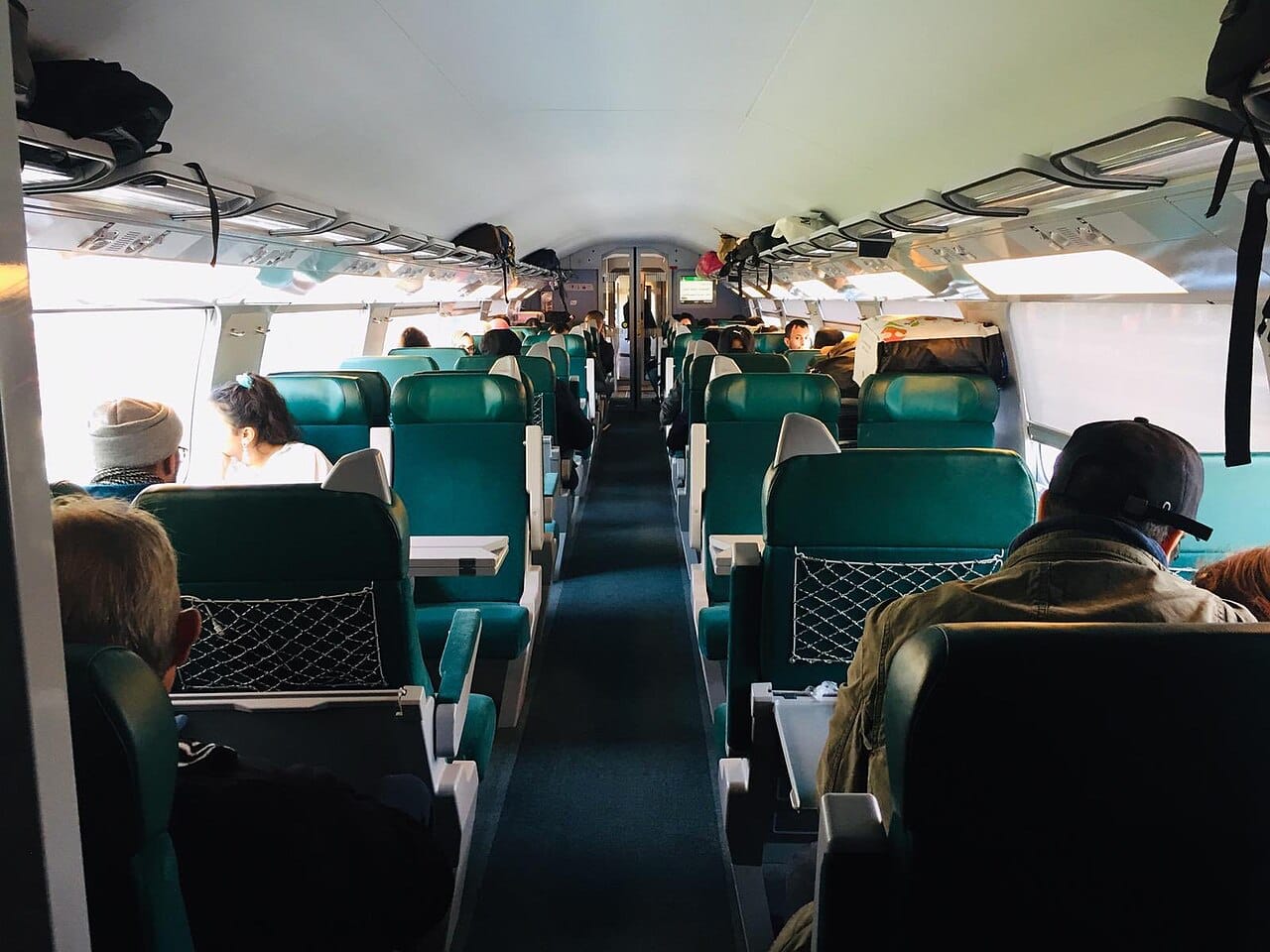
Is first class worth it? On a two-hour run, honestly, not usually. You get more legroom, a quieter carriage and a wider seat, for something like a 30% premium at the same booking distance. On a full midday train in August it buys real comfort. On a Tuesday morning it buys space you’d have had anyway. Book second class early rather than first class late, because the booking-date effect is worth more than the class upgrade. Measured across eight routes that effect runs from 33% to 66%, and on this route first class booked early actually undercuts second class booked late: the full round is in what Moroccan trains and coaches actually cost.
How do you book Moroccan train tickets with a foreign card?
Book direct at oncf-voyages.ma, which states a three-month booking window (Seat 61, retrieved 23 August 2026). The loaded calendar often runs shorter than the policy: on 28 August 2026 no train was bookable beyond 31 October, which is 64 days out. The single most reported problem for visitors is a foreign card being declined at the payment step, and the reliable fallback is buying at a station counter.
I want to be careful here, because this is exactly the kind of question where the internet supplies a confident number and no methodology. You will find claims that some specific percentage of British and North American cards fail on the ONCF portal. That figure traces back to a tour operator’s blog with no stated method behind it. No published failure rate exists. What is well attested, across years of traveller reports, is that the failure happens often enough to plan around.
So plan around it. Try the ONCF site or the app first, because direct is cheapest. If the payment bounces, don’t escalate straight to a reseller: their markup is the price of skipping a queue you may not need to join. Counters at the major stations sell on the spot and take cash and cards, and the station at Casablanca Mohammed V Airport means you can buy onward tickets on arrival day.
The counter is less of an ordeal than the forum threads suggest. At Tanger Ville the queue moves, the machines take a card, and the clerk will find the train if you say the destination and the hour. What you should bring is the exact departure you want, written down, because the timetable board is in Arabic and French and the conversation is faster if you are not translating it live. I’ve never had a counter refuse a foreign card. I have had the website refuse one twice.
When will the high-speed train reach Marrakech?
The 430 km Kenitra to Marrakech line is past 30% complete, with commissioning targeted for late 2029. The project runs to roughly 96 billion dirhams, about $10.3 billion, and the 30% figure comes from the transport minister in May 2026 (Morocco World News).
That figure is a statement by the project’s owners, not an independent audit. The table below keeps that distinction visible, because it’s the difference between “on schedule” and “said to be on schedule”.
| Milestone | Target | Status, and whose statement it is | Last verified |
|---|---|---|---|
| Land acquisition | Done | Complete, rights of way cleared, per ONCF (Morocco World News) | 23 Aug 2026 |
| Earthworks | Rolling | ~20 million m³ executed, per ONCF | 23 Aug 2026 |
| Viaducts and bridges | Rolling | 15 viaducts under construction, work begun on 92 rail and road bridges, per ONCF | 23 Aug 2026 |
| Overall civil works | End 2028 | Past 30%, per the transport minister, May 2026 | 23 Aug 2026 |
| New stations (24 in total) | Before 2030 | Programme launched late 2025. First reported setback on the Benguerir to Marrakech section (Le Desk, 10 August 2026) | 23 Aug 2026 |
| Commissioning | Late 2029 | Targeted, per ONCF and government communiqués | 23 Aug 2026 |
That station row matters more than its size suggests. Le Desk reported on 10 August 2026 that while the line advances on the ground, the 24-station programme has hit its first delay, and the Marrakech section is where it slowed. One wobble in a very large project. It is also the only reported wobble I can find in English at all, which says more about the coverage than about the construction.
When it opens, the announced journey times are Casablanca to Marrakech in about 1h15, Tangier to Marrakech in about 2h40, and Rabat to Casablanca’s airport in about 35 minutes (Maroc.ma, April 2025). Those are announced figures from a launch communiqué, not a published timetable. Treat them as intent.
One more distinction worth holding onto: today’s Al Boraq runs at up to 320 km/h, while the new line is being built for 350 km/h design speed. Coverage blurs the two constantly. Plan with journey times, not top speeds.
For how the rail programme sits inside the wider build-out of stadiums, airports and hotels, see everything changing in Morocco before the World Cup.
What should you actually do before 2029?
Until roughly late 2029, any itinerary with Marrakech in it is a fast leg bolted to a slow one. You take Al Boraq as far as Casa Voyageurs, then change onto the classic network for the run south. That’s the practical shape of Moroccan rail right now, and it’s worth building your route around rather than discovering at the platform.
The change itself is the part nobody warns you about, and it’s a mood shift more than a logistical one. You step off a quiet, sealed, 300-plus-kilometre-an-hour train into a station that is doing four other things at once, and the onward platform is not signposted as a continuation of your journey, because it isn’t one. Give yourself a real buffer rather than a tight connection. Twenty minutes is comfortable. Ten is a jog with luggage, and I have done the jog.
There’s a detail in the rolling stock that makes the timing vivid. ONCF has ordered 168 new trains: 18 Alstom Avelia Horizon double-deck high-speed sets worth 781 million euros, 40 CAF intercity trains and 110 Hyundai Rotem urban sets (Railway Gazette). The high-speed sets are being built for a line that does not exist yet. Meanwhile, to carry the traffic in the meantime, ONCF has been buying retired intercity stock from Italy (Morocco World News, June 2026).
The practical read for a trip in 2026, 2027 or 2028: the fast leg is genuinely good, the slow leg is ordinary and fine, and you’ll ride a country that is mid-upgrade in both directions at once. If you’re routing a first trip around this, my ten-day route is built on today’s timetable rather than the announced one.
Where the new stations will be, and why it matters for 2030
The extension adds stations at Rabat Agdal, the Grand Stade de Rabat, Casa Sud, Nouaceur at the Casablanca airport terminal, Ville Verte Benguerir, and Marrakech (Médias24, December 2025). The Marrakech stop is a new build at Guéliz, with the existing station reorganised around the new traffic.
Two of those tell you what the planners are optimising for. A high-speed station at the airport terminal turns an arrival into a connection rather than a taxi negotiation. A station at the Rabat stadium is a match-day movement decision made five years early.
If you’re planning around 2030 specifically, hold this loosely. Station names, locations and opening sequence are still moving, and a reader who assumes they’ll step off at today’s Marrakech station may be stepping off somewhere else entirely.
Frequently Asked Questions
How fast is Morocco’s high-speed train?
Al Boraq runs at up to 320 km/h, but only on the 186 km purpose-built section between Tangier and Kenitra. South of Kenitra it uses classic track and slows down. The new Kenitra to Marrakech line is being built for a 350 km/h design speed.
Is there a high-speed train from Casablanca to Marrakech?
Not yet. The high-speed network currently stops at Casablanca. The 430 km line south is past 30% complete with commissioning targeted for late 2029, per the transport minister in May 2026. Until then you change at Casa Voyageurs onto the classic network.
How much is Al Boraq from Tangier to Casablanca?
ONCF advertised the route from 89 dirhams on 23 August 2026. Observed fares run roughly 99 to 224 dirhams in second class and 129 to 292 in first, per The Man in Seat 61. Pricing is demand-based, so booking distance matters more than class.
Can I book ONCF tickets from abroad?
Yes, at oncf-voyages.ma or through the ONCF Voyages app. ONCF states a three-month window, though on 28 August 2026 nothing was bookable beyond 31 October, so check the calendar. Foreign cards are declined often enough to plan around, though no operator has published a failure rate. If payment fails, station counters sell on the spot, including at Casablanca Mohammed V Airport.
Is first class worth it on Al Boraq?
On a 2h10 run, usually not. First class costs roughly 30% more at the same booking distance and buys legroom, seat width and a quieter carriage. That is worth it on a full summer train and largely wasted on a quiet weekday one. Booking earlier in second class saves more than the upgrade costs.
The short version
Morocco’s fast train is real, busy and good, and it covers a quarter of the country. Everything else is a construction site with a date on it.
- Today: Tangier to Casablanca in 2h10, hourly, up to 320 km/h on the dedicated section, and 2h17 on the summer 2026 works timetable ONCF is publishing as of 30 August 2026
- The money: advertised from 89 dirhams, observed 99 to 224 in second class, set mostly by how early you book
- The booking: direct at oncf-voyages.ma, with the station counter as the fallback that always works. The bookable calendar can run well short of the stated three months
- The gap: nothing fast south of Casablanca until roughly late 2029, on a target attributed to ONCF and the ministry rather than to an auditor
Before you book anything on the strength of the 2029 date, check the last-verified stamp on the status table above. I re-check every row every 60 days, and I’ll say plainly when one of them slips.