Last verified: October 2, 2026. On 1 and 2 October I read labelled prices for eight items on a Moroccan retailer’s pages, Morocco’s customs answers on drones and medicines, the UK’s travel advice, and both airlines’ bag rules. Shelf prices move fastest, so they carry their read date. I re-read all of it every 60 days and move the date each time.
The one thing Moroccan customs will take off you at the airport isn’t on any packing list I’ve read, and it’s the first thing to settle when you decide what to pack for Morocco. It’s a drone. Customs says a drone without an import licence is held at the border for up to 45 days and then treated as abandoned (Administration des Douanes, foreign visitors section, read 2 October 2026).
Disclosure: Some links in this guide may earn us a commission, at no extra cost to you. It never changes what we recommend.
Every other list is a shopping list, and most are written by someone selling a tour. None says which items you could simply buy on arrival, or for how much. So here’s the list I use, numbered. Each item comes with why it’s there and a pack-or-buy verdict. There’s also the one thing to leave at home, the bag limits that decide all of it, and labelled Moroccan prices for the eight items I could find on a shelf here.
Key Takeaways
- Leave the drone at home. Without an import licence, Moroccan customs holds it for up to 45 days, then treats it as abandoned
- The bag decides the list. Ryanair’s free bag is 40 x 30 x 20 cm; Royal Air Maroc allows 10 kg at 55 x 40 x 25 cm in Economy
- One bag, two climates. Marrakech averages a 37.7°C July high; a January night near the dunes averages 2.0°C (NOAA normals)
- Morocco uses European two-pin plugs, 220 volts. A plug adapter has a median labelled price of 49 dirhams on a Moroccan retailer’s pages
- Buy the fiddly things here, bring the ones that matter. On a Moroccan retailer’s pages a padlock’s median is 49 dirhams and a headlamp’s about 62; sunscreen’s is 178 a bottle, about 113 per 100 ml
Table of Contents
What to pack for Morocco, at a glance
Twenty items in six groups, one bag, and nothing that needs a specialist shop. I read labelled Moroccan prices for eight of the items a shop here could replace, on 1 and 2 October 2026. The last column shows whether forgetting one means a 49-dirham shelf price or a ruined day.
The clothes rows point to the guide on what to wear, which already priced them. “Either” means the item is worth packing if you own it, and easy to buy here if you don’t.
| # | Item | Why it’s on the list | Pack or buy here? | Labelled shelf median |
|---|---|---|---|---|
| 1 | Passport | Validity, and the entry stamp | Pack | |
| 2 | Two cards, some euros | Machines and networks fail | Pack | |
| 3 | Travel insurance, offline | It’s how you reach a private clinic | Pack | |
| 4 | Riad address and map pin, offline | Drivers stop at the medina gate | Pack | |
| 5 | Two pairs of loose long trousers or a long skirt | Covered and cool | Either | priced in the dress guide |
| 6 | Three loose shirts, two long-sleeved | Sun and custom at once | Either | priced in the dress guide |
| 7 | One warm layer | Desert nights and winter | Pack | |
| 8 | A large scarf | Sun, dust, wind, mosque | Either | priced in the dress guide |
| 9 | Closed walking shoes, broken in | Cobbles and slopes | Pack | |
| 10 | Sandals and swimwear | Coast and pool only | Either | |
| 11 | Sunscreen SPF 50 | Strong sun most of the year | Pack, top up here | 178 a bottle; about 113 per 100 ml |
| 12 | Sunglasses and a hat | Glare and midday heat | Either | 164 |
| 13 | A small medical kit, your prescriptions | Two days of cover; a pharmacy does the rest | Pack | |
| 14 | Mosquito repellent | Summer and the south | Either | 89 |
| 15 | Plug adapter, outside Europe | Types C and E | Buy here if you forget | 49 |
| 16 | Power bank, 10,000 mAh | Camps don’t promise power | Pack | 226 |
| 17 | Headlamp or small torch | Camps and dark lanes | Buy here | about 62 |
| 18 | Tissues and sanitiser | Paper and soap aren’t a given | Either | |
| 19 | A folding tote bag | Plastic bags are banned | Either | |
| 20 | A zipped daypack and a small padlock | Crowds and lockers | Either | padlock 49 |
The 21st line says “leave it”, and it’s the drone. It gets its own section below.
What documents and money should you pack for Morocco?
Six months of passport validity is comfortable practice, and the FCDO warns that travellers without an entry stamp have had difficulty leaving Morocco, as the visa guide’s entry-stamp check sets out. Nothing in this group can be bought on arrival, so it goes in the bag first.
1. Passport, and look at the stamp
The airline desk may enforce six months even though the codified UK rule is shorter. More useful: watch the officer stamp your passport, and check the stamp before you walk away. It takes five seconds.
2. Two cards on different networks, and some euros
Cards on two different networks, kept apart, so one swallowed card isn’t the end of the trip. Euros change easily on arrival. Dirhams are a closed currency, and you can only take 2,000 dirhams in or out, so don’t plan to buy them at home or carry a pile back.
3. Travel insurance, saved offline
The UK’s advice is blunt: “Public health facilities in Morocco provide limited medical care. Private clinics are available and operate to a higher standard” (FCDO, read 1 October 2026). Insurance is how you reach the second kind. Keep the policy number and the assistance line on your phone, offline, and on paper.
4. Your riad’s address and a map pin, offline
Medina addresses mean little to a taxi driver, and cars stop at the gate anyway. I save the pin, a photo of the door, and the riad’s phone number before I fly. Many riads will send someone to meet you at the gate if you ask, so ask.
What clothes should you pack for Morocco?
Pack six items that layer, not outfits. In a July week Marrakech averages a 37.7°C high and Essaouira 21.9°C, and in January the nearest station to the dunes averages 2.0°C overnight (NOAA 1991 to 2020 normals). One bag has to cover all three.
The covering rule and the clothes’ labelled prices are in the dress rule, city by city. The short version is loose, shoulders and knees covered in the medinas, and swimwear for beaches and pools. These six items obey it.
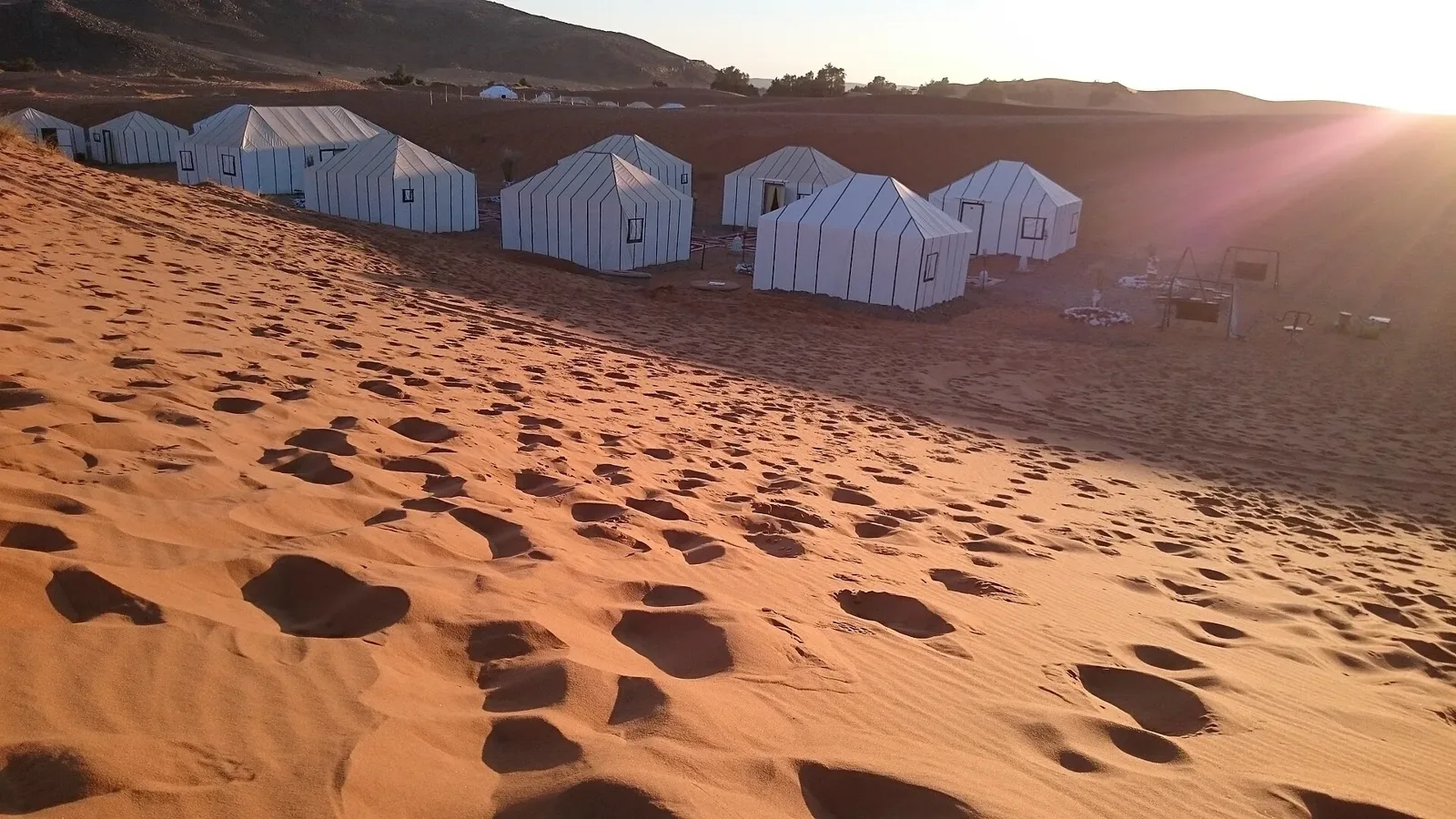
A desert camp at Merzouga as the sun drops. The temperature drops with it. Photo: Isabeldianamadrid, CC BY-SA 4.0, via Wikimedia Commons.
5. Two pairs of loose long trousers, or a long skirt
Linen or thin cotton, loose enough to move air. Two pairs let one dry while you wear the other, and most riads will do laundry.
6. Three loose shirts, at least two long-sleeved
A loose long sleeve is cooler in the sun than a tight short one, and it covers you for a mosque terrace without a second thought.
7. One warm layer
A fleece or a packable down jacket, even in a hot month, if the desert is on the route. At Errachidia, the nearest station with published normals, January nights average 2.0°C and the record is minus 8.1°C, as the Sahara camp census reports. Camps add blankets, but they supply blankets, not heating. In winter you’ll sleep in this layer.
8. A large scarf
It’s shade at noon, a dust mask on a desert road, a windbreak in Essaouira and a cover inside a mosque. No other item does four jobs.
9. Closed walking shoes, already broken in
Medina lanes are polished stone, slopes and whatever the mules left behind. Closed toes, a grippy sole, and never a first outing.
10. Sandals and swimwear
For the coast, a hotel pool or a hammam. Swimwear stays on the sand; a cover-up goes on for the walk back through town.
What sun and health items do you need?
Four items, and only two of them, sunscreen and your own prescriptions, are worth carrying in quantity. Any Moroccan pharmacy sells the basics at a price printed on the pack by law: three sachets of oral rehydration salts cost 11.50 dirhams and 20 Imodium capsules 28.50. So pack two days of cover, not two weeks.
11. Sunscreen SPF 50, a full bottle
The World Health Organization’s UV index advice starts at index 3: seek shade at midday, cover up, and use sunscreen and a hat. At 8 and above it says to avoid being outside at midday (WHO, read 2 October 2026). That’s the sunscreen, the hat and the long sleeves in one sentence.
On a Moroccan retailer’s pages on 2 October 2026, adult SPF 50 body sunscreen had a median labelled price of 178 dirhams a bottle, or about 113 dirhams per 100 ml, across 27 listings. Children’s and face products were left out. My verdict: bring the formula you trust, and top up here if it runs out.
12. Sunglasses and a hat
Polarised sunglasses had a median labelled price of 164 dirhams across 34 listings. Only 9 of the 34 name a UV400 rating in the title, so I’d bring a pair you already trust. The dress guide has the hat’s labelled price.
13. A small medical kit, and your prescriptions
Oral rehydration salts, an anti-diarrhoeal, paracetamol, plasters and blister pads, for two days. Everything on that list sits behind any pharmacy counter, so this is cover for the first night, not a stockpile.
Your own prescriptions are different. Customs admits medicines for personal use free of duty if you produce the medical documents, such as a prescription or a doctor’s certificate. You also commit to using them yourself and taking the unused rest home (Administration des Douanes, read 2 October 2026). Keep them in their original packs, with the prescription beside them.
14. Mosquito repellent, for summer and the south
Morocco was certified malaria-free by the WHO in 2010 (WHO, read 2 October 2026). Repellent here is about bites, not malaria. The labelled median on a Moroccan retailer’s pages was 89 dirhams across 13 sprays, mostly essential-oil formulas. None names DEET or icaridin, so bring your own if strength matters to you.
What electronics should you bring to Morocco?
Morocco uses type C and E plugs at 220 volts and 50 hertz, and flat Euro plugs need no adapter at all (ADAC, the German motoring club, read 2 October 2026). From the UK, the US or elsewhere, item 15 is the cheapest thing to forget.
15. A plug adapter, if your plugs aren’t European
The labelled median on a Moroccan retailer’s pages was 49 dirhams across 32 listings, and the middle half sat between about 37 and 64. If you forget it, buy one here. Your phone does the rest, with offline maps saved before you land.
16. A 10,000 mAh power bank
A desert camp is the reason. In the Sahara camp census, no camp listing names a generator or a power schedule. The labelled median on a Moroccan retailer’s pages was 226 dirhams across 36 listings, and the upper half ran from 226 to 599. This is one to bring from home: you want the one you know holds its charge.
17. A headlamp or a small torch
For the camp after dark, and for medina lanes at night. The labelled median was about 62 dirhams across 16 single lamps. Buy one here if you don’t own one.
What small things save a day in Morocco?
Morocco’s plastic bag law, Law 77-15, has banned the making, import, sale and use of plastic bags since 1 July 2016 (Hespress, 27 December 2024). That’s the reason for item 19. The other two cover the moments a trip goes sideways: no paper, or a crowd.
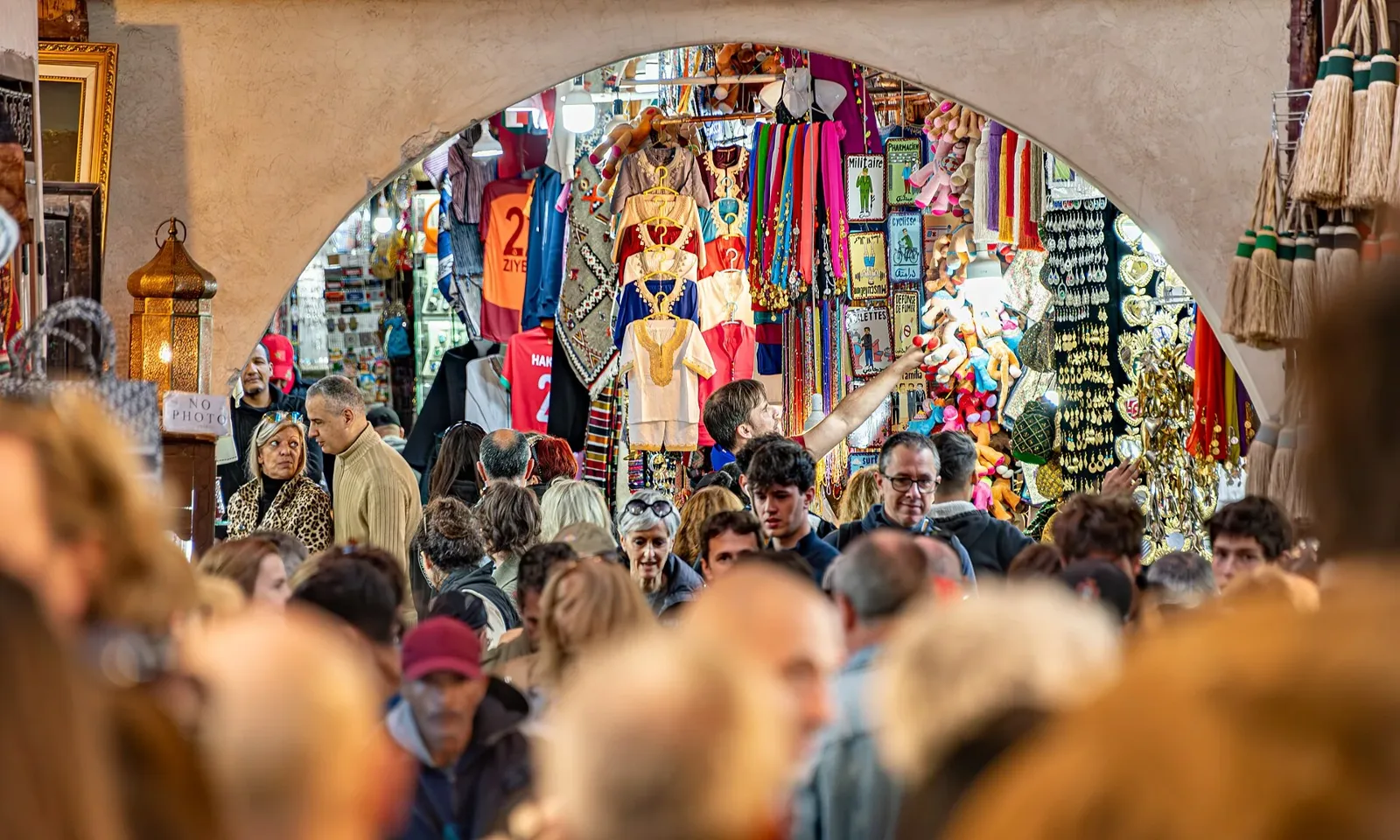
A souk lane in Marrakech at its busiest. A zipped bag worn in front is the whole strategy. Photo: Jorge Franganillo, CC BY 2.0, via Wikimedia Commons.
18. A pack of tissues and a little sanitiser
Café and station toilets often have neither paper nor soap. A pocket pack and a small bottle weigh nothing, and they’re the item I’d least like to be without.
19. A folding tote bag
Hespress reports that illegal factories have brought plastic bags back into markets, so the ban is patchy. Even so, many shops have nothing to give you. A tote that folds into a pocket carries fruit, a bottle of water and whatever you didn’t plan to buy.
20. A zipped daypack and a small padlock
A bag that zips shut, worn in front in a crowded souk. That’s most of how petty theft actually works here, and most of the answer to it. The padlock is for hostel lockers and bag zips; the labelled median was 49 dirhams across 19 single locks.
Notice how short the “pack” column has become? Documents, the sunscreen you trust, a charged battery and one warm layer. Most of the rest has a labelled price on a Moroccan retailer’s pages.
The one thing to leave at home: your drone
Morocco’s customs administration says importing a drone is prohibited unless you produce a licence from the foreign trade department. Without one, the drone is held in deposit for up to 45 days pending regularisation, then considered abandoned (Administration des Douanes, foreign visitors section, read 2 October 2026).
The French wording leaves no room: drones and model aircraft “est interdite, sauf production d’une licence délivrée par le département chargé du Commerce Extérieur.” Flying one is a separate permission. The UK says you need it from the Directorate General for Civil Aviation, or “you risk fines and confiscation of your equipment” (FCDO, updated 19 August 2026).
Customs repeated the point in a leaflet for the Africa Cup of Nations in December 2025: declare your drone on arrival to avoid confiscation (leaflet as republished by Bladi.net). Declaring it keeps it out of the confiscation bin; it doesn’t get it into the air.
The only legal route customs names is that import licence, arranged before you travel. Leave the drone at home.
The same leaflet carries the two money lines worth knowing at the border. You declare foreign currency worth 100,000 dirhams or more. And dirhams may go in or out only up to 2,000, which the money guide explains.
Should you pack it or buy it in Morocco?
Buy the fiddly things here and bring the ones where the brand matters. On a Moroccan retailer’s pages on 1 and 2 October 2026, a plug adapter and a padlock each had a median labelled price of 49 dirhams, and a headlamp about 62. A power bank was 226, and sunscreen 178 a bottle, about 113 per 100 ml.
I read the first page of results on Jumia Maroc, a Moroccan online retailer that prints a price on every listing, for eight items. I removed duplicates and dropped multipacks, children’s lines, bundles and anything that wasn’t the item. These are labelled prices, read on the dates shown. They aren’t what a medina stall, a pharmacy or an airport kiosk charges, and I didn’t collect prices at home, so none of this says “cheaper than at home”.
| Item | Listings kept | Range, MAD | Median, MAD | Read |
|---|---|---|---|---|
| Universal plug adapter | 32 | 17 to 199 | 49 | 1 Oct 2026 |
| Luggage padlock, single | 19 | 25 to 189 | 49 | 1 Oct 2026 |
| Headlamp, single | 16 | 19 to 109 | about 62 | 1 Oct 2026 |
| Mosquito repellent spray | 13 | 49 to 249 | 89 | 1 Oct 2026 |
| Polarised sunglasses | 34 | 69 to 329 | 164 | 1 Oct 2026 |
| Sunscreen SPF 50, adult body | 27 | 59 to 525 a bottle | 178 a bottle; about 113 per 100 ml | 2 Oct 2026 |
| Power bank, 10,000 mAh | 36 | 125 to 599 | 226 | 1 Oct 2026 |
| Tampons, box of 16 to 20 | 5 | 52 to 99 | range only, three brands | 1 Oct 2026 |
Four readings come out of it. The cheap, fiddly items cost less to replace than the hassle of going without. Polarised sunglasses spread widely, from 99 to 244 in the middle half, so price says little about quality. Sunscreen and power banks are where the brand matters, and they’re the two I pack. And tampons are on the shelf, in three brands, at 52 to 99 dirhams a box.
How big a bag do you need for Morocco?
Ryanair’s free personal bag has been 40 x 30 x 20 cm since 4 September 2025, which works out at 24 litres (Ryanair). Royal Air Maroc allows Economy passengers a 10 kg cabin bag up to 55 x 40 x 25 cm, plus a 2 kg personal item (Royal Air Maroc, read 1 October 2026).
Twenty items in 24 litres is tight. It only works if the clothes are the six above and you wear the warm layer and the walking shoes on the plane, and a winter jacket makes it tighter still. If you’re flying on the free bag alone, test the pack at home before the gate tests it for you.
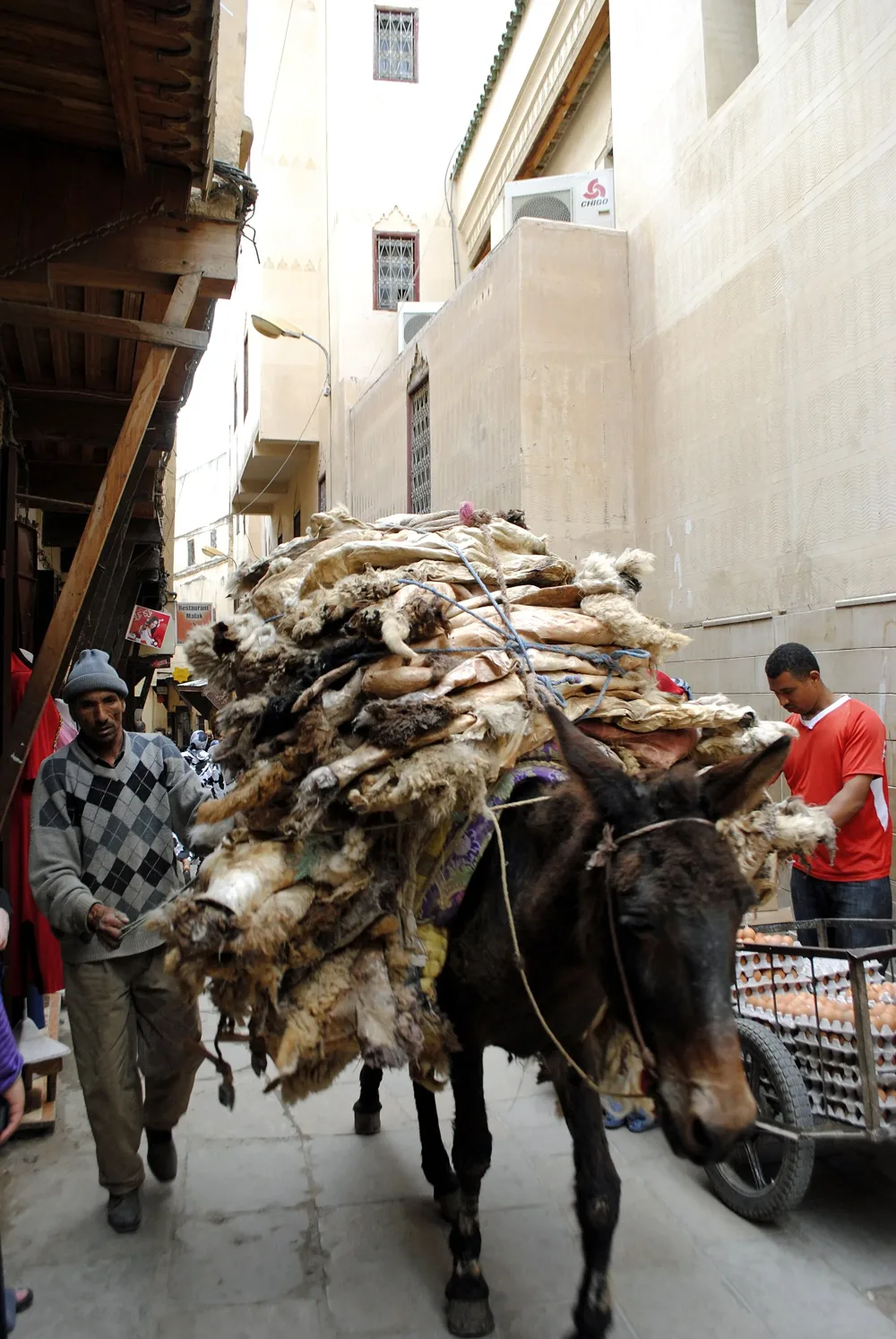
A loaded mule in the Fes medina. In the old cities, this is the delivery van. Photo: just_a_cheeseburger, CC BY 2.0, via Wikimedia Commons.
Backpack or wheels? I carry a backpack. Medina lanes are closed to cars, often stepped, and the riad door can be a ten-minute walk from where the taxi stops. That’s why porters with handcarts work the main gates of the big medinas. A suitcase works if you can lift it up a flight of stone stairs.
Frequently Asked Questions
Can you bring a drone to Morocco?
Not without an import licence. Morocco’s customs administration says drones are prohibited unless you produce a licence from the foreign trade department; without one, the drone is held for up to 45 days and then treated as abandoned. Flying one also needs civil-aviation permission. Leave it at home.
Do I need a plug adapter in Morocco?
Only if your plugs aren’t European. Morocco uses type C and E sockets at 220 volts, and flat Euro plugs fit without an adapter. If you forget yours, a universal adapter had a median labelled price of 49 dirhams on a Moroccan retailer’s pages in October 2026.
Can you buy sunscreen and tampons in Morocco?
Yes. On a Moroccan retailer’s pages in October 2026, adult SPF 50 sunscreen had a median labelled price of 178 dirhams a bottle, about 113 per 100 ml, across 27 listings. Tampons were listed at 52 to 99 dirhams a box in three brands. Bring your preferred formula and buy here if you run out.
What should I pack for the Sahara desert?
One warm layer, a torch, a charged power bank and a scarf. At Errachidia, the nearest station to the dunes, January nights average 2.0°C, and camps supply blankets rather than heating. No camp listing I read names a generator or a power schedule, so carry your own light and charge.
Is a backpack or a suitcase better for Morocco?
A backpack, or a suitcase you can carry up stairs. Medina lanes are closed to cars, and the riad can be a walk from the gate. Ryanair’s free bag is 40 x 30 x 20 cm, about 24 litres, while Royal Air Maroc allows a 10 kg cabin bag up to 55 x 40 x 25 cm.
The short version
Twenty items, and one left behind. Pack the documents, the sunscreen you trust, a charged power bank and one warm layer, and leave the drone at home. Pack layers, not outfits, because one bag crosses about 36 degrees between a July afternoon in Marrakech and a January night near the dunes. And when you forget something fiddly, a Moroccan shelf sells it with a price on it.
For everything else to settle before you fly, start with the full trip-planning guide.