Last verified: September 20, 2026. I read the listings for 25 Merzouga desert camps myself on the date above, then opened the property pages of the first 15 and recorded what each one says about the bathroom, the water, the heating and the power. The permit rules come from the decree itself in the Bulletin Officiel, and the temperatures from NOAA’s 1991 to 2020 normals. Listings change weekly and implementing orders get published, so I re-read all of it every 60 days and move the date above each time.
Twenty-five desert camps came back on the first page when I searched for one November night near Merzouga. Every one of them scored at least 9.3 out of 10. The median was 9.9. If you are trying to choose a Sahara desert camp from a screen, the ratings will not help you, because they cannot tell these places apart.
Disclosure: Some links in this guide may earn us a commission, at no extra cost to you. It never changes what we recommend.
Everything written about this night is written by somebody selling it. The words barely change between sites: a traditional dinner, drumming around the fire, a sky thick with stars, a tent with a real bed and a hot shower, then a sunrise and a Berber omelette. It is not untrue. It is just not information.
So I measured what I could. I read the listings, counted what they name and what they leave out, opened the law that governs the tent you sleep in, and checked what the sky is actually doing during the months these camps are sold in. Three of those four things turn out to be published, checkable, and ignored by everyone.
Key Takeaways
- The ratings cannot separate the camps. All 25 on page one scored between 9.3 and 10.0 on 20 September 2026, median 9.9, with 22 of 25 at 9.5 or better. The whole field fits inside seven tenths of a point
- Distance is the number nobody uses, and it is on every card. Median 4.7 km from the village, range 300 m to 16.5 km. It sets your camel leg, your light pollution and how much of the neighbouring camp you hear
- Every listing promises WiFi and not one mentions electricity. Of the 15 property pages I opened, 15 name a private bathroom and WiFi, 4 name heating, 1 names hot water, and 0 name a generator, a power schedule or how many tents the camp has
- The tent is the coldest place in Morocco in winter. At Errachidia, the nearest station with published normals, the January mean overnight low is 2.0C and the record low is -8.1C
- Your camp holds a permit that expires. A bivouac authorisation runs six months at most, comes from the local authority rather than the tourism ministry, and is checked against a specification document that has not been published yet
Table of Contents
What is a night in a Sahara desert camp actually like?
It is about eleven hours between arriving at dusk and leaving at dawn, and roughly two of them are the part in the photographs. The camel leg takes 45 to 90 minutes depending on which camp your operator uses, which is the range across every listing that states a time.
Here is the honest shape of it. You reach the dunes in the late afternoon, get on a camel, and ride into the light going orange. You arrive, drop a bag in a tent, and climb a dune for the sunset with everyone else. There is tea. There is dinner, usually a tagine, usually at a long table under canvas. There is drumming at the fire, which is genuinely good for about forty minutes.
Then the music stops, the lights go off, and the desert does the thing it is famous for. It gets completely silent and extremely cold, in that order. You sleep badly, because canvas is loud and the ground is hard and somebody wakes you before sunrise. You climb the dune again. Then you get back on the camel.
I would do it once. I would not do it twice in the same trip, and I would not pay extra for a better tent when the same money moves the night to a better week. The rest of this page is why.
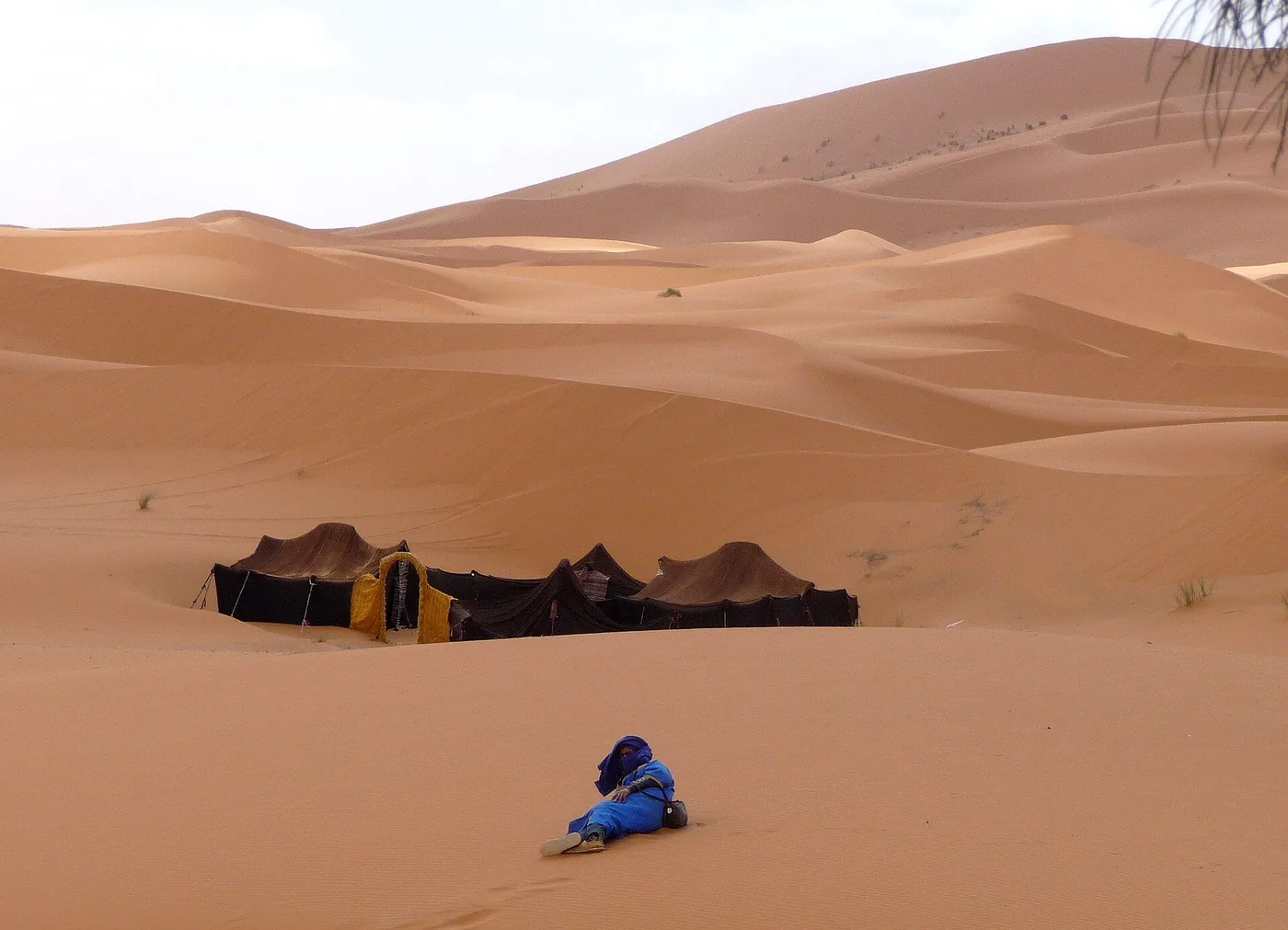
The version most people picture: low black tents on the sand below the dunes at Merzouga. Most of the camps on sale today look nothing like this. Photo: gailhampshire, CC BY 2.0, via Wikimedia Commons.
How many camps are there, and can you tell them apart?
One search for one November night returned 531 properties, and the 25 on page one all scored between 9.3 and 10.0. The median was 9.9. Twenty-two of the twenty-five sat at 9.5 or better and four held a perfect 10.0.
Here is the method, because it matters more than the number. On 20 September 2026 I searched Booking.com for Merzouga, filtered to the luxury-tent property type, set one night from 10 to 11 November 2026 for two people, and read the whole first page in one pass: name, score, review count, distance. I collected no prices, deliberately, because what a desert trip should cost is measured properly in its own post. This is what one platform returned for one search on one night. It is not a register of camps, and I would not use it as one.
The scores are the finding. A median of 9.9 built on a median of 279 reviews is not a quality measure, it is a satisfaction measure, and what it tells you is that almost nobody regrets a night in the Sahara. Fair enough. It also means the number on the card cannot choose for you, and that a camp with 13 reviews and a perfect 10.0 sits above one with 2,087 reviews and a 9.3.
The names have stopped carrying information too. Eighteen of the twenty-five call themselves Luxury. Twenty have Camp in the title. And on nine of the fifteen pages I opened, the name on the card shares no distinctive word with the camp’s own booking address: Shining Luxury Camp lives at dunes-vacation-camp, Merzouga Luxury Camp at cameltrekking-camp. Those camps have traded under another name at least once.
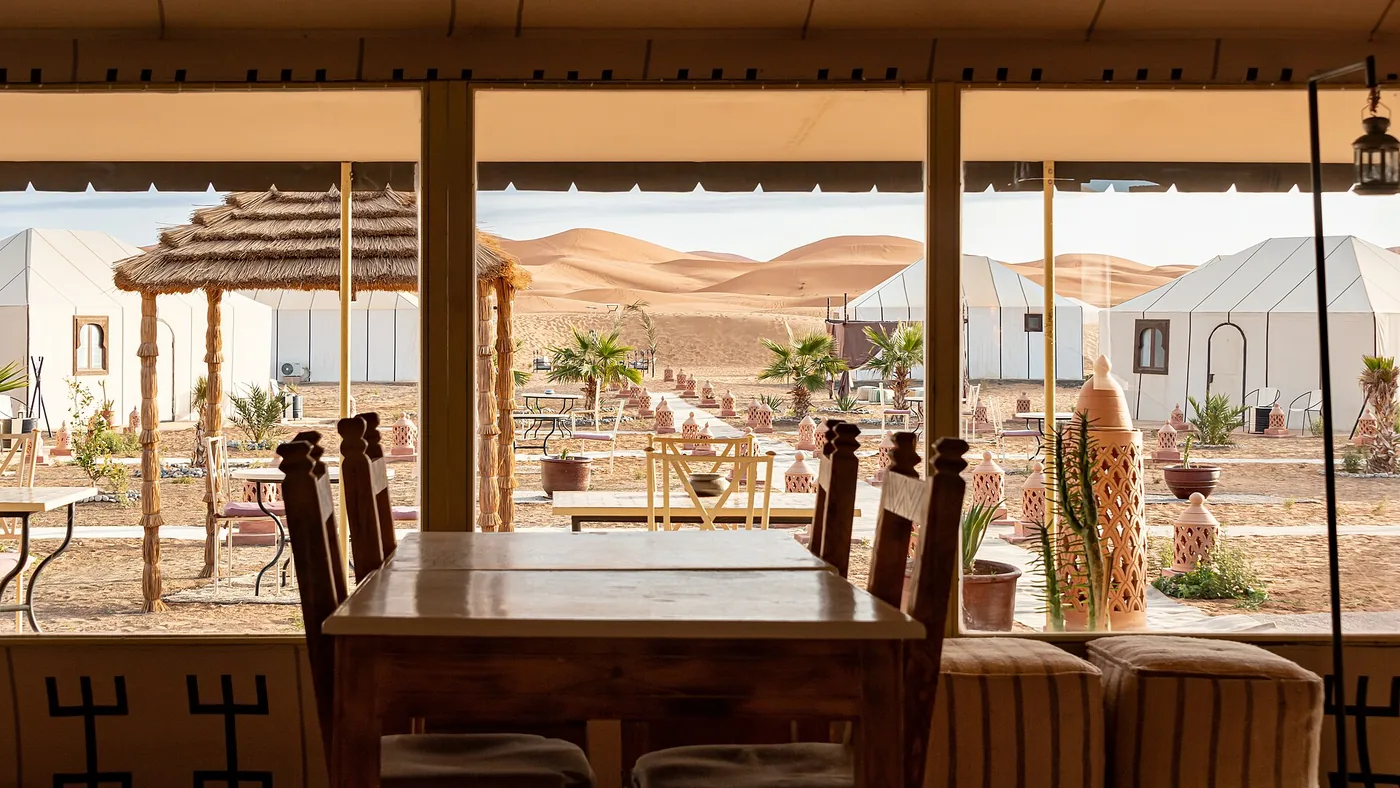
What “luxury camp” means in practice at Erg Chebbi: white canvas rooms in rows, potted palms, and air conditioning units on the back of the tents. Photo: Jorge Franganillo, CC BY 2.0, via Wikimedia Commons.
So if the rating cannot choose, what can? Three things, and the first one is printed on the same card as the useless number. Before any of them, make the seller name the erg, the camp standard and the group cap in writing.
Where is the camp actually going to be?
Across the 25 camps I read on 20 September 2026, the median sits 4.7 km from the centre of Merzouga, and the range runs from 300 metres to 16.5 kilometres. Fifteen of the twenty-five are within 5 km. Four are 10 km or further out.
That number decides more of your night than the tent does. A camp at 300 metres is a walk from a village with lights, generators, dogs and other camps. A camp at 16 kilometres means a longer camel leg or a 4×4 transfer in the dark, a genuinely black sky, and a long way from a road if something goes wrong at two in the morning. Neither is better. They are different nights, and the listing tells you which one you are buying if you read the small grey line.
There is a structural reason the camps sit where they do. Erg Chebbi runs about 28 km north to south and 5 to 7 km east to west, with dunes reaching 150 metres above the surrounding hamada, and Merzouga sits on its western lee. The camps are not in the middle of that. Wikipedia’s own entry puts it plainly: the companies run camel trips “to permanent campsites on the outer sections of the erg” (Wikipedia, Erg Chebbi). Every camp on my list is on the edge of the dune sea, because that is where a truck can reach.
Two neighbouring questions belong to other pages, and I am handing them over rather than blurring them. Whether Merzouga or Zagora is the right dune field at all is a decision with its own evidence. And whether the camp you arrive at is the camp in the photographs is a misrepresentation problem with a legal name. This section is only about what the distance does to the hours between dinner and dawn.
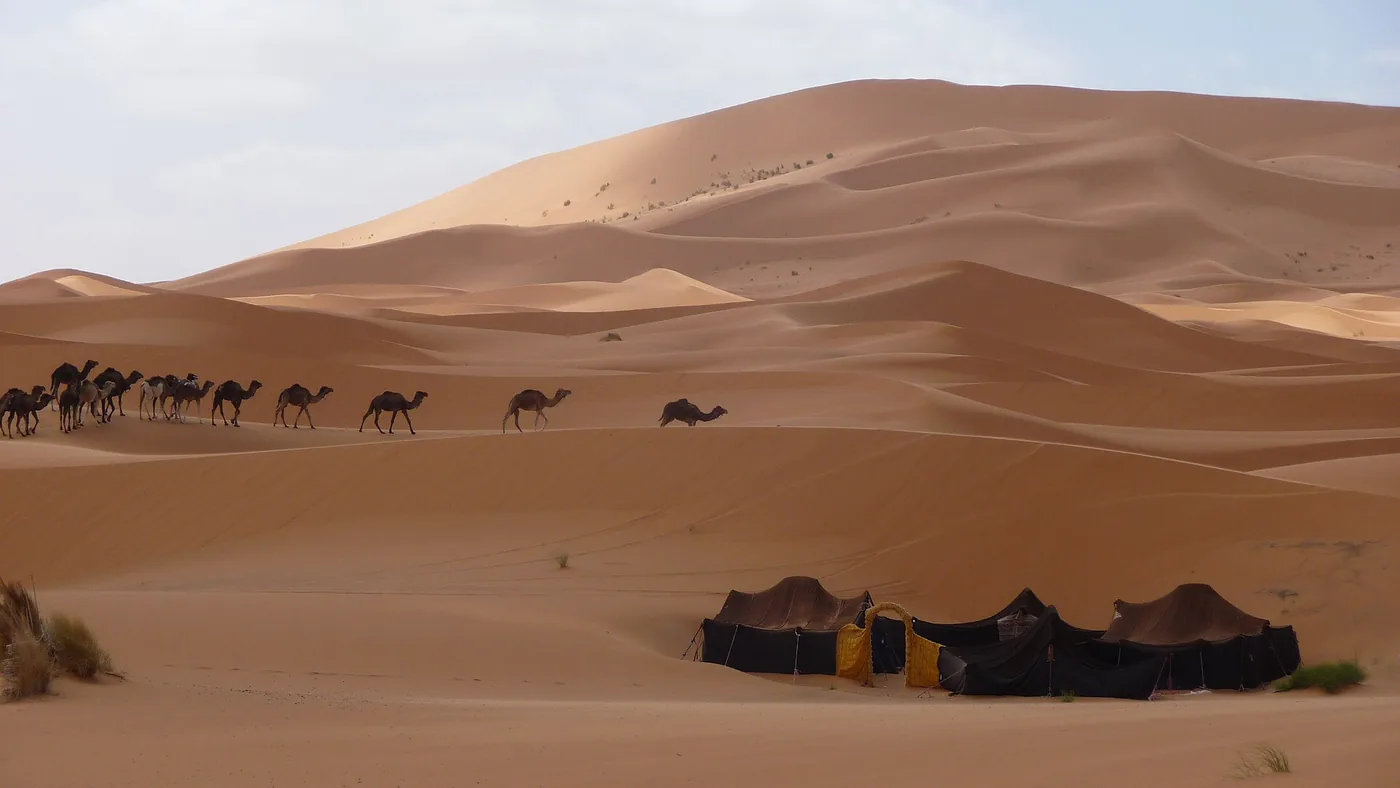
The camel line on the ridge and the camp on the flat below. The tents sit where a vehicle can reach them, which is the outer edge of the erg. Photo: gailhampshire, CC BY 2.0, via Wikimedia Commons.
Is your camp even allowed to be there?
A Moroccan desert camp is a bivouac, a named category of tourist accommodation with its own permit, and that permit lasts six months at most. It is issued by the local authority, not by the tourism ministry, and it can be withdrawn after an inspection.
The rules sit in decree n° 2-23-441 of 13 July 2023, taken under law 80-14, whose French official translation appeared in Bulletin Officiel n° 7462 of 4 December 2025. Articles 51 to 59 cover bivouacs specifically. The application goes to the local authority against a receipt at least 14 days before the camp is pitched. The file has to carry an insurance contract. It also has to carry a copy of the accreditation of the natural-spaces guide who will accompany the guests. The authorisation then runs for one month if the camp is a stage on a trek. If it stands on a site reserved for the purpose, six months.
There is a gap in all this, and it is the interesting part. The decree leaves two things to a joint order of the interior and tourism ministries. One is the model specification document. The other is the list of sites where bivouacs may be installed. I could not find either published as of 20 September 2026. The implementing order that has appeared, arrêté 835-24 of 22 January 2025, fixes the classification paperwork for hotels, riads and guest houses, and mentions bivouacs zero times. So the permit exists and the standard it is measured against is still being written.
What do you do with that as a traveller? Not much, and I would rather say so than invent a checklist. Ask who holds the authorisation and when it expires. A camp on a reserved site renews twice a year and will know. One that cannot answer has told you something. Note also that this is the camp’s own permit. The licence of the agency that sold you the trip is a completely different register, in a different ministry. Confusing the two is how people end up complaining to the wrong business.
How cold does it actually get in a tent?
At Errachidia, the nearest station with published official normals, the mean overnight low in January is 2.0C and the record low is -8.1C (NOAA 1991 to 2020 normals, via Wikipedia). In October the mean low is 14.2C, which is the difference between a jumper and a problem.
One caveat, stated in the same breath. Errachidia sits at 1,009 metres and about 80 km north of the dunes, while Merzouga is at 730 metres, so camp nights run a little milder than the station’s numbers. How much milder I do not know, and I am not going to invent a figure for it. Modelled series for Merzouga put January nights closer to 6C. Whichever you use, the answer to the question is the same: in midwinter the tent is near freezing, and what you are given is blankets, not heating.
Of the fifteen property pages I read, four mention heating of any kind and none mentions an extra blanket. That gap is worth planning around rather than arguing with. Layers, a hat, and the acceptance that you will sleep in most of your clothes. What to bring to Morocco generally is its own packing decision, and if the cold is the thing that worries you, the month you pick matters far more than the camp, which is a decision with twelve months of evidence behind it.
Will you actually see the Milky Way?
You will see a superb sky, and for three months of the camping season you will not see the galactic core at all, because it is not above the horizon at night. The bright, dense centre of the galaxy is a summer object for the northern hemisphere: the Royal Observatory Greenwich puts the first true views of the core in June (Royal Observatory Greenwich).
Now put that against the season. The comfortable months at Erg Chebbi are October to April. From November to January the core is on the daytime side of the Earth. From February to April it rises only in the last hours before dawn. So the photograph in the listing, the one with the galaxy standing over the tents, is a May to August photograph, taken in exactly the months the same sellers will tell you are too hot to sleep out in.
The band of the Milky Way is still there in winter, and a dark desert sky in January is better than almost anything you have seen from a city. But the picture you were sold has a season, and nobody selling it mentions which one.
The second variable is free to control and nobody mentions that either. The moon washes out everything. A full moon turns the dunes silver and the sky empty, and the cycle takes about 29.5 days, so the dark window comes round every month. The Royal Observatory publishes the dates: the 2026 full moons fall on 26 October, 24 November and 24 December (Royal Museums Greenwich). Book your night a week either side of those and you have done more for your sky than any upgrade can.
What do you actually get to eat, hear and sleep on?
Of the 15 Merzouga camp listings I opened on 20 September 2026, every one promises WiFi and not one mentions electricity. Fifteen name a private bathroom, fifteen name a shower, fifteen include breakfast and dinner. Four name heating, four name air conditioning, one names hot water, and none says how many tents the camp has.
I read those flags three ways on each page at once: the structured room-facility data the page carries for itself, the popular-facilities block, and the description. The collapsed full inventory does not open to an automated read, so these are counts of what a listing tells a shopper, not claims about what the camp owns. The distinction matters, and it does not soften the point. If a camp heats its tents, that is the single best thing it could say to somebody booking a January night, and four of fifteen say it.
The generator is the fact the whole night turns on. Power at these camps comes from one, or from panels, and when it goes off so do the lights, the sockets and any heating. Not one listing in fifteen tells you what hour that happens. It is the most consequential unpublished number in the product.
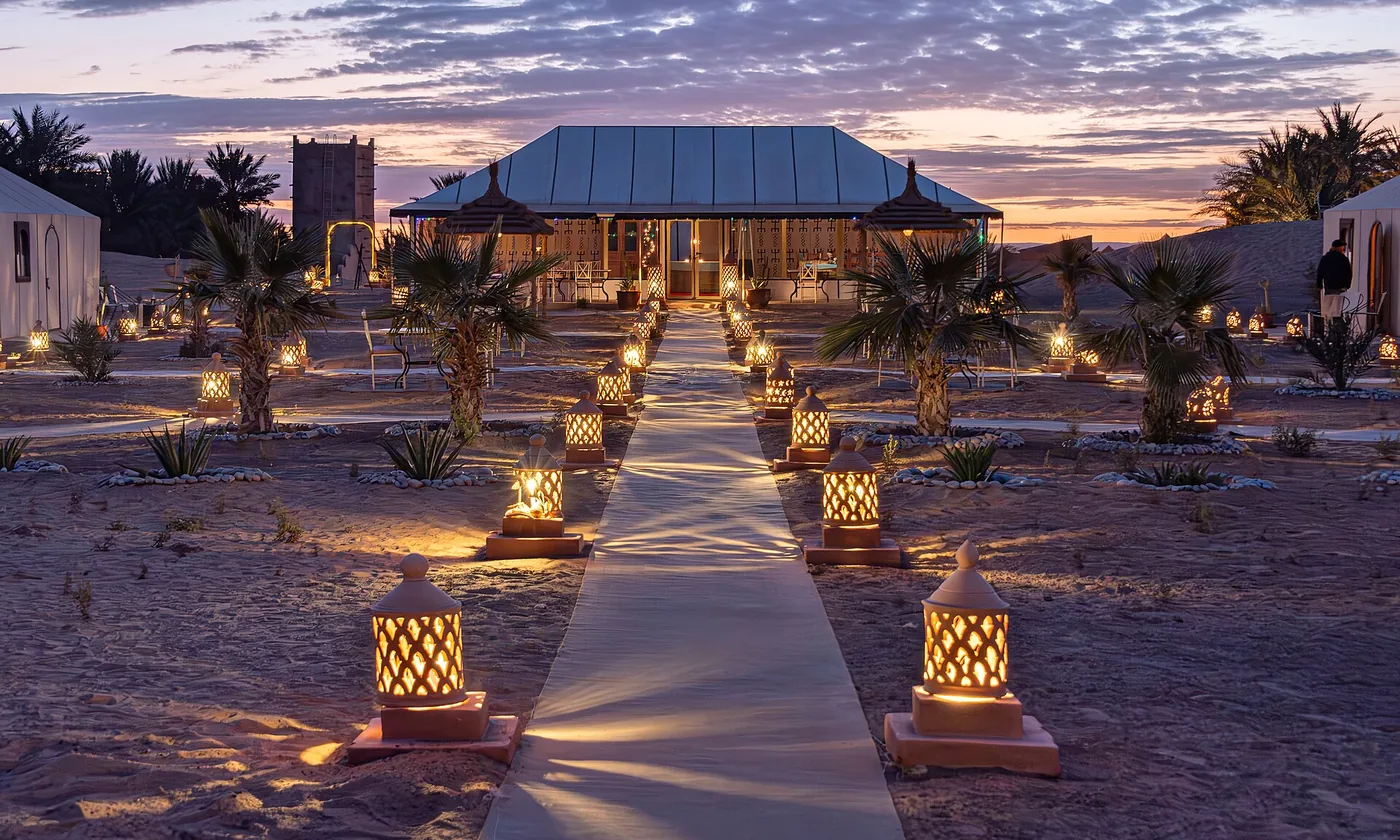
Sixty lit lanterns and a dining tent, at dusk. Something is running all of that, and no listing I read says for how long. Photo: Jorge Franganillo, CC BY 2.0, via Wikimedia Commons.
Dinner is the other half of what you are buying and it is reliably fine: soup, a tagine, fruit, mint tea, served communally. The drumming is real, and it is also a performance that happens at the same time every night at every camp on that list. What separates standard from luxury as a category, the bathroom and the bed and where the camp sits, the cluster hub sets out properly. What varies inside a tier is what I have counted here.
Is one night enough, and would I do it again?
One night is enough to have been there and not enough to have been in the desert. On the standard three-day shape you spend roughly 20 hours in a vehicle for those eleven hours at the camp, which is a ratio worth looking at squarely before you book.
Here is the whole page in one table: what you decide, and what the camp decides for you.
| The decision | Who makes it | What it changes |
|---|---|---|
| Which month | You | Whether the tent is near freezing or merely cool |
| Which week in that month | You | Whether there is a moon in the sky, which decides the stars |
| How far out the camp sits | You, off the listing card | The camel leg, the village light, the neighbouring generator |
| Standard tent or luxury tent | Your budget | The bathroom and the bed, for the hours you are asleep |
| What hour the power stops | The camp, and no listing says | The lights, the sockets and any heating, from that hour on |
| What is for dinner | The camp | Very little. It is a tagine at every camp on the list |
Would I do it again? Yes, once, and differently. Two nights if the trip can absorb them, because the second night is the one where the novelty drops away and you actually notice the silence. If the trip cannot absorb two, then one night at a camp within about 5 km of the village, which is where most of them are anyway, and the money that would have gone on the upgrade spent on going in the right week instead.
The right week is the one thing on this page you fully control. Pick a month at the shoulder, October, November, or the turn of February into March, and the month decision has its own evidence. Then pick a night away from the full moon. Those two choices change the night more than any camp on my list of twenty-five can.
And the honest counter-argument, which I would rather state than bury: if you have six days in Morocco, the arithmetic above is a reason not to go at all. Three of those days become one night in a tent. Plenty of people should spend them in Fes instead, and the desert will still be there.
Frequently Asked Questions
What is a night in a Sahara desert camp actually like?
About eleven hours, from a dusk arrival by camel to a pre-sunrise wake-up. Two of them are dinner, drumming and the sky. The rest is canvas, cold and a generator that stops. The camel leg itself runs 45 to 90 minutes across every listing that states a time.
How cold does a Sahara desert camp get at night?
Cold enough to plan for. At Errachidia, the nearest station with published NOAA 1991 to 2020 normals, the January mean overnight low is 2.0C with a record of -8.1C. Merzouga sits 280 metres lower and runs a little milder, but camps supply blankets rather than heating.
Do desert camps have electricity all night?
No listing I read would say. Of 15 Merzouga camp pages I opened on 20 September 2026, all 15 promised WiFi and none mentioned a generator, a power schedule or solar capacity. Assume the power stops after the drumming, and carry a charged battery and a torch.
Can you see the Milky Way from a desert camp?
You will see a remarkable sky, but the galactic core is a summer object. From November to January it is not in the night sky at all, and from February to April it rises only before dawn. The moon matters more than the camp: avoid the week around a full moon.
Is one night in a desert camp enough?
For most people, yes, and it is not much. The three-day shape costs about 20 hours in a vehicle for 11 hours at the camp. Two nights is materially better if your route can absorb it. If it cannot, pick the week rather than the tent.
The short version
A Sahara desert camp night is eleven hours long, and the parts of it you will remember are free: the silence, the cold, the sky. The parts you pay for vary less than the listings imply.
- The rating cannot choose for you. 25 camps, scores 9.3 to 10.0, median 9.9, read on 20 September 2026
- The distance can. Median 4.7 km from the village, range 300 m to 16.5 km, printed on every card
- The listings are quietest about what matters. 15 of 15 promise WiFi, 4 name heating, 1 names hot water, 0 name a generator
- The sky has a season and the moon has a cycle. Neither is in the photograph you were shown
Pick the month, then the week, then the camp, in that order. Everything I counted above was read on 20 September 2026, and I re-read it every 60 days. The rest of the desert cluster, including which dune field and what the trip should cost, lives under Sahara and Desert.