Last verified: September 30, 2026. On 29 and 30 September I read Morocco’s 1967 alcohol order and its public drunkenness decree in the Ministry of Justice’s official texts. I read the drink-driving article of the Highway Code and the customs allowance on the customs administration’s own site. Then I read the published drink menus of 13 Marrakech bars and restaurants. I paid none of these prices: each is printed on a menu, and the shop price is crowd-sourced. I re-read all of it every 60 days and move the date each time.
Alcohol in Morocco is legal, taxed and mostly home-grown. The country makes about 40 million bottles of wine a year and drinks more than 98% of them itself (Hespress, citing the International Organisation of Vine and Wine, 19 December 2024). Yet the order that governs every glass was signed in July 1967 and last amended in 1970.
Disclosure: Some links in this guide may earn us a commission, at no extra cost to you. It never changes what we recommend.
The usual line is “legal but frowned upon”, which tells you nothing you can act on. So I read the two 1967 texts themselves, then the road law and the customs rules. Six rules fall out of them. Then I read 13 published drink menus in Marrakech, and one in Rabat, to see what a beer costs once you’ve found one.
Key Takeaways
- Alcohol in Morocco is legal for visitors, in licensed places only. A 1967 order bans serving Moroccan Muslims, not you
- Drink inside, not outside. Drinking in the street “is illegal and can lead to arrest” (UK travel advice)
- Ramadan can close it. Casablanca shut its bars and bottle shops for the whole month in 2015
- The driving limit is 0.2 grams per litre of blood, a quarter of England’s. Refusing the test costs the same as failing it
- A beer is about 100 dirhams in a Marrakech hotel bar (median of nine menus) and 50 to 80 on two medina menus. A crowd-sourced shop price is about 22
Table of Contents
Is alcohol in Morocco legal for tourists?
Rule 1: yes, you may drink. The law restricts the seller, not the visitor. Article 28 of the order of 17 July 1967 regulating the trade in alcoholic drinks (Ministry of Justice, consolidated text in Arabic) forbids any licensed establishment to sell or give alcohol to Moroccan Muslims. The seller risks one to six months in prison, a fine of 300 to 1,500 dirhams, or both.
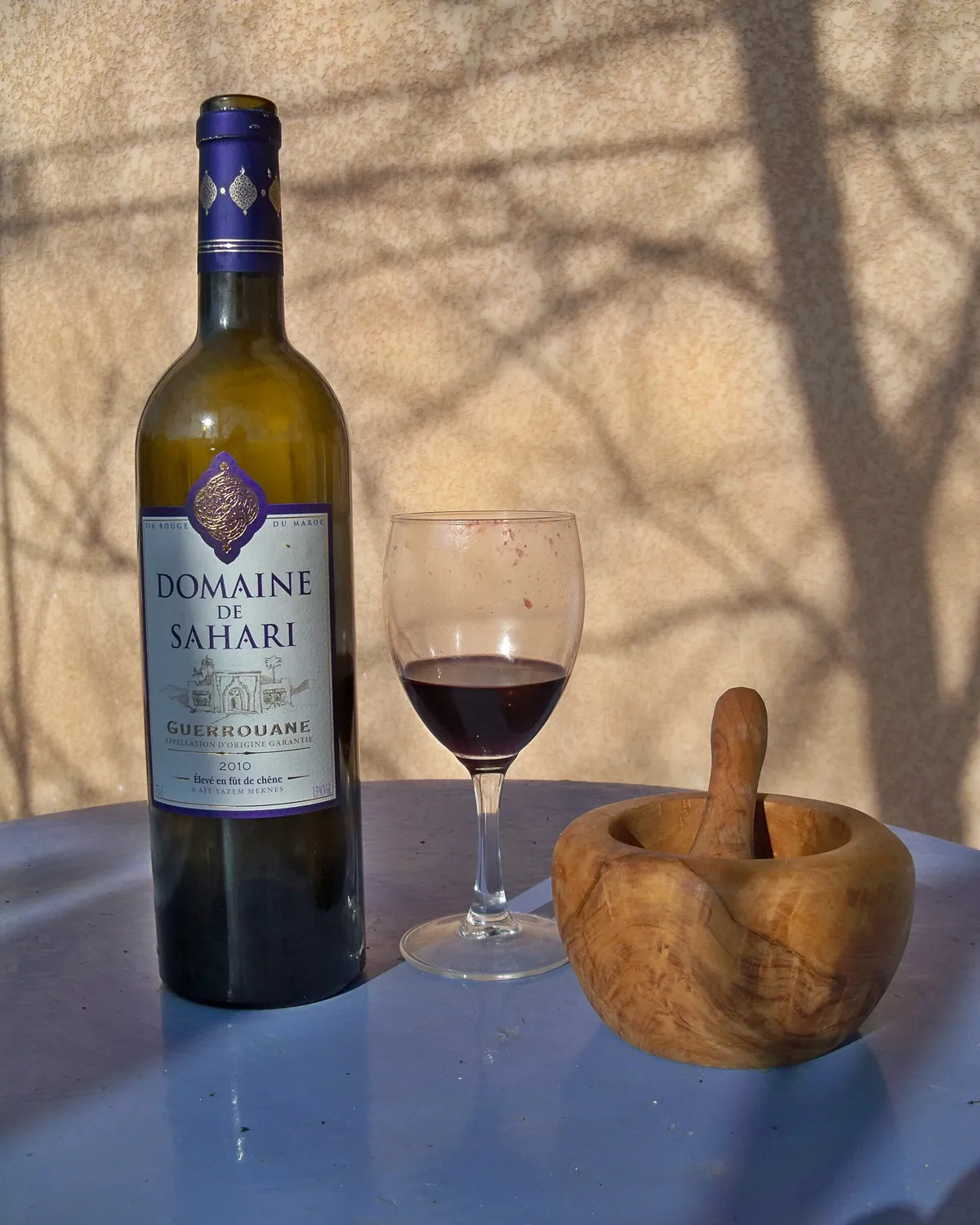
A Moroccan red from the Guerrouane appellation, near Meknès. Photo: Marianne Casamance, CC BY-SA 3.0, via Wikimedia Commons.
The French wording is blunter than any summary. “Il est interdit à tout exploitant d’un établissement soumis à licence de vendre ou d’offrir gratuitement des boissons alcooliques ou alcoolisées à des marocains musulmans,” as TelQuel quoted it on 17 June 2015. Read it twice and notice who it addresses: the person holding the licence.
That is why a bar may ask where you are from: the licence, not the drink, is what the law watches. It is also part of why a country with 42,216 hectares of vines can feel dry from the street. Selling is legal, but it happens behind licensed doors.
What about age? You will often see 18. The order says something else. Article 30 forbids serving “mineurs de 16 ans”, and article 29 keeps unaccompanied under-16s out of bars. The business site EcoActu pointed this out on 29 December 2019, noting that Morocco’s age of majority is 18. So the 1967 text sets the floor at 16. I found no law that sets it at 18.
Where can you buy alcohol in Morocco?
Rule 2: only from a licence holder. Under the same 1967 order, anyone selling bottles needs prior authorisation from the local authority, granted after the police or gendarmerie are consulted (art. 1). Selling without it carries one to six months and a fine of 500 to 2,500 dirhams. In practice that means hotel bars, licensed restaurants, bars in the new towns, and licensed shops.
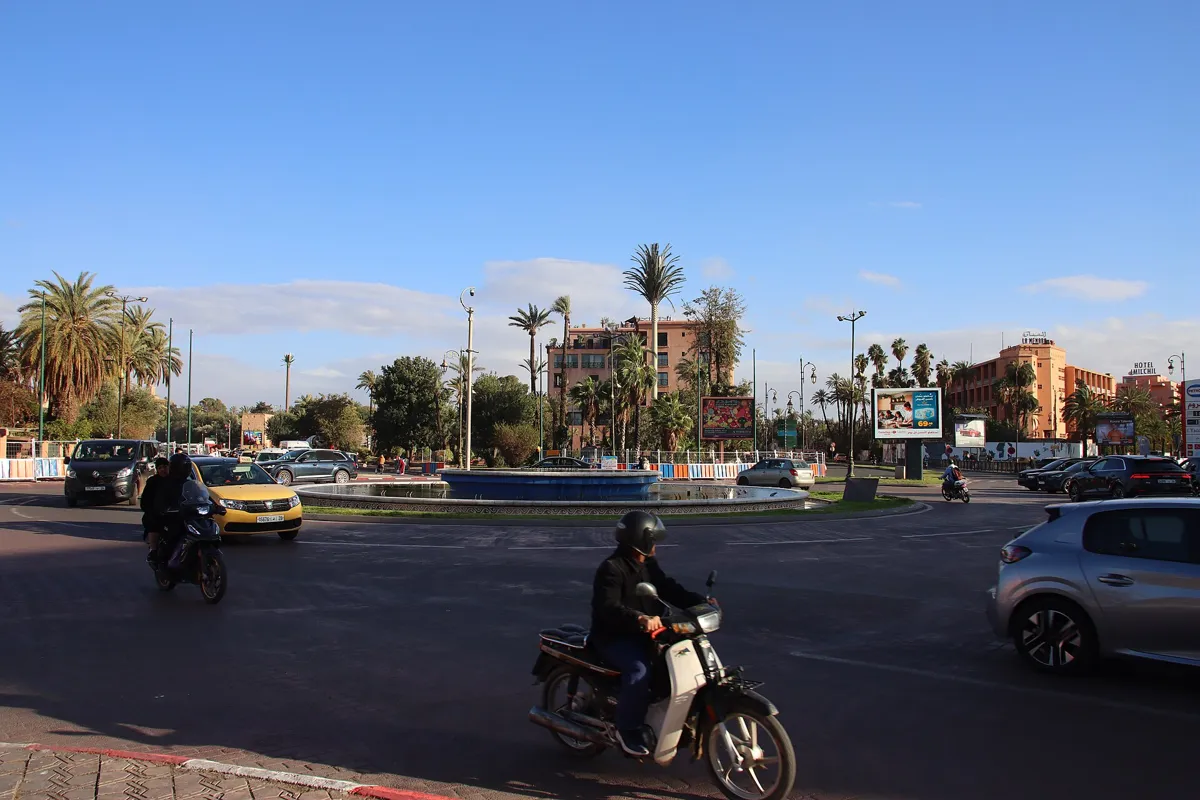
Guéliz, the new town of Marrakech. Photo: Draceane, CC BY-SA 4.0, via Wikimedia Commons.
The order creates two kinds of drinking place, and the difference shows on the menu. A full licence covers a café, bar, restaurant, hotel or cabaret where alcohol is served and drunk on the spot. A second, lighter category covers places that serve food and may pour only wine, beer and cider alongside it, nothing stronger (art. 3). Ever been handed a wine list in a restaurant that has no gin? That is often the second licence.
Geography follows from two more articles. Local authorities may ban bottle sales near religious sites, cemeteries, schools, hospitals and barracks (art. 2). Drinking places can’t open near those either, nor in buildings owned by the religious endowments, nor near any place where decency must be observed (art. 4). A medina is dense with mosques, shrines and endowment property. That is a large part of why the old cities have a handful of licensed tables and the new towns have the rest.
Outside bars and restaurants, bottles come from licensed shops. Canada’s travel advice puts it in one line: alcohol “can also be purchased from licensed stores for private consumption” (Government of Canada, updated 24 September 2026). I’m not naming shops or supermarket chains, because I couldn’t confirm from a current source which ones sell today.
And your riad? Some hold a licence and have a wine list. Many don’t. Whether you may open your own bottle on the terrace is the owner’s decision, so ask before you book, not at check-in. What a medina riad costs is in the Marrakech riad prices round.
Can you drink in public in Morocco?
Rule 3: no. “Drinking alcohol in the street and anywhere other than a licensed restaurant or bar is illegal and can lead to arrest,” says the UK’s travel advice (FCDO, updated 19 August 2026). Canada says the same: consumption “outside of licensed bars, hotels and restaurants is prohibited”, and offenders “may be punished by detention or other penalties”.
Behind both sits a second 1967 text, the royal decree of 14 November 1967 on public drunkenness (Ministry of Justice, in Arabic). Anyone found visibly drunk in a street, a café, a cabaret or any other public place faces one to six months in prison, a fine of 150 to 500 dirhams, or both (art. 1). Both can be doubled if the person disturbs the peace. On a repeat offence, prison is mandatory (art. 2).
Note the list: cafés and cabarets are on it. The offence is being visibly drunk where the public can see you, and a licensed bar is still a public place. A quiet drink in a bar is lawful. Being carried out of one is not.
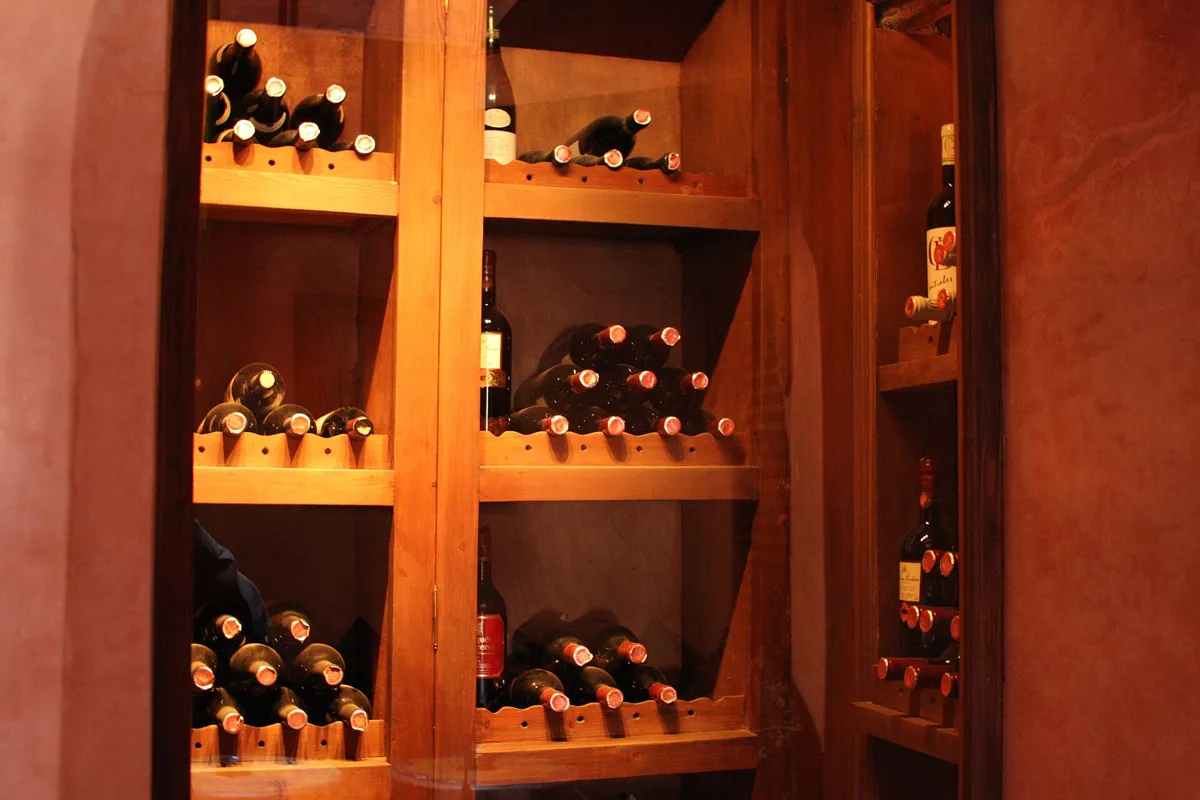
The wine wall of a Marrakech restaurant. Inside is where the law wants the glass. Photo: Luca, CC BY 2.0, via Wikimedia Commons.
On the ground, a beach, a public garden or the roof of an unlicensed café all count as “anywhere other than a licensed restaurant or bar”. Canada’s advice adds the other half: a bottle bought from a licensed shop is for private consumption. So carry it home in a bag, and open it in a private room, if your host allows it.
One more line of the UK advice matters more than any fine: “There have been deaths and cases of serious illness caused by alcoholic drinks containing methanol in Morocco.” Buy sealed, labelled bottles from licensed sellers. Anything decanted, home-distilled or sold from under a counter is the risk that warning describes. Where it sits among Morocco’s real risks is in the honest assessment of whether Morocco is safe.
Can you drink alcohol during Ramadan in Morocco?
Rule 4: plan on not being able to. In 2015 the wali, or regional governor, of Greater Casablanca ordered bottle shops, bars and nightclubs to close from 27 Chaâbane to 3 Chaoual. That ran from a few days before Ramadan until just after it ended (TelQuel, 17 June 2015). That is one documented order for one region, not a national rule, but it is the safest assumption to plan around.
I can’t give you a national text, because I didn’t find one. Closures of this kind are local administrative decisions, which is exactly the power the 1967 order gives local authorities over licences and bottle sales. They can differ by city and by year.
What I can say is narrower. The Casablanca order named bottle shops, bars and nightclubs. It didn’t mention hotels either way, and I found no reliable source on what hotel bars do in the month. If a drink matters to your trip, ask the hotel or restaurant what it will serve during Ramadan, and get the answer in writing.
You will read claims about Ramadan exceptions for foreigners. I found no source I trust for any of them, so none of them is advice here.
Ramadan 2027 runs from about 8 February to 9 March, subject to the moon sighting. The dates are in the best time to visit Morocco, and what else they change about a trip is in the guide to Ramadan in Morocco.
What is the drink-driving limit in Morocco?
Rule 5: 0.2 grams of alcohol per litre of blood, or 0.10 milligrams per litre of breath (Aujourd’hui le Maroc, October 2014, reporting the national limits as roadside breath tests began). Driving over it carries six months to a year in prison, a fine of 5,000 to 10,000 dirhams, or both, under article 183 of the Highway Code (Loi 52-05, published by NARSA).
The court also suspends the licence for six months to a year. The article was amended in 2016 (Loi 116-14). The change matters to anyone tempted to argue at the roadside: refusing the breath test or the blood test carries the same penalties as failing it.
How low is 0.2? England, Wales and Northern Ireland allow 80 milligrams per 100 millilitres of blood, which is 0.8 grams per litre. Scotland allows 50 (GOV.UK). Morocco’s line is a quarter of England’s. I won’t tell you how many drinks that is, because no honest number exists: it depends on your weight, your dinner and the hour.
The practical reading is zero. If you’ve hired a car, the drink waits until the car is parked for the night. The rest of what a rental contract and a police checkpoint ask of you is in the guide to renting a car in Morocco.
How much alcohol can you bring into Morocco?
Rule 6: one litre of wine and one litre of spirits. Every adult visitor may bring them in free of duty and formalities, plus 200 grams of tobacco. Morocco’s customs administration words it as “une bouteille de vin d’un litre” and “une bouteille de spiritueux d’un litre ou un autre alcool de même contenance” (Administration des Douanes, foreign visitors section, read 29 September 2026).
Two details on that page are worth knowing. The allowance is per adult, so a couple may carry two litres of each. And going over it is not a crime. You declare the extra and pay the duty, and customs gives you a receipt.
There is a third option. You may leave the surplus in deposit with customs at your point of entry, with no storage charge, and collect it when you leave. The page sets the limit at 60 days. Carrying a gift bottle for someone outside Morocco? That rule fits your case.
Bottles you bring in are for private consumption, like bottles bought from a licensed shop. If your host is happy for you to open one in your room, the allowance is the simplest way to arrive with it.
How much does a beer cost in Morocco?
About 100 dirhams in a Marrakech hotel bar, 50 to 80 on the two medina menus I could read, and about 22 for a half-litre bottle in a shop. The first figure is the median of nine hotel-bar menus read on 29 and 30 September 2026. The last is crowd-sourced (Numbeo, updated 2 August 2026), because no Moroccan retailer I found publishes an alcohol price online.
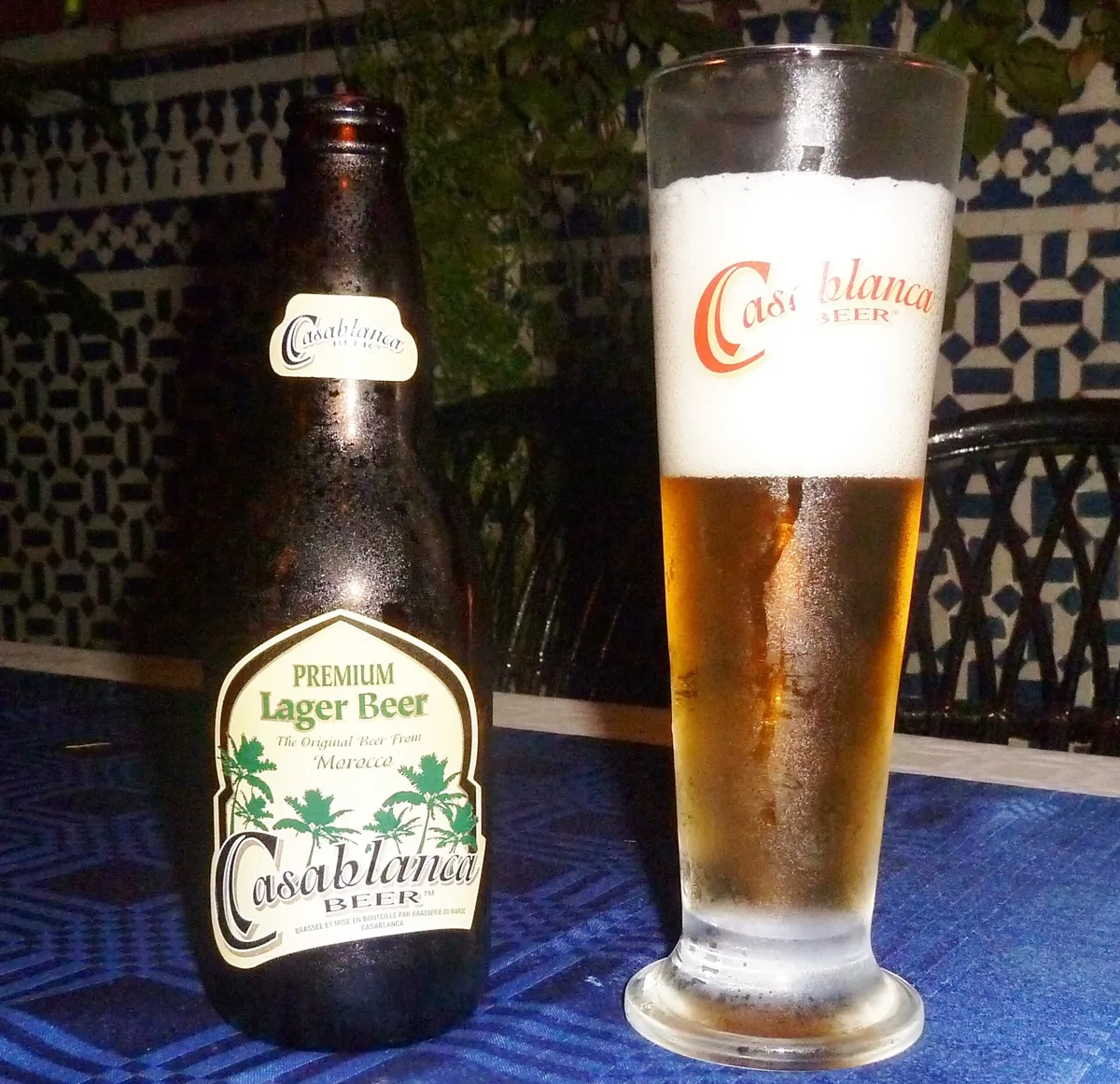
Casablanca, one of the two Moroccan lagers on almost every menu. Photo: Ekem, CC BY-SA 3.0, via Wikimedia Commons.
The nine hotel bars sit in five hotels: Four Seasons, La Mamounia, Es Saadi, Fairmont Royal Palm and Sofitel. A Casablanca, the local lager, runs from 75 to 110 dirhams across them. That is a narrow band. The gap between the cheapest and the dearest hotel bar is smaller than the gap between the median hotel and the cheapest medina rooftop.
Outside hotels I found only four venues that publish drink prices, too few to average. Here they are by name.
| Venue | Where | Beer | Wine | Cocktails |
|---|---|---|---|---|
| Kabana | medina rooftop, near the Koutoubia | Flag 25 cl 50, 50 cl 70; Casablanca 25 cl 60, 50 cl 80 | Moroccan glass 100; reds from 450 | 160 |
| Le Salama | medina, off Jemaa el-Fnaa | Flag 60; Casablanca 75 | Moroccan bottles from 495 | 185 |
| +61 | Guéliz | Casablanca 65 | not on the page I read | 140 |
| Le Comptoir Darna | Hivernage | San Miguel 110; no Moroccan beer listed | no glass listed | from 180 |
All prices in dirhams, as printed. The +61 menu carries no clear date, so treat it as the least certain row.
Put the steps together and a beer costs about three to four and a half times as much at the bar as on the shelf. A half-litre is a crowd-sourced 22 in a shop and 80 on Kabana’s rooftop. In a hotel it is about 100, usually for a bottle of a third of a litre or less where the size is printed.
Here is the finding I didn’t expect. On the same menu, a beer costs not much more than a soft drink. At Le Salama a Flag is 60 dirhams and a Coca-Cola is 60. In the hotels, a Casablanca at a median of 100 sits beside a cola at 60 to 80. Most of what you pay for is the table, not the alcohol. What the same terraces charge for food and water is in the food prices in Morocco round.
Wine costs more than beer everywhere I looked. A glass of Moroccan wine is 130 dirhams at the median of seven hotel menus, and 100 at Kabana. The cheapest Moroccan bottle was 450 to 520 on five menus, four in Marrakech and one in Rabat (Kabana’s 450 is its cheapest red). La Mamounia’s list starts at 950. Hotel cocktails run from 110 to 230, with a median of 190.
Two lines at the foot of a menu can move the bill. Fairmont’s bar menu states that a 5% service fee applies, and none of the other menus I read prints one. Le Salama prints a happy hour, from 15h to 18h and again from 22h30, with two small Flags for 80 dirhams.
How much of the price is excise duty? Less than you’d guess in a bar, and more than you’d guess in a shop. Since 1 January 2024 the excise duty has been 1,550 dirhams a hectolitre on beer and 1,150 on wine. Spirits pay 25,500 per hectolitre of pure alcohol (Administration des Douanes, circular 6522/210, 29 December 2023). The customs circulars for the 2025 and 2026 finance laws list no change to those rates.
That works out to 7.75 dirhams on a half-litre of beer and 8.63 on a bottle of wine. On the crowd-sourced 22-dirham shop beer, excise is about a third of the price. On Kabana’s 50-dirham Flag it is 8%. On a 450-dirham restaurant bottle of wine it is under 2%. The state takes its share at the brewery gate, and the rest of a bar price is the bar’s.
What I couldn’t measure: a shop price I read myself, any bar outside Marrakech except one Rabat hotel (where a Casablanca is 90), and what people pay after a happy hour or a tip.
Frequently Asked Questions
What is the legal drinking age in Morocco?
The 1967 order that regulates alcohol forbids licensed sellers to serve anyone under 16 (art. 30), on pain of one to two months in prison, a 24 to 360 dirham fine, or both, and keeps unaccompanied under-16s out of drinking places (art. 29). Morocco’s age of majority is 18. I found no law that sets a drinking age of 18.
Can I drink alcohol in my riad in Morocco?
Only if the riad holds a licence, or the owner agrees to you opening your own bottle in your room. Serving alcohol needs a licence under the 1967 order (art. 3), and serving a Moroccan Muslim carries a fine of 300 to 1,500 dirhams (art. 28), so many riads simply don’t serve. Ask before you book.
Do Moroccans drink alcohol?
Some do. The World Health Organization estimates total consumption at 0.45 litres of pure alcohol per person aged 15 and over in 2023 (WHO Global Health Observatory). Yet more than 98% of the wine Morocco makes is drunk inside the country, according to figures Hespress attributes to the International Organisation of Vine and Wine.
How much is a glass of wine in Morocco?
On seven Marrakech hotel-bar menus I read in September 2026, a glass of Moroccan wine ran from 120 to 190 dirhams, with a median of 130. The one medina rooftop that prints a glass price charges 100. The cheapest Moroccan bottle was 450 to 520 dirhams on five menus, one of them in Rabat, and 950 at La Mamounia.
What happens if I bring more than one litre of spirits into Morocco?
You declare it and pay duty, or you leave it with customs. Morocco’s customs administration allows each adult one litre of wine and one litre of spirits free of duty. Anything above that can be held in deposit at your point of entry, free of storage charges, for up to 60 days.
Where to start
Three things. Drink where there’s a licence and nowhere else: a hotel bar, a licensed restaurant, a new-town bar. Take nothing into the street, and nothing to the wheel of a car. And if you’re travelling in Ramadan, ask your hotel what it serves before you arrive.
On price, a beer was about 100 dirhams at the median of nine Marrakech hotel-bar menus, and 50 to 80 on the two medina menus I read. The crowd-sourced shop price is a fraction of that, when a shop is open.
For the rest of what keeps a trip out of trouble, start with the honest assessment of whether Morocco is safe.