Last verified: September 5, 2026. The law, the two surveys and the mosque’s visit conditions on this page are quoted from their published texts on the date above, and the garment prices were read from a Moroccan retailer’s labelled shelf the same day. I re-read the Hassan II Mosque conditions and the shelf every 60 days and move the date each time.
The only dress code I’ve ever been shown in writing in Morocco came with a 140-dirham mosque ticket. The fine that circulates online, up to 2,000 dirhams for “indecent” clothing in Marrakech, was denied by the city’s own authorities within days. Between those two facts sits everything you actually need to know about what to wear in Morocco.
Disclosure: Some links in this guide may earn us a commission, at no extra cost to you. It never changes what we recommend.
Every page on this question says “cover your shoulders and knees” in the voice of a law. Not one of them says whose law. So a reader can’t tell custom from statute, or a tour operator’s preference from a rule with a fine attached, and the difference matters when you’re standing in a riad on the first morning deciding about shorts.
I live in Rabat and I wear the answer daily. Below is what the penal code says, what Moroccans say when a pollster asks, the rule for women and for men, seven cities one by one, the places with a written code, and what the modest layer costs if you’d rather buy it here than pack it.
Key Takeaways
- Morocco has no dress law for visitors. Article 483 of the penal code punishes voluntary nudity and obscene acts, with a fine of 200 to 500 dirhams. The 2015 Inezgane skirt case ended in acquittal, and Marrakech’s authorities denied the 2024 “2,000-dirham fine” story
- The rule is custom, and it’s the same for everyone: loose, shoulders and chest covered, hem at or below the knee, in medinas, small towns and the countryside. Hair is your own business; even the one written code doesn’t mention it, though a scarf in the bag covers you if a guide at a religious site asks
- The only written dress code you’ll meet is the Hassan II Mosque’s: shoulders, torso and below the knee covered, shorts and sleeveless “absolutely forbidden”, for men and women alike. 140 dirhams for a foreign adult
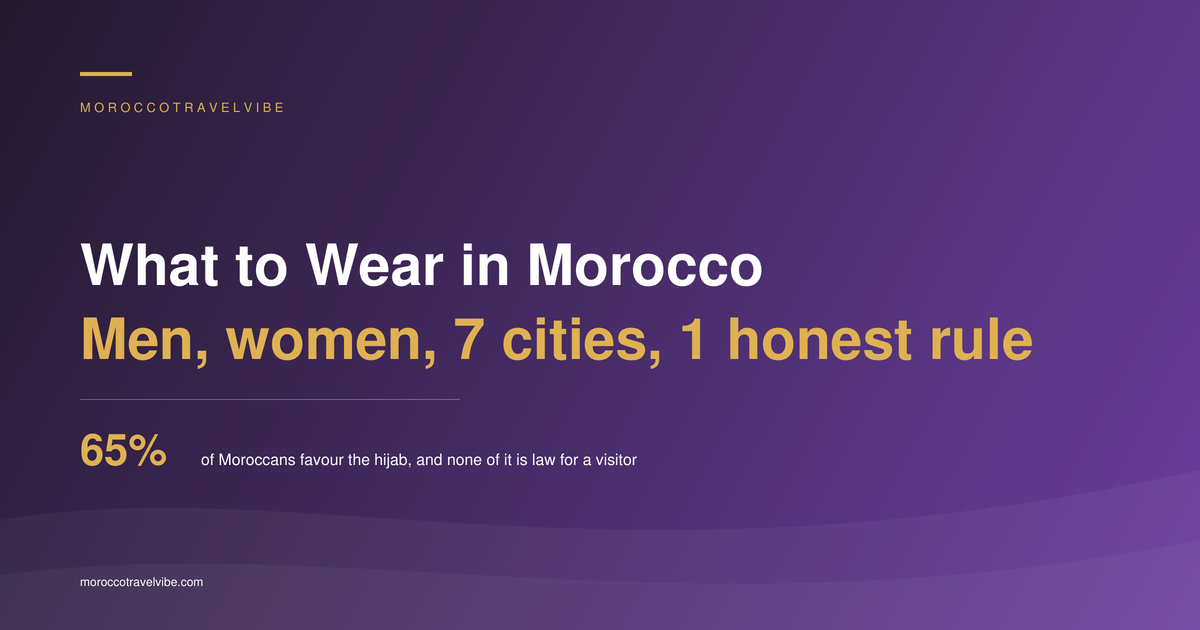
- Moroccans hold both views at once. 65% favour an obligation to wear the hijab (Sunergia, 2022) and 50% call a woman’s clothing style a personal freedom (Menassat, 2021). Dress for the first number; nobody polices you on the second
- City by city, the coverage rule barely moves; the climate does. Marrakech swings 13 degrees between an April lunch and the small hours, Essaouira swings 5
- Buying the layer here is cheap and labelled. A women’s djellaba at the median cost 299 dirhams on a Moroccan retailer’s shelf, a long scarf about 104, a sun hat 99, read 5 September 2026
Table of Contents
Is there a dress code in Morocco, legally?
No. No statute regulates what a visitor wears. Article 483 of the penal code punishes “outrage public à la pudeur”, and it defines the offence as voluntary nudity or obscene gestures and acts, with a sentence of one month to two years and a fine of 200 to 500 dirhams (Code pénal, version consolidée 2018, Article 483). Clothing isn’t in the text. Neither is a hemline, a sleeve or a headscarf.
The one famous prosecution of two women for what they wore tested exactly that text. In June 2015, two hairdressers were surrounded by traders in the Inezgane market near Agadir, accused of dressing indecently, and charged under Article 483. On 13 July 2015 the Inezgane Court of First Instance acquitted them (Morocco World News, 13 July 2015). The petition that grew around the case was called “wearing a dress is not a crime”, and the court agreed.
Then there’s the fine. In October 2024 a story spread that Marrakech had started fining women up to 2,000 dirhams for “indecent” clothing. The city’s local authorities told Hespress: “These claims are unfounded, and the news is false. Local authorities have no authority to enact such regulations” (Hespress English, 10 October 2024). Three of the pages I read while researching this still repeat the fine as fact.
What the British government actually advises is softer than most blogs. Its Morocco page says: “Consider wearing loose-fitting clothing which cover the arms, legs and chest,” and separately that “women may receive unwanted attention in Morocco, especially when travelling alone” (GOV.UK, Morocco travel advice). It adds a line about following local dress codes during Ramadan, which I cover in the guide to Ramadan in Morocco. The word is “consider”. The rest of this page is about how strongly the custom is held, and where.
What do Moroccans actually think about how women dress?
Two thirds favour an obligation to wear the hijab, and half call a woman’s dress her own choice, in the same population. When Sunergia polled 1,061 Moroccans by telephone between 27 July and 12 September 2022, with a margin of 3.1 points, and asked whether they were for or against an obligation for women to wear the hijab, 65% were for, 14% against and 21% indifferent (Groupe Sunergia, 27 September 2022). Among women the figure for was 67%.
A year earlier, Menassat’s study of individual freedoms put 103 questions to 1,311 people and found the other half of the picture. 61.2% approved of women wearing the veil (65.3% of women, 57.1% of men), and in the same sample 50% considered a woman’s clothing style a personal freedom. Only 3.8% opposed it outright, and 38% of those who approved said it prevents harassment and gossip (Menassat, Les libertés individuelles au Maroc, November 2021).
Those two surveys asked different questions, so don’t add them up. One measured support for an obligation, the other measured approval and freedom. What they show together is a society where covering is the majority preference and dress is, at the same time, widely regarded as the woman’s own decision.
That is exactly what a Rabat tram looks like at eight in the morning. Hijab and no hijab share the same pole. Nobody reacts to either. The practical translation for a visitor is simple: dress for the 65%, and understand that the 50% is why nobody will say a word to you if you don’t.
What to wear in Morocco as a woman?
Loose, shoulders and chest covered, hem at or below the knee, and your hair is your own business. That’s the whole rule, and it’s custom, not law. Even the one written dress code in the country, the Hassan II Mosque’s, says nothing about hair. The British advice quoted above uses one word that most blogs drop: “loose-fitting” (GOV.UK). A tight long-sleeved top draws more attention in a medina than a loose short-sleeved one, and a fitted maxi dress more than wide trousers.
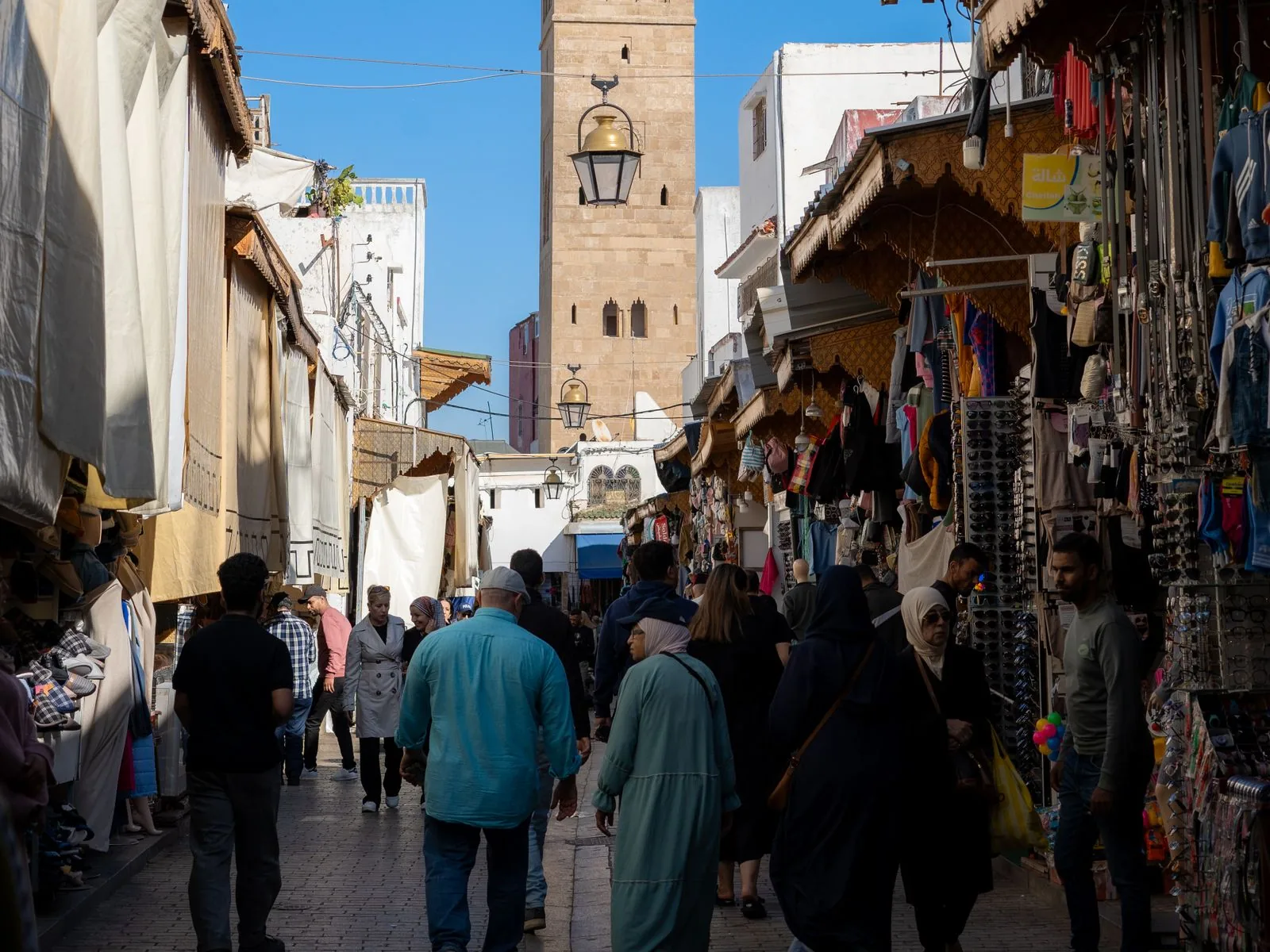
The fabric does more work than the cut. The hottest day of an average July in Marrakech reaches 44.8 degrees, and the average daily high in July and August sits above 37 (NOAA normals, 1991 to 2020). Linen and cotton in light colours are the difference between a good day and a bad one, and long sleeves in linen are cooler than bare arms in the sun. Closed or strapped shoes handle medina cobbles, mule traffic and whatever the mule left.
Carry a scarf. Not because anyone requires it, but because it’s the most useful object in the bag: shade at noon, a mosque cover if you visit one, dust in the south, wind on the coast. Swimwear is for pools and beaches only, which is what the Morocco travel guide’s short version has always said. Wearing it to the café across the road from the beach is the thing that draws comment.
One sentence on attention, because it’s the question underneath every other one. Covering changes the volume of the attention, not its existence. In the HCP’s 2019 national survey, 12.6% of Moroccan women reported violence in a public space in the previous year, and sexual harassment was the main form of it. Those numbers, the strategies that actually work and the honest verdict live in solo female travel in Morocco, which is the post that covers them.
What should men wear in Morocco?
The same rule, applied more loosely by custom and identically by the one written code. The Hassan II Mosque foundation’s visit conditions say “shorts et sans manches sont absolument interdits”, shorts and sleeveless absolutely forbidden, and they say it to everyone (Fondation de la Mosquée Hassan II). Outside a mosque, men get the softer version: long trousers in medinas, small towns, the countryside and anywhere with a sign; shorts in Gueliz, on the coast and at the pool.
Look at what Moroccan men actually wear in August, in Rabat or Fes. Long trousers, short sleeves, sandals, and on a Friday a djellaba, the hooded full-length robe, over the lot. Nobody is in shorts in the medina unless he’s a tourist or a footballer, and the football shorts are the tell. On the Agadir seafront, in Taghazout, along the Essaouira ramparts and in the Marrakech ville nouvelle, shorts stop meaning anything at all.
By custom, vest tops are for the beach and nowhere else. A linen shirt with the sleeves rolled does everything a vest does and passes at every door. If you want the garment Moroccan men genuinely wear in summer, it’s the gandoura, a light summer robe worn loose over a sleeveless layer, which the djellaba is the winter version of, and I’ve priced it below.
What to wear in Morocco, city by city
The coverage rule barely moves between cities. The temperature does, and so does how relaxed the street is. Marrakech in April runs a daily high of 25.7 degrees and a low of 12.4, a 13-degree swing between lunch and the small hours, while Essaouira swings 5 (NOAA normals, 1991 to 2020). That gap decides whether you’re carrying a cardigan or a jacket, and it’s the only climate question this page answers. Month-by-month planning has its own post.
| Where | The street norm | Men | The fact that changes your bag |
|---|---|---|---|
| Marrakech | Medina strict by custom; Gueliz and Hivernage noticeably relaxed | Long trousers in the medina; shorts fine in Gueliz | April 25.7 high, 12.4 low. July daily highs above 37. Carry layers |
| Fes | The most conservative of the big medinas, by every account and by mine | Long trousers even in heat | Nights fall hard in spring and autumn; carry the layer you’d carry in Marrakech |
| Chefchaouen | A small Rif town in the survey region where support for the hijab obligation runs highest (74%, north and east). Relaxed with visitors, conservative at home | Long trousers in town | About 600 metres up. Cool nights all year; no reliable normals to quote |
| Rabat and Casablanca | Offices, trams and the most relaxed street outside the coast | Shorts unremarkable in Agdal or on the Corniche | Rabat April 21.2 high, 10.9 low. Home of the one written code |
| Tangier | New-city seafront relaxed; the kasbah and medina are a medina | Shorts on the seafront, trousers in the kasbah | April 19.2 high, 11.2 low on the older 1961 to 1990 normals. Wind |
| Essaouira and the Agadir coast | The beach rule lives here | Shorts everywhere on the front | Essaouira April 19.5 high, 14.1 low; August 22.4 and 18.1. A permanent wind. Agadir April 23.2 and 14.1 |
| Merzouga and the south | Conservative villages, a tourist economy | Long trousers, and a scarf for the dust | The cold at night is the thing to plan for. What the camp actually provides against it is what the desert tour guide found |
Two things the table can’t say. Gueliz, the Corniche and the coastal fronts aren’t a different country; they’re places where visitors and Moroccans in city clothes outnumber everyone else, so the custom relaxes with the crowd. And Chefchaouen’s survey figure is a region, not the town. The north and east are where support for an obligation runs highest in Sunergia’s data, and the town’s own attitude to visitors is famously easy. Both are true.
What do you wear at mosques, mausoleums, hammams and the beach?
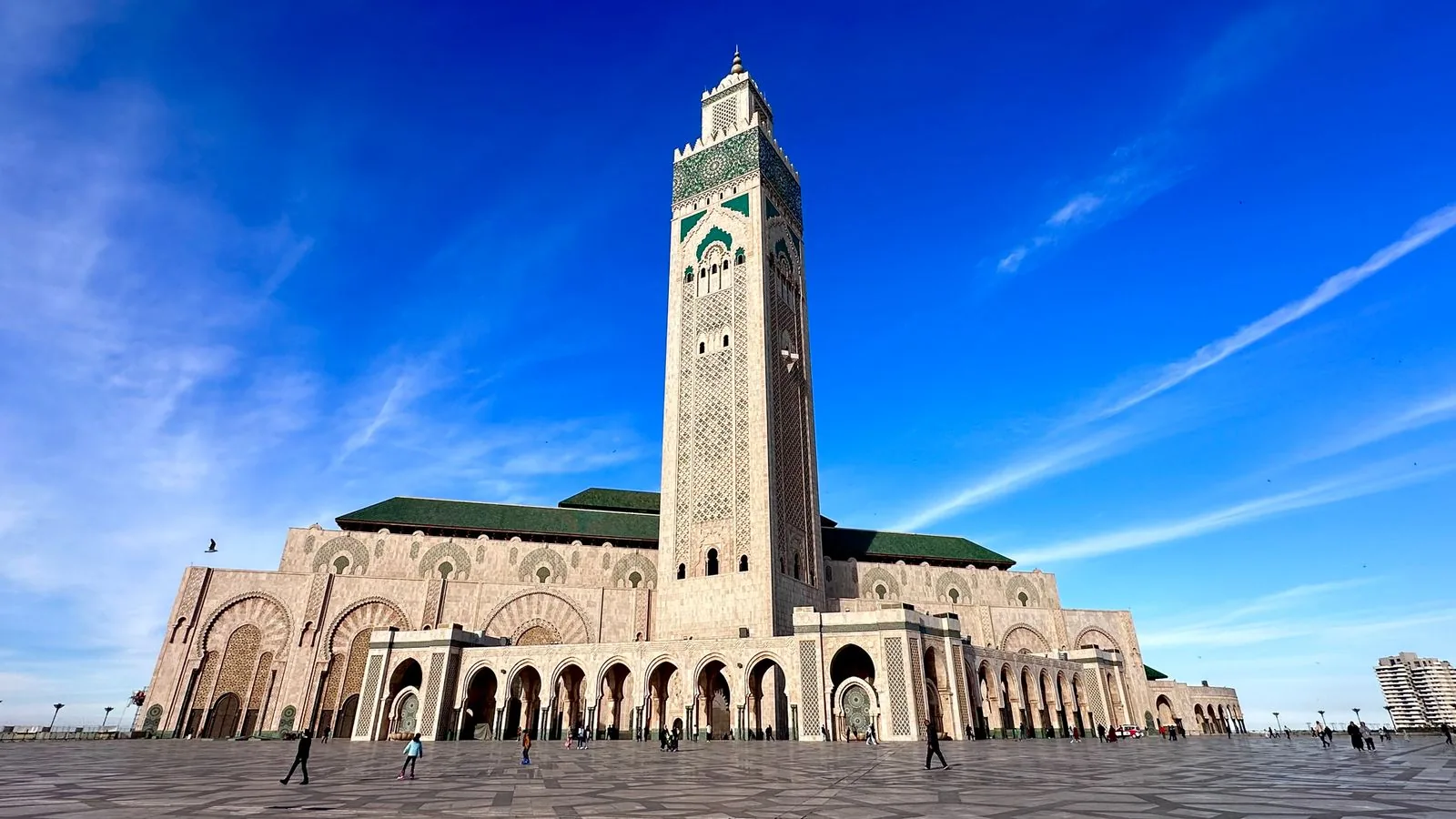
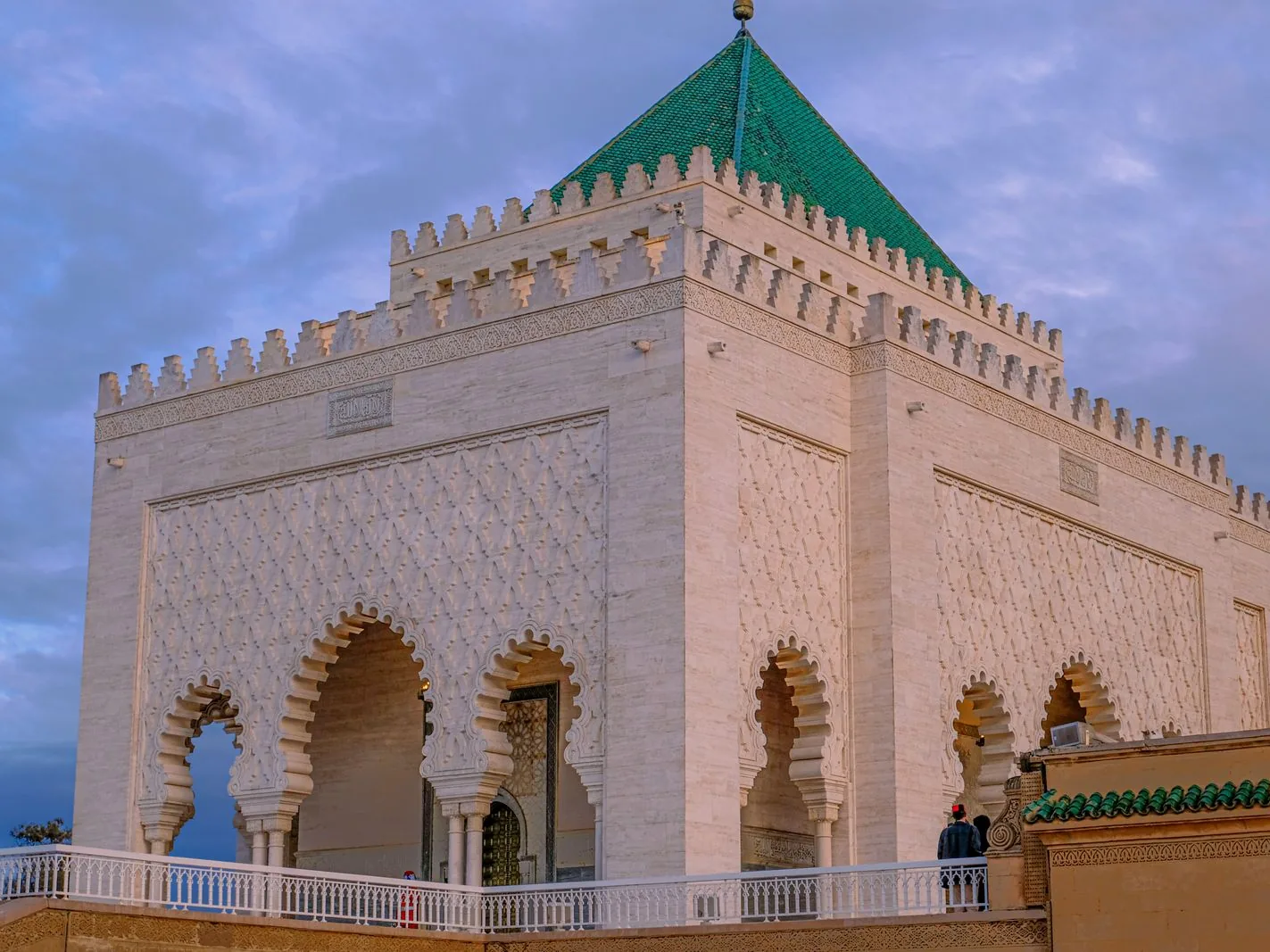
A written code at exactly one place, a custom at the rest, and a beach that’s a beach. The Fondation de la Mosquée Hassan II publishes its conditions: clothing that covers the shoulders and torso and reaches below the knee, shoes off and carried in a bag they hand you, no smoking or eating during the visit, no video cameras. A foreign adult pays 140 dirhams, a foreign student or Moroccan resident 70, a child from 4 to 12 pays 30 (Fondation de la Mosquée Hassan II, read 5 September 2026). Hair is not mentioned anywhere in the text.
| Place | The rule | Who says so | Hair | Shoes |
|---|---|---|---|---|
| Hassan II Mosque, Casablanca | Shoulders, torso and below the knee covered; no shorts, no sleeveless | Written, the foundation | Not required | Off, carried in a bag |
| Mausoleum of Mohammed V, Rabat | Shoulders and knees covered | Custom; what the guards ask for in my experience of the place | Not asked | On, it’s an open gallery |
| Bou Inania and Al Attarine, Fes; Ben Youssef, Marrakech | Shoulders and knees by custom; no written code | Custom | Not asked | Off where the ropes say so |
| Tin Mal, High Atlas | Closed | Ministries of Islamic Affairs and Culture, rebuilding after the 8 September 2023 earthquake | Not applicable | Not applicable |
| Public hammam | Underwear stays on; sexes separated by session or building | Reported practice, no official source | Not applicable | Plastic sandals |
Tin Mal deserves a sentence, because tour pages still sell it. The 12th-century mosque lost its minaret, prayer hall and outer walls in the Al Haouz earthquake, and the rebuild is being done with the original fragments under the two ministries, with no reopening date (Morocco World News, September 2024). Don’t plan around it.
The beach is the easy one. On the sand at Agadir, Taghazout and Essaouira, swimwear is unremarkable, and a hotel or riad pool is private. What draws a look is walking into a shop or a café in it. Carry the cover-up for the 200 metres between the towel and the town, and the whole question disappears.
Should you buy the modest layer in Morocco instead of packing it?
You can, cheaply, and from a shelf with a price on it. On 5 September 2026 I logged every priced listing on the first results page of Jumia Maroc, a Moroccan online retailer with a price on every listing, for seven garments, deduplicated them and dropped the children’s lines and multipacks. A women’s djellaba came out at a median of 299 dirhams, a men’s gandoura at about 359, a long scarf at about 104 and a sun hat at 99.
| Item | n | Labelled range, MAD | Median, MAD |
|---|---|---|---|
| Djellaba, women’s | 34 | 99 to 2,375 | 299 |
| Gandoura or light djellaba, men’s | 33 | 149 to 799 | about 359 |
| Hijab or long scarf, single | 26 | 29 to 199 | about 104 |
| Sun hat, wide brim | 34 | 34 to 282 | 99 |
| Linen-look trousers, women’s | 32 | 86 to 299 | 175 |
| Linen-look trousers, men’s | 23 | 107 to 899 | 271 |
| Linen shirt, men’s | 22 | 100 to 599 | about 217 |
Read the ranges before the medians. The 99-dirham women’s djellabas are Ramadan lines from one brand, and the 2,375-dirham top is an embroidered occasion piece. The cluster in the middle, sixteen listings between 254 and 300, is the everyday garment. On the men’s side, the traditional djellabas I logged separately came out at a median of 599 and are the formal Friday kind; the gandoura at about 359 is what men wear on a hot afternoon.
A scarf and a hat together clear about 200 dirhams, and they’re the two items that do the most work: the head is where the sun hits and the scarf is the mosque cover, the dust cover and the windbreak. These are labelled shelf prices, and the shelf is the floor for a labelled garment for the reasons set out in haggling in Morocco. What the same scarf costs in the souk after negotiation is unmeasured, and I’m not going to guess.
Why does a hat make the table at all? Because the World Health Organization’s UV index advice kicks in at index 3: seek shade at midday, put on a shirt, sunscreen and a hat; and from index 8 it says avoid being outside at midday altogether (WHO). The modest layer and the sun layer are the same layer, which is the point most packing lists miss. The full list of what I actually carry is in what to pack for Morocco.
Common questions
Do women have to cover their hair in Morocco?
No. No law requires it, and the only written dress code a visitor meets, the Hassan II Mosque foundation’s, covers shoulders, torso and knees and doesn’t mention hair. A scarf is worth carrying for sun, dust and wind, and it doubles as a cover if a guide at a religious site asks for one.
Can you wear shorts in Morocco?
Men: on the coast, in Marrakech’s Gueliz and at any pool, yes; in medinas, small towns and the countryside, long trousers by custom. Women: knee length or longer by custom anywhere outside a beach, and below the knee at the mosque. The Hassan II Mosque forbids shorts for everyone, in writing, and charges 140 dirhams to go in.
Is there a dress code law in Morocco?
No. Article 483 of the penal code punishes voluntary nudity and obscene acts with a fine of 200 to 500 dirhams and says nothing about clothing. The 2015 Inezgane skirt case ended in acquittal on 13 July 2015, and Marrakech’s authorities called the 2024 “2,000-dirham fine” story false.
What should tourists wear in Marrakech?
Loose, covered to the knee and shoulder in the medina; noticeably more relaxed in Gueliz and Hivernage. April swings 13 degrees between a daily high of 25.7 and a low of 12.4 on NOAA’s normals, so carry a layer for the evening, and in July expect daily highs above 37.
Can you wear a bikini in Morocco?
On the sand at Agadir, Taghazout and Essaouira, and at any hotel or riad pool, yes. Not for the walk through town, and nowhere inland outside a pool. Keep a cover-up in the beach bag for the shop and the café, and the question never comes up.
The short version
Loose and covered is a courtesy that nobody polices. The only written rule is at a mosque door, and it applies to men and women alike.
- There’s no law. Article 483 is about nudity and obscene acts, the skirt case was acquitted, and the fine was denied
- Dress for the 65% and expect the 50%. Most Moroccans favour covering; half call it your own business; neither will say a word
- The rule doesn’t change by city; the temperature does. Thirteen degrees in Marrakech between an April midday and dawn, five in Essaouira
- The one written code is precise. Shoulders, torso, below the knee, no shorts, no sleeveless, hair not required, 140 dirhams
- Buy the layer here if you’d rather. A djellaba under 300 at the median, a scarf and a hat for about 200 together
Everything else on staying safe, and the straight answer on whether you need to worry at all, is in is Morocco safe, and the rest of what I’ve checked sits in Safety and Scams.