Last verified: August 30, 2026. I read ONCF’s stop list, its published network timetables and CTM’s booking system myself on that date, and every count and journey time below comes from that round. Operator networks change when a line or a route opens, so I re-read all three every 60 days and move the date above each time.
Morocco’s railway is the second largest network in Africa, and it does not go to Chefchaouen, Essaouira, Merzouga, Ouarzazate or anywhere in the High Atlas. That gap is the whole problem with how to get around Morocco, and almost nobody writing about it says how big the gap actually is.
Disclosure: Some links in this guide may earn us a commission, at no extra cost to you. It never changes what we recommend.
So on 30 August 2026 I counted it. I pulled ONCF’s complete stop list out of its booking system, downloaded all fourteen of its published passenger timetables, read CTM’s full city list, and checked Royal Air Maroc’s domestic network. Then I took the 25 places a first or second trip to Morocco actually visits and asked, for each one, what can get you there.
The answer changed how I plan my own trips here. It is not “take the train”. It is not “rent a car” either, whatever the rental sites tell you.
Key Takeaways
- Rail reaches 8 of the 25 places travellers actually go. Scheduled coaches reach 20. Four are road-only and have no public transport at all
- The coach network, not the hire car, is what fills the gap. CTM’s booking system lists 119 cities and ONCF’s own system lists 154 stops, 30 of them Supratours coach stops rather than stations
- Marrakech to Merzouga is 12h30 by coach, once a day. Marrakech to Essaouira is 3h00, nine times a day. Frequency collapses as you go south, and that is the real constraint
- Morocco recorded 4,577 road deaths in 2025, up 25.5%, the worst year on record according to NARSA. That belongs in the decision about whether to drive, and it never appears on the pages selling you the car
- Use both operators’ planners. ONCF routes Fes to Chefchaouen the long way round via Tangier, in 6h32, because it will only sell you a journey on its own network
Table of Contents
What is the best way to get around Morocco?
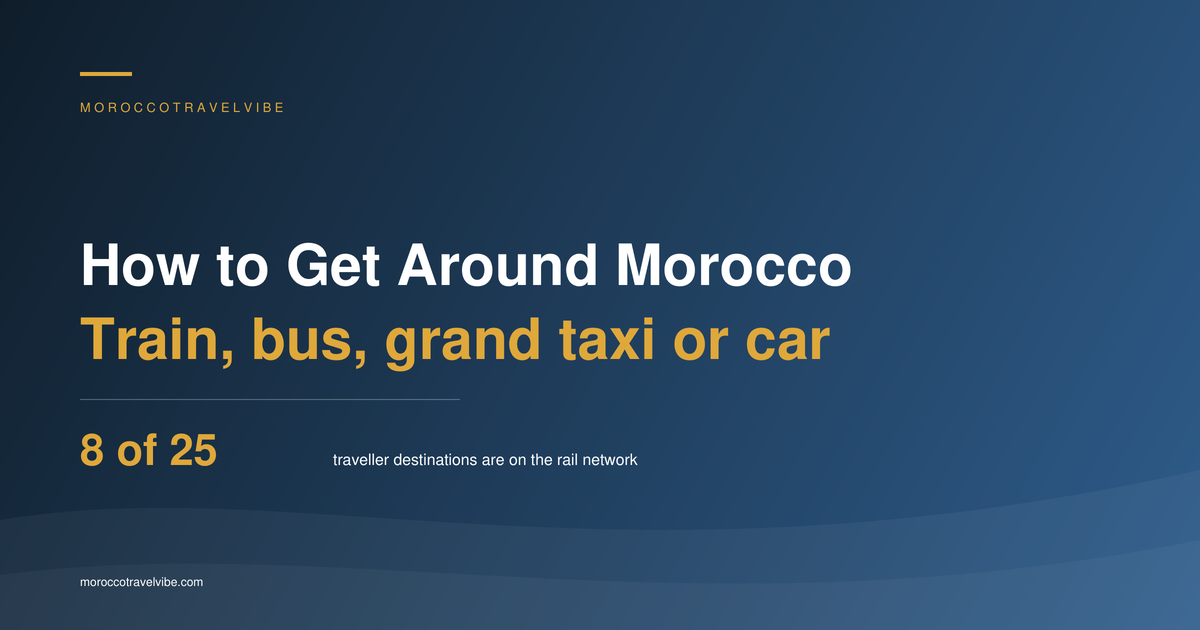
There is no single best mode, and the honest plan for a first trip is mixed: rail along the Tangier to Marrakech spine, scheduled coach for everything the rail misses, and a car or a driver only for the four road-only places. Of the 25 destinations I checked on 30 August 2026, rail reached 8 and scheduled coaches reached 20.
That is the shape of the country’s transport, and it explains why generic advice keeps failing people. “Take the train” works beautifully for Tangier, Rabat, Casablanca, Fes and Marrakech. It is useless for the Sahara, the Atlas and the coast south of Casablanca.
Here is the whole count. A place is marked as rail-served only if it appears on one of ONCF’s fourteen published passenger timetables, coach-served if it appears in the CTM or Supratours booking systems, and air-served if Royal Air Maroc lists it.
| Destination | Train | Scheduled coach | Flight |
|---|---|---|---|
| Casablanca | Yes | Yes | Yes |
| Rabat | Yes | Yes | Yes |
| Tangier | Yes | Yes | Yes |
| Fes | Yes | Yes | Yes |
| Marrakech | Yes | Yes | Yes |
| Meknes | Yes | Yes | No |
| Asilah | Yes | No | No |
| El Jadida | Yes | Yes | No |
| Agadir | No | Yes | Yes |
| Ouarzazate | No | Yes | Yes |
| Zagora | No | Yes | Yes |
| Tetouan | No | Yes | Yes |
| Laayoune | No | Yes | Yes |
| Dakhla | No | Yes | Yes |
| Chefchaouen | No | Yes | No |
| Essaouira | No | Yes | No |
| Merzouga | No | Yes | No |
| Tinghir and Todra | No | Yes | No |
| Boumalne and Dades | No | Yes | No |
| Ifrane | No | Yes | No |
| Sidi Ifni and Legzira | No | Yes | No |
| Aït Ben Haddou | No | No | No |
| Imlil and Toubkal | No | No | No |
| Taghazout | No | No | No |
| Volubilis and Moulay Idriss | No | No | No |
| Totals, out of 25 | 8 | 20 | 11 |
The 25 are the places that turn up as a named overnight or day-trip stop on a mainstream first or second visit. That selection is a judgement, and a different list would give a different headline number. Merzouga is reached by Supratours but not by CTM. Asilah is the one place on the list with a railway station and no scheduled coach at all. Read 30 August 2026.
The mixed plan is not a compromise. Each mode is genuinely good at the thing it does, and the trouble only starts when you try to make one of them do everything.
It helps to know why the country is shaped this way. Morocco took a record 19.8 million visitors in 2025, up 14% (Ministry of Tourism figures via ATTA, January 2026), and most of them land in four cities that the railway serves well. The famous places outside those cities were never on a rail plan, and the coach network grew to fill exactly that gap.
Where does the train actually go?
ONCF publishes exactly fourteen passenger axes, and between them they form a spine, not a web. Its booking system listed 154 stops when I read it on 30 August 2026, but 30 of those are Supratours coach stops rather than railway stations, and I only counted a place as rail-served if it appeared on one of the fourteen published timetables (ONCF Voyages, read 30 August 2026).
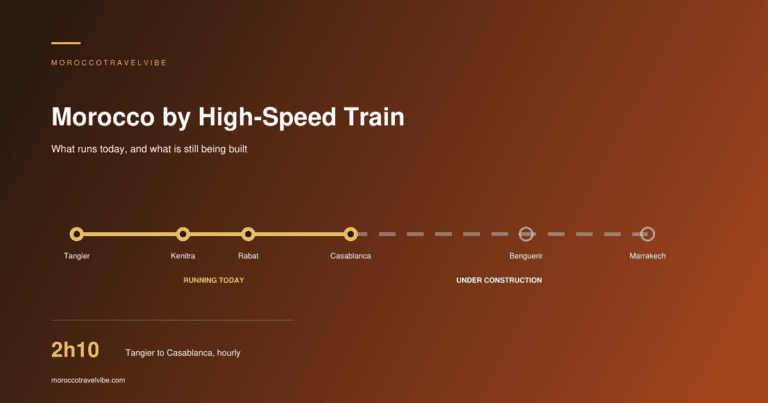
The spine runs Tangier down through Kenitra, Rabat and Casablanca to Marrakech, with an eastern arm through Meknes and Fes to Taza, Oujda and Nador. Branches reach El Jadida, Settat, Safi, Khouribga and Oued Zem. Al Boraq, the high-speed service, covers Casablanca to Tangier in 2h17 on the summer 2026 works timetable I read. What Al Boraq costs and when the Marrakech extension arrives is a separate question, and I have answered it in detail in what Al Boraq costs and when Marrakech gets it.
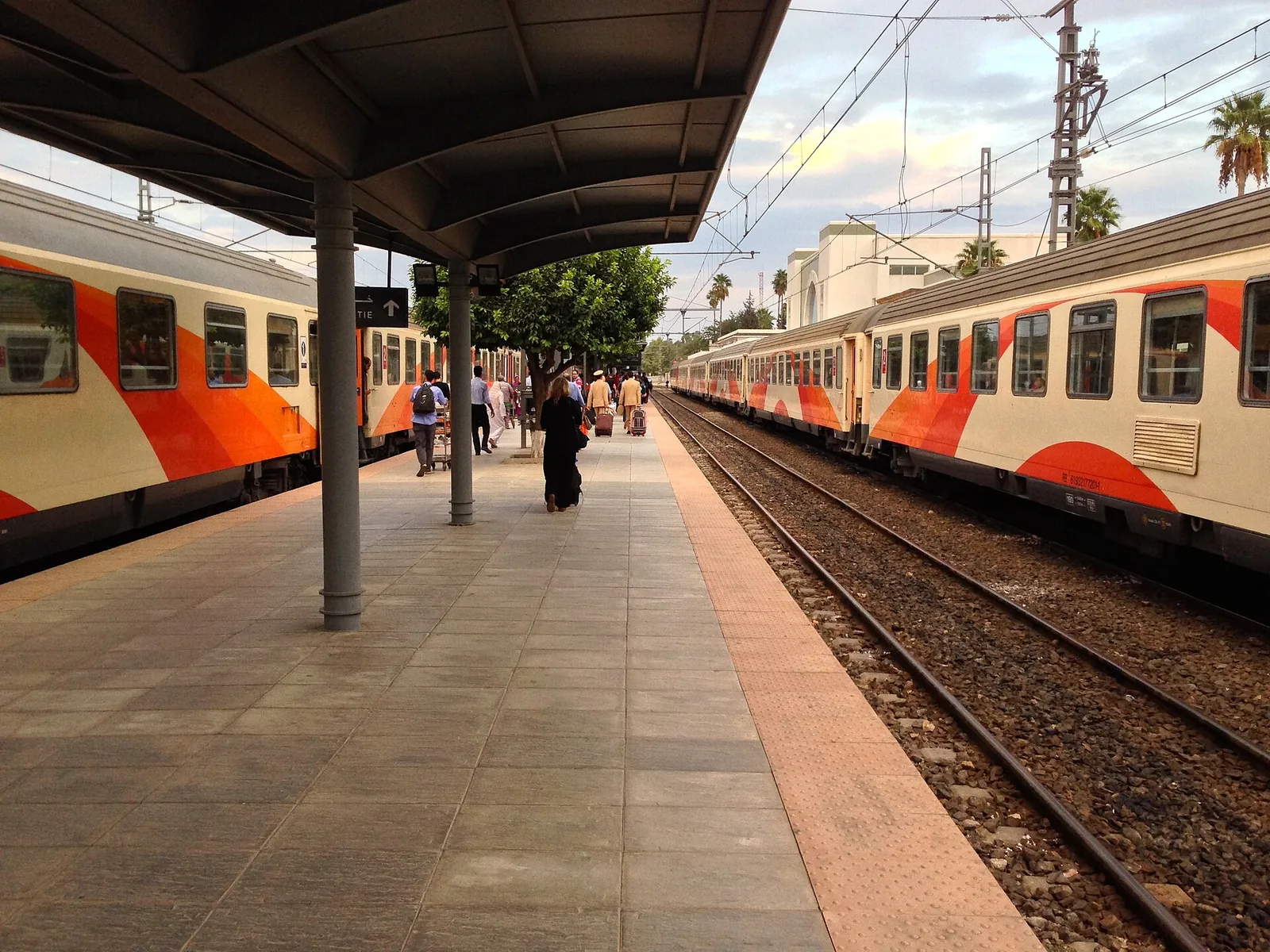
Fes station. Eight of the 25 places on my list have one of these. Photo: Andrew Nash, CC BY-SA 2.0, via Wikimedia Commons.
Within that spine the train is the obvious choice, and it is getting busier: ONCF expects 58.5 million passengers in 2026, about 4% up on the year before (Railway Gazette International, July 2026). A 430 km high-speed line to Marrakech is under construction for 2029 (Railway Gazette International, March 2026), which will change this picture, but not before your trip.
One practical note that catches people out. Casablanca’s intercity station is Casa Voyageurs, not Casa Port, except for the airport shuttle, which runs from Casa Port. Rabat’s is Rabat Agdal. Book the wrong one and you have added a taxi to your day. For what any of these journeys costs, I priced twelve routes at two booking distances in what the same seat costs two days out and three weeks out.
Why the coach network matters more than the train
Scheduled coaches reach 20 of the 25 destinations, against the railway’s 8, and they are the reason a car is optional rather than necessary. CTM’s booking system listed 119 cities when I read it on 30 August 2026, and ONCF’s own system listed 30 Supratours coach stops alongside its stations.
Those two networks are shaped differently, and the difference is worth knowing. Supratours is run by ONCF itself, so its coaches are timed against train arrivals and sold in the same booking flow: Casablanca to Agadir came back as eight departures a day, 6h45 to 7h46, as a train to Marrakech and a coach onward. CTM is independent, founded in 1919, and covers more towns in its own right, including places ONCF does not list at all, such as Ifrane and Sidi Ifni.
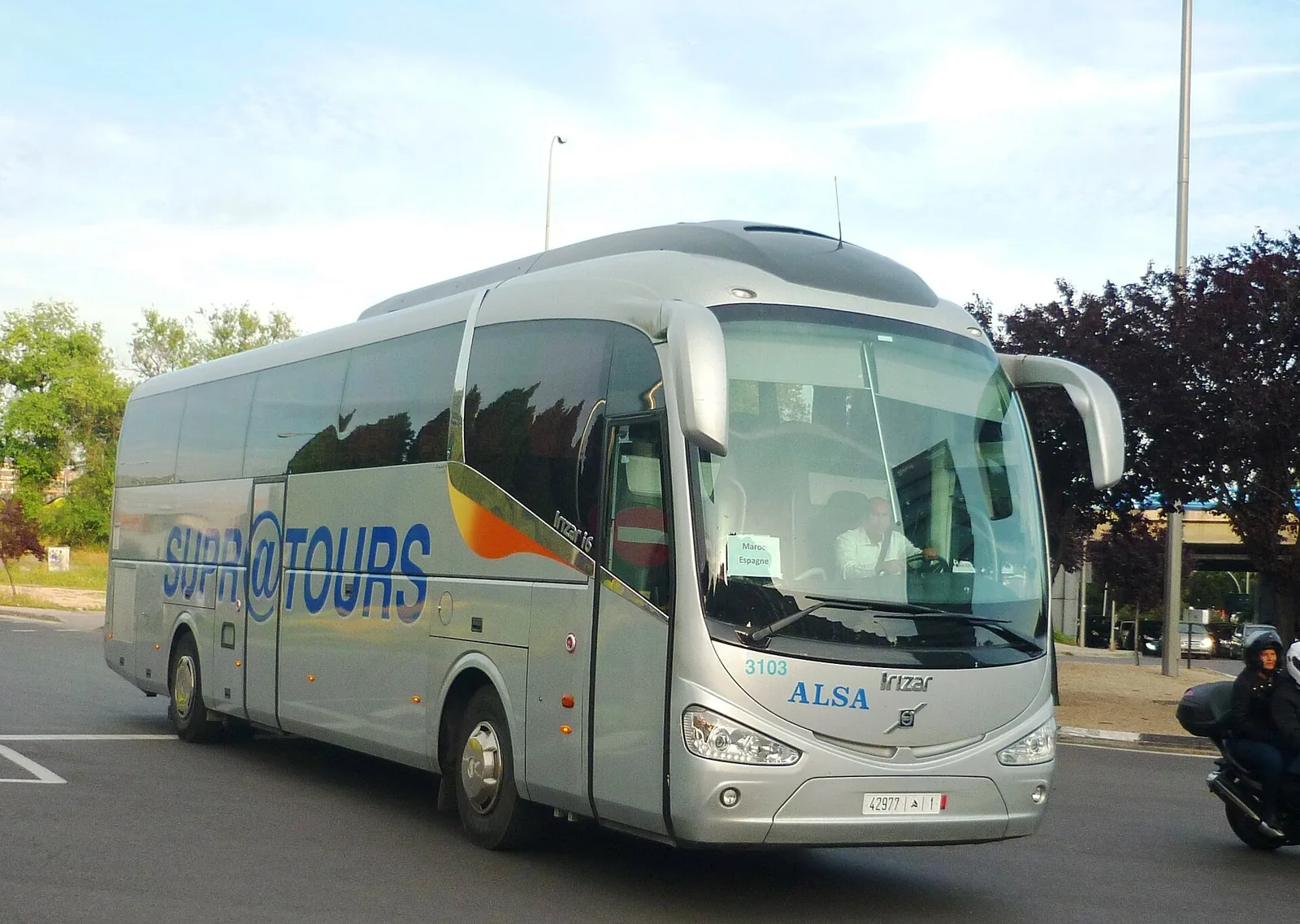
A Supratours coach. The rail operator runs its own road network precisely because the railway stops where it stops. Photo: Antonio Vera, CC BY-SA 2.0, via Wikimedia Commons.
Which of the two wins on any given route is a real question with a real answer, and it deserves its own post rather than a paragraph here.
What matters for planning is frequency, because that is what actually constrains a day. Marrakech to Essaouira ran nine times on the day I looked, in about three hours. Marrakech to Ouarzazate ran five times, in around four. Tangier to Chefchaouen ran twice. Marrakech to Merzouga ran once as a direct service, and took 12h30.
One departure a day is not a schedule you plan around casually. It is a schedule you build a day of your trip on.
There is a trap here that cost me an afternoon once. Each operator’s journey planner only sells its own network, so each one will route you the long way round rather than admit the short way exists. Ask ONCF for Fes to Chefchaouen and it offers 6h32 with two connections, sending you north to Kenitra, onto Al Boraq to Tangier, then back south by coach. Anyone who has looked at a map knows Chefchaouen sits between Fes and Tangier. Check both operators, always.
What is a grand taxi for?
A grand taxi is a shared car, usually six seats, running a fixed route between two towns and leaving when it fills rather than at a set time. It is the mode that covers the gaps the timetables leave, which is why it still matters even in a country with 119 CTM cities.
In practice you will use one for two things. The first is short hops the coach timetable does not cover well, where waiting five hours for a scheduled departure is worse than sharing a Dacia for forty minutes. The second is the final leg into the four road-only places: there is no scheduled service to Imlil, so you get to Marrakech and take a grand taxi through Asni.

Grand taxis leave when they fill, not on a timetable. Photo: Sambasoccer27, CC BY-SA 4.0, via Wikimedia Commons.
The mechanics are genuinely different from a taxi at home, and getting them wrong is the most common way visitors overpay. Which colour does what, when the meter applies, what the fixed airport tariff is, and how the six-seat fare works are all in the petit and grand taxi rulebook, meters and the airport run.
Do you need to rent a car in Morocco?
For a trip built on cities, no. For the Atlas passes, the Dades and Todra gorges, and the four road-only places, a car or a hired driver is the only thing that works. Those four were the whole road-only set in my 25: Aït Ben Haddou, Imlil, Taghazout, and Volubilis with Moulay Idriss.
Before you decide, one number belongs in the conversation. Morocco recorded 160,347 injury accidents and 4,577 road deaths in 2025, up 25.5% on the previous year, its worst year on record, with two and three-wheeler users alone accounting for 2,060 of those deaths, or 45% (NARSA figures via Morocco World News, July 2026). Pedestrians and two-wheeler riders together made up more than 70% of all road deaths. August is consistently the worst month (Morocco World News, August 2026).
I am not telling you not to drive here. I do drive here, for exactly the legs above. I am telling you that the figure exists, that it is the single most relevant input to the decision, and that you will not find it on the pages recommending you rent. Search renting a car in morocco and the results are dominated by rental brokers and agencies. The pages recommending a private driver are, almost without exception, selling private drivers.
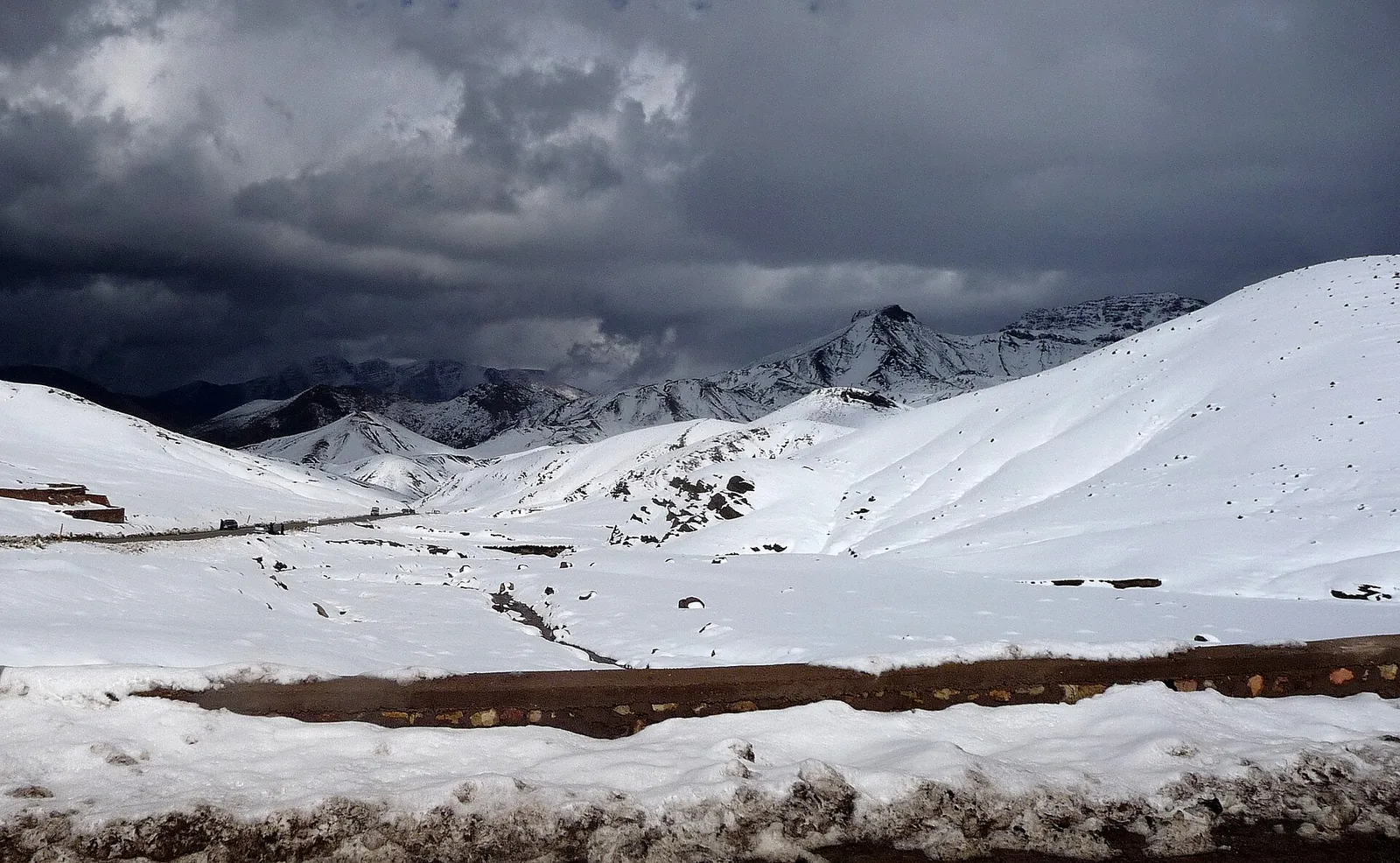
The Tizi n’Tichka. Nothing on a timetable goes where this road goes, which is exactly when a car earns its cost. Photo: gailhampshire, CC BY 2.0, via Wikimedia Commons.
The road quality itself splits sharply. The motorway network runs to roughly 1,800 km, second largest in Africa, with a stated target of 3,000 km by 2030 (Global Highways). Those trunk roads are fine. The mountain roads are a different proposition, and they are the ones you would be renting the car for.
What it costs, what insurance to take, what the checkpoints want and whether you need an international permit are a post of their own, coming in this cluster.
Is it worth flying between Moroccan cities?
Only for the far south. Royal Air Maroc lists 18 domestic destinations (Royal Air Maroc network), and for 11 of my 25 places there is a flight, but on most of those the flight is the slower door-to-door option once you add the airport.
The exceptions are real and they are large. Casablanca to Laayoune is 1h45 in the air against roughly 19 hours by road, and Casablanca to Dakhla is 2h20 against about 28 (Rough Guides). If the Western Sahara coast is on your route, fly it. There is no sensible argument for two days on a coach each way.
Everywhere else, do the arithmetic honestly. Casablanca to Tangier is 2h17 city centre to city centre by Al Boraq. A flight is about an hour, plus the run to Mohammed V, plus check-in, plus the run into Tangier. The train wins, and it is not close. Getting to Mohammed V itself is 58 minutes from Casa Port on the airport shuttle, or a fixed-tariff taxi, which I covered in the taxi rulebook.
How do you get around inside a city?
Petit taxi first, tram where there is one. Casablanca and the Rabat-Salé conurbation both run modern tram networks, and in the corridors they serve they beat a taxi in traffic comfortably.
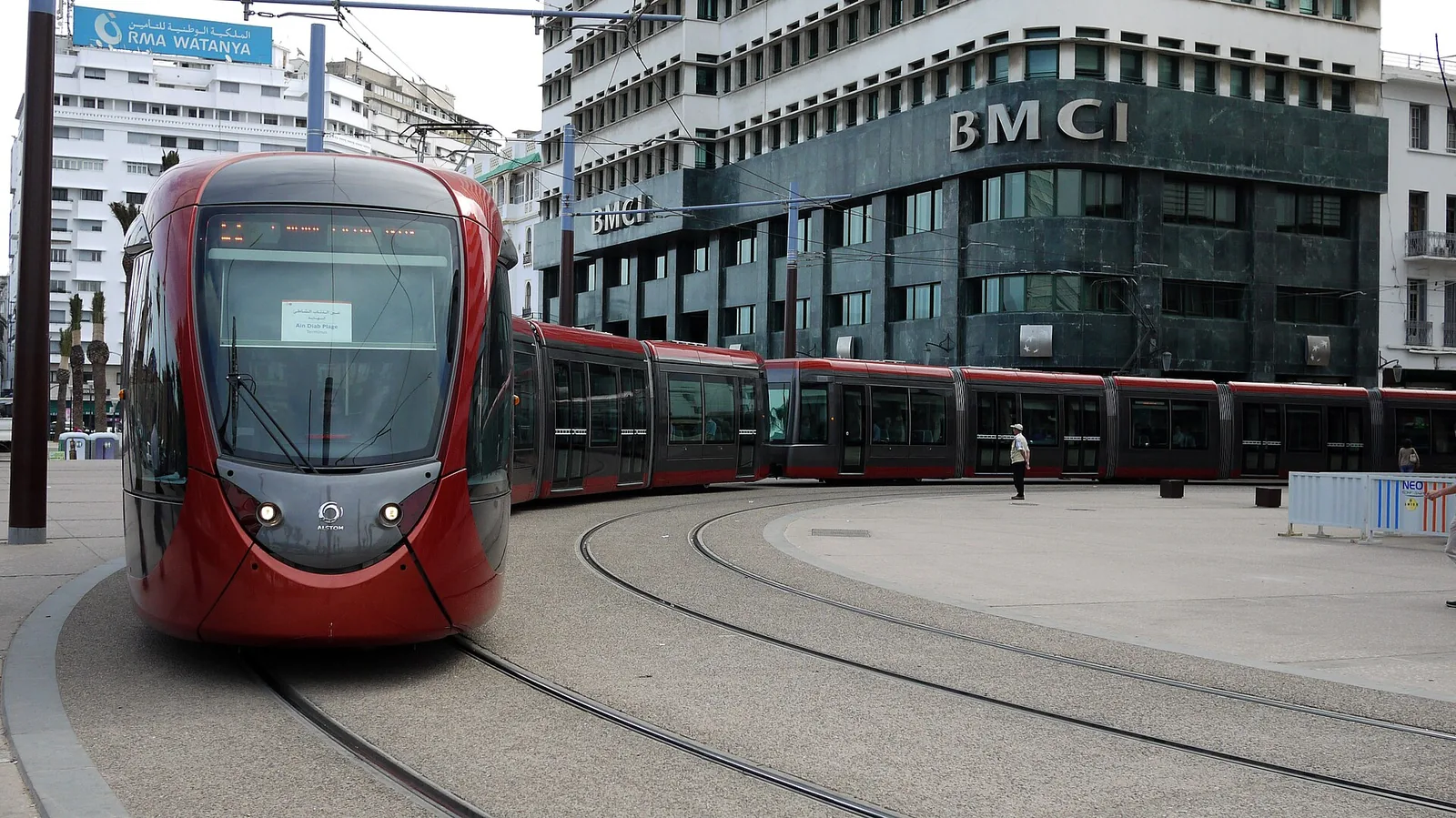
Casablanca’s tram. Rabat and Salé have the other network. Photo: Mustapha Ennaimi, CC BY 2.0, via Wikimedia Commons.
Both cities are getting more. ONCF has begun a 20 billion dirham programme to build a full suburban rail network around Casablanca by 2030, alongside the existing trams and a restructuring of the city’s buses (Railway Gazette International, March 2026). None of that helps you this year, but it is why Casablanca will feel different by the World Cup.
In Marrakech, Fes and Chefchaouen the answer is simpler: the parts you came to see are medina, and the medina is walking. A petit taxi gets you to the gate.
The official advice is worth reading with a date in mind. Morocco’s national tourist office still describes the Casablanca tram as having “two additional lines” coming into effect and calls Al Boraq the TGV (Moroccan National Tourist Office, read 30 August 2026). Those extra lines have been running for years. It is the top result for this question, and it is the stalest page I read while writing this.
Which mode for which leg?
Match the mode to the leg, not to the trip. Here is how the common legs actually resolve, using the times I read on 30 August 2026.
| Leg | Take | Time |
|---|---|---|
| Casablanca to Tangier | Al Boraq | 2h17 |
| Casablanca to Marrakech | Train | 3h00 |
| Casablanca to Fes | Train | 4h20 |
| Casablanca to Mohammed V Airport | Airport shuttle | 0h58 |
| Marrakech to Essaouira | Coach, 9 a day | ~3h00 |
| Marrakech to Ouarzazate | Coach, 5 a day | ~4h00 |
| Casablanca to Agadir | Train to Marrakech, then coach | 6h45 to 7h46 |
| Tangier to Chefchaouen | Coach, 2 a day | 2h30 |
| Fes to Chefchaouen | Coach direct, check CTM not ONCF | see note |
| Marrakech to Merzouga | Coach, 1 direct a day | 12h30 |
| Marrakech to Imlil | Grand taxi via Asni | no scheduled service |
| Marrakech to Aït Ben Haddou | Car or driver | no scheduled service |
Rail times from ONCF’s published timetables; coach times and frequencies from the ONCF Voyages journey search. All read 30 August 2026. Fes to Chefchaouen is the one leg where ONCF’s own planner is misleading: it offers 6h32 via Tangier because it will not sell you the direct road route.
My own default, after several trips, looks like this. Rail for everything on the spine, because it is fast, cheap and I can work on it. Supratours or CTM for Chefchaouen, Essaouira and the desert gateways, booked the day before in high season because two departures a day sell out. A car for exactly one stretch, the Atlas circuit through Aït Ben Haddou and the gorges, picked up in Marrakech and dropped back there.
That plan uses three modes on a ten-day trip. It is more moving parts than “rent a car for the whole thing”, and it is cheaper, safer and less tiring. The route those legs belong to is the 10-day Morocco itinerary I actually use, what the whole trip adds up to is broken down in what a Morocco trip actually costs, and how the rest of the planning fits together is in the full Morocco planning guide.
Frequently Asked Questions
What is the best way to get around Morocco?
A mix. Rail covers the Tangier to Marrakech spine fast and cheaply, but reaches only 8 of the 25 places travellers commonly visit, on my own count against ONCF’s published timetables on 30 August 2026. Scheduled coaches reach 20, including Chefchaouen, Essaouira and the desert gateways. Four places have no public transport at all and need a car or grand taxi.
Can you get everywhere in Morocco by train?
No. ONCF publishes fourteen passenger axes, and they miss Chefchaouen, Essaouira, Agadir, Ouarzazate, Merzouga, Zagora and the entire High Atlas. Checking every one of the 25 destinations on my list against ONCF’s own timetables on 30 August 2026, exactly 8 had a railway station.
Do you need a car in Morocco?
Not for a city trip. Scheduled transport covers 20 of 25 common destinations. A car earns its cost for the Atlas passes, the Dades and Todra gorges, and places like Aït Ben Haddou and Imlil with no scheduled service. Weigh it against the 4,577 road deaths NARSA recorded in 2025, up 25.5%.
How do you get from Marrakech to Merzouga?
There is no train. On 30 August 2026 the ONCF Voyages system showed one direct Supratours coach a day, leaving Marrakech at 08:00 and arriving in Merzouga at 20:30, a journey of 12h30. Most visitors instead take a multi-day desert tour that includes the transport both ways.
Is it safe to drive in Morocco?
Morocco recorded 160,347 injury accidents and 4,577 road deaths in 2025, a 25.5% rise and the worst year on record, according to NARSA. The 1,800 km motorway network is good. Mountain roads are the real risk, and they are exactly the roads a hire car is usually rented for.
How to get around Morocco, in one paragraph
Rail is excellent and narrow: 8 of 25 destinations, brilliant on the spine, absent everywhere else. Scheduled coaches are the workhorse at 20 of 25, and Supratours exists precisely because the railway stops where it stops. Grand taxis fill the last gaps. A car is worth it for four places and the Atlas, with the road-safety figure in front of you when you decide. Flying only makes sense for Laayoune and Dakhla.
Every count and time above was read from the operators on 30 August 2026. I re-check all of them every 60 days.