Last verified: September 2, 2026. I re-read the ten shared three-day listings behind the site’s desert price survey on that date and ticked what each one includes, and every count below comes from that round. Listings change their inclusions more often than their prices, so I re-read all ten every 60 days and move the date above each time.
A Morocco desert tour is roughly 20 hours in a minibus for one night in the dunes. That is not a complaint. It is the shape of the product, and once you know it, every other decision about the trip gets easier.
Disclosure: Some links in this guide may earn us a commission, at no extra cost to you. It never changes what we recommend.
The trouble is finding anyone who will say so. Four of the five pages that rank for this question sell the tour they are describing, and the best independent one I could find appears to date from 2022 and carries no date, no hours, no temperatures and no list of what you actually get. So on 2 September 2026 I did the reading myself: ten shared listings, eight line items each, plus the road figures this site already publishes and a year of Merzouga temperatures.
Key Takeaways
- A three-day Morocco desert tour is about 20 hours in a minibus for one night in the dunes. Seven hours on day one, five on day two, eight to ten on day three. Knowing that is what makes the rest easy
- Three days reaches the real Sahara. Two days does not. The two-day tour goes to Zagora and a small dune field. The 150-metre dunes at Erg Chebbi need the third day, and the fourth day buys a slower return, not more desert
- Lunches are excluded on 9 of the 10 listings I read, and only 6 of 10 tell you what time you get back. Dinner, breakfast, the camel leg and pickup are on every one
- October and November are the honest answer on timing. Merzouga averages a 43C high in July and a 6C low in January, and spring carries the sand
- Start in Marrakech and finish in Fes if the itinerary allows. The one-way shape turns the worst leg of the trip into your transfer
| Shape | Nights in the dunes | Hours in the vehicle | Dune field reached | Who it fits |
|---|---|---|---|---|
| 2-day Zagora loop | 1 | about 14 | Tinfou, small dunes outside Zagora | A hard 48-hour hole and nothing more |
| 3-day Merzouga loop | 1 | about 20 | Erg Chebbi, dunes to 150 m | Most people. The product as designed |
| 3-day Marrakech to Fes | 1 | about 19 | Erg Chebbi | Anyone whose next stop is Fes anyway |
| 4-day Merzouga | 1 | about 20, split over four days | Erg Chebbi | Families, and anyone who cannot face a nine-hour day three |
Hours are sums of route figures this site already publishes, plus the day-by-day drive times the operators state on their own listings. Zagora is about seven hours each way. None of these shapes gives you a second night in the dunes.
Table of Contents
What is a Morocco desert tour, actually?
A Morocco desert tour is a two-to-four-day road trip from Marrakech or Fes to one of two dune seas, with one night in a tented camp that you reach by camel, sold as a fixed itinerary in a shared minibus of up to 17 people or a private 4×4. Every one of the ten shared listings I read on 2 September 2026 follows that template. What varies is the erg, the camp, and what the listing leaves out.
The dune sea almost everyone means is Erg Chebbi, behind the village of Merzouga. Its dunes rise to about 150 metres and the field runs roughly 28 kilometres north to south (Wikipedia, Erg Chebbi, read 2 September 2026). The other is Erg Chigaga, Morocco’s largest, some 56 kilometres south-west of M’Hamid, with dunes over 50 metres (Wikipedia, Erg Chigaga). A tour sold from Marrakech with “Zagora” in the name reaches neither. Which dune field you are actually buying is its own decision, and I have made it on its own page.
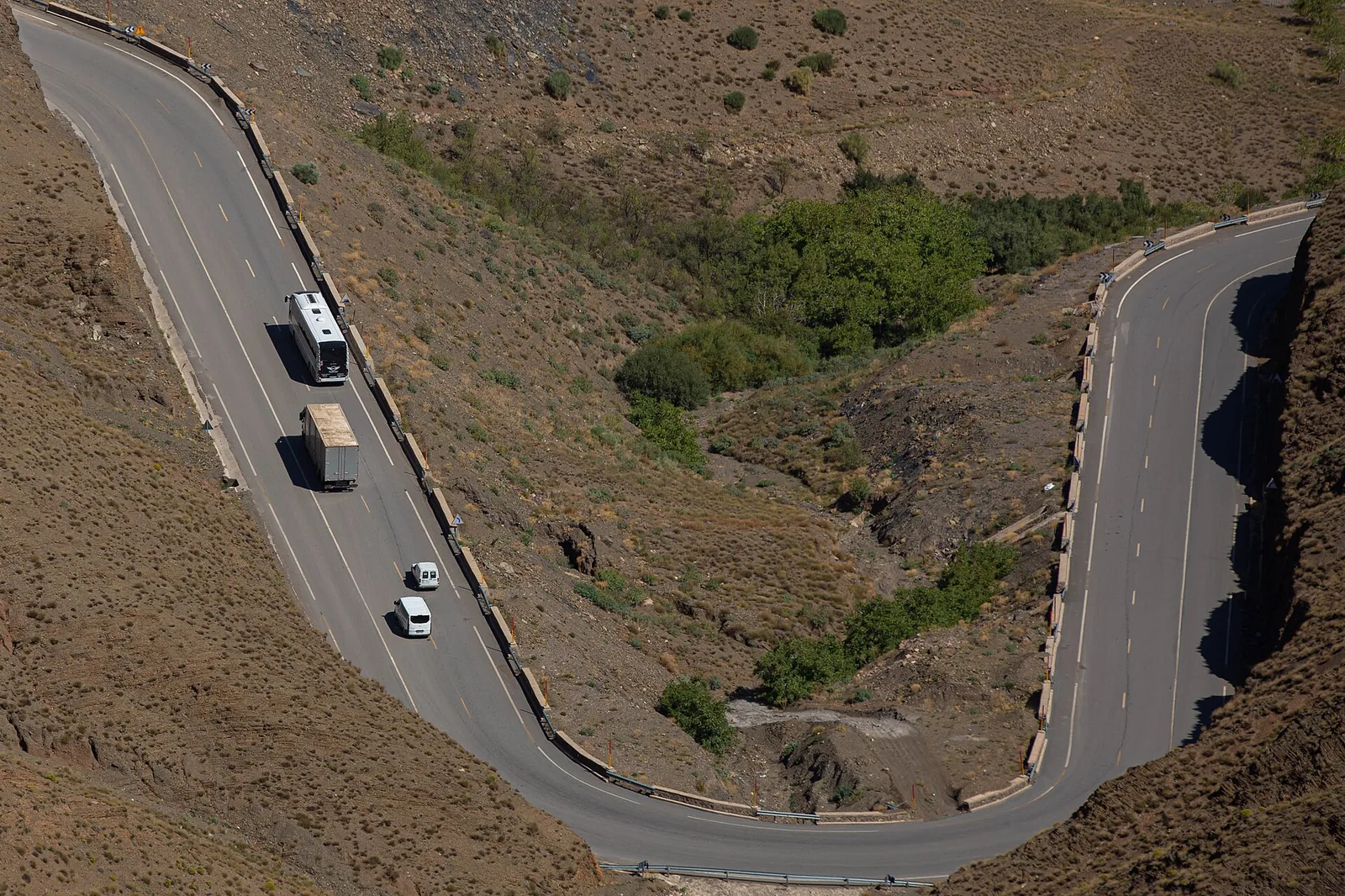
The Tizi n’Tichka hairpins. The white minibuses are the product. Photo: Youssef.ma.o, CC BY-SA 4.0, via Wikimedia Commons.
The pressure on all of this is real. Morocco took 9.4 million visitors in the first half of 2026, up 6% on the year before (Direction des Études et des Prévisions Financières, via Morocco World News, July 2026), and the desert camps are a fixed number of tents at the end of a long road.
Here is what the product is not. It is not a trek. It is not a night in the deep desert. And on the standard shape it is not two days in the dunes, however the photographs read. Hold that shape in your head and the rest of this page is just detail.
Should you take a 2-day, 3-day or 4-day tour?
Three, unless a third day is genuinely impossible. The fourth day is a comfort decision about the return, not a desert decision. Every four-day listing I read adds a night at the Dades or in Ouarzazate on the way back. Not one adds a second night in the dunes.
Two days means Zagora. The road is about seven hours each way, and the camp is at Tinfou, a small dune field just outside the town that its own sellers describe as miniature. The honest case for it is a hard 48-hour hole in the itinerary. If you can find a third day, it is not close, and the Merzouga vs Zagora decision goes through it properly.
Three days is the product as designed. Day one crosses the High Atlas to the Dades valley. Day two runs through the Todra gorge to Merzouga, the camel leg at dusk, and the camp. Day three is the road home, 560 kilometres and eight to nine hours of it. That last figure is the one this site uses everywhere, and it is the whole argument for the one-way shape below.
Four days is the same route with the return broken in two. If you are travelling with children, or you simply do not want to spend nine hours in a minibus on the last day, it is worth having. Just know what you are buying: a gentler day three, not more Sahara.
The one-way shape is the version I would take. Every one of the direct operators I read offers a three-day tour that ends in Fes instead of looping back to Marrakech. It converts the worst leg of the trip into your intercity transfer, and it is the single most useful booking instruction in this cluster. Whether it fits depends on the rest of your route, which is a planning question rather than a desert one, and the 10-day Morocco itinerary I actually use is built around exactly that drop-off.
My own pick, for what it is worth: three days, Merzouga, the standard camp, Fes drop-off, late October. I will explain each of those choices below.
What happens on each day?
Day one is the mountains, day two is the gorges and the dunes, day three is the road home. Add the drive times the operators publish for each and you get about 20 hours in the vehicle. Here is the working, because a number with no working is just an opinion.
| Leg | Distance | Drive time | What you see |
|---|---|---|---|
| Day 1: Marrakech to the Dades valley | about 310 km | about 7 hours | Tizi n’Tichka, Aït Benhaddou, Ouarzazate, the Rose valley |
| Day 2: Dades to Merzouga | about 200 km | about 5 hours | Todra gorge, Tinghir, Erfoud, then the camel leg at dusk |
| Day 3: Merzouga to Marrakech | 560 km | 8 to 9 hours | Sunrise, then the same road in reverse |
| Three-day total | about 1,070 km | about 20 hours | one night in the dunes |
Day-1 and day-2 times are the drive times stated on the shared listings I read on 2 September 2026. The day-3 figure is the house figure this site uses on every desert post. Operators publish nine to ten hours for the return.
Day one climbs to the Tizi n’Tichka pass at 2,205 metres on the N9, where snow can fall from November through March (Wikipedia, Tizi n’Tichka). Then it drops to Aït Benhaddou, the mud-brick ksar that has been on the World Heritage List since 1987 (Wikipedia, Aït Benhaddou), and runs east to a hotel in the Dades valley or Kelaat M’Gouna. Not one listing puts the first night anywhere near the dunes.
Day two is shorter and better. The Todra gorge is a walk between rock walls that reach 160 metres in the narrow section and up to 400 metres at their highest (Wikipedia, Todgha Gorge), then the road runs through Tinghir and Erfoud to Merzouga, where the camels are waiting. The camel leg itself is 45 minutes to an hour and a half, depending on which camp the operator uses, and every listing that states a time is inside that range. Dinner is at the camp, the drumming is at the fire, and the sunrise is at whatever time the guide wakes you.
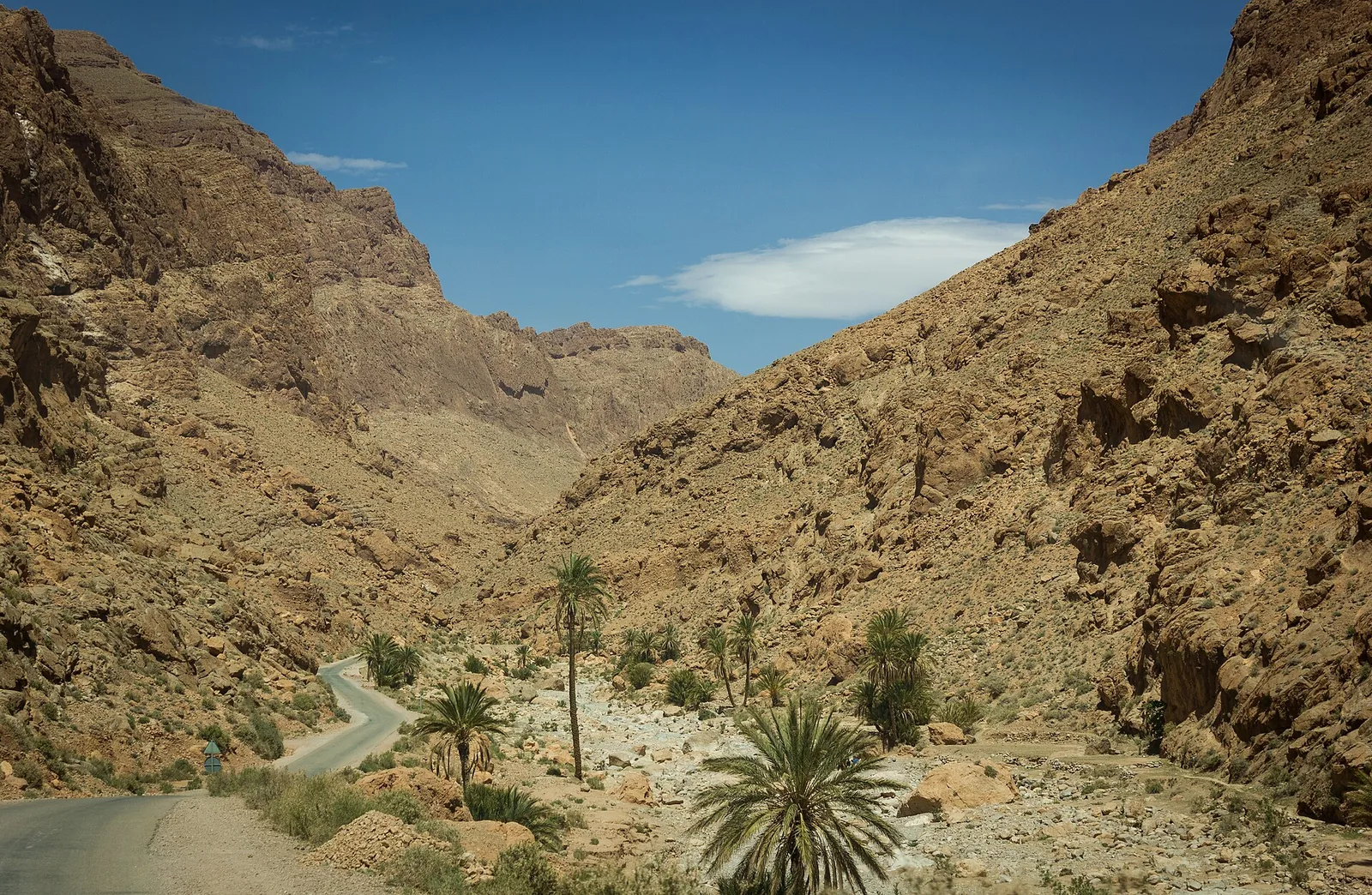
The Todgha gorge. Day two’s stop, and the reason day two is the good day. Photo: ThartmannWiki, CC BY-SA 4.0, via Wikimedia Commons.
Day three is the one nobody photographs. Breakfast, then the same road back over the Atlas, with a lunch stop in Ouarzazate and a drop-off in Marrakech somewhere between five and eight in the evening. Four of the ten itineraries I read also name a workshop, a fossil shop or a film studio stop along the way. Why those stops exist is a separate subject, and I have documented it separately.
One reviewer on a booking platform put the ratio at “about 80% of the tour is driving”. That is one person’s estimate of one tour, but my sum lands in the same place. Where the road itself goes, stop by stop, and whether to break the journey, is a post of its own in this cluster.
What is included in a Morocco desert tour, and what is not?
Lunches are excluded on 9 of the 10 shared listings I read on 2 September 2026, and only 6 of the 10 state what time you get back to Marrakech. Dinner, the camel leg, and hotel pickup are on all ten. Breakfast is on nine. Here is the full matrix.
| Listing | Dinner | Breakfast | Lunches | Camel | Aït Benhaddou entry | Pickup | Return time | Fes option |
|---|---|---|---|---|---|---|---|---|
| Marrakech Desert Trips | Yes | Yes | Excluded | Yes | Excluded | Yes | Stated | Stated |
| Mouhou Tours | Yes | Yes | Excluded | Yes | Not stated | Yes | Stated | Stated |
| Morocco Live Trips | Yes | Yes | Excluded | Yes | Included | Yes | Stated | Stated |
| Nomad Excursion | Yes | Yes | Excluded | Yes | Excluded | Yes | Not stated | Not stated |
| Marrakesh Desert Tours | Yes | Yes | Not stated | Yes | Excluded | Yes | Not stated | Stated |
| Morocco Service Tours | Yes | Yes | Excluded | Yes | Not stated | Yes | Stated | Stated |
| GetYourGuide, Ando Travel | Yes | Yes | Excluded | Yes | Excluded | Yes | Stated | Not stated |
| Viator, Ando Travel | Yes | Yes | Excluded | Yes | Excluded | Yes | Stated | Not stated |
| Viator, Morocco Global Adventures | Yes | Yes | Excluded | Yes | Excluded | Yes | Not stated | Not stated |
| Viator, Morocco Tours | Yes | Not stated | Excluded | Yes | Included | Yes | Not stated | Not stated |
| Count of 10 | 10 | 9 | 9 excluded | 10 | 2 included | 10 | 6 | 5 |
The ten are the shared three-day Marrakech to Merzouga listings behind this site’s August price survey, re-read on 2 September 2026. “Excluded” means the listing says so. “Not stated” means it is silent, which for your purposes means the same thing. Ando Travel appears twice because it sells the same tour on two platforms, so this is nine sellers, not ten.
Read the matrix from left to right and the product declares itself. The left half is standard: two dinners, two breakfasts, the camel, the driver, the pickup. Nobody competes on those. The right half is where a listing goes quiet, and the quiet is the point. Lunches happen at roadside restaurants the driver chooses, entry to Aït Benhaddou is a separate fee or an “optional” guide on eight of the ten, and drinks are on you everywhere.
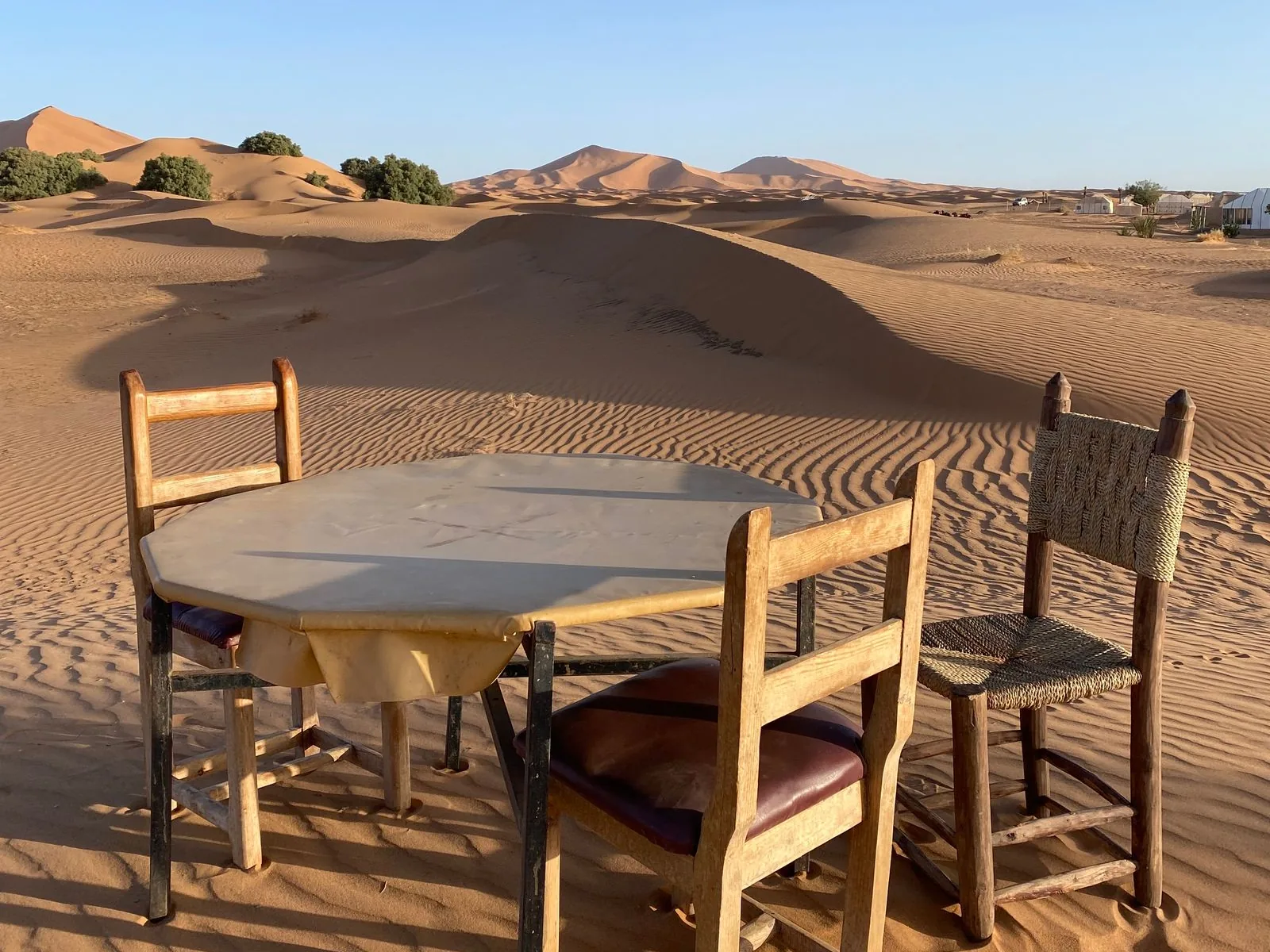
Dinner at the camp is on every listing. The two lunches on the road are on none of them. Photo: Zak Mogel, Pexels.
What any of those extras actually costs, itemised from a verified review and priced across the same ten operators, is in what a shared three-day tour should cost, and what the extras add. I am not going to repeat a single figure here, because that page carries the dates and the sample sizes and this one does not need to.
Two other things the round turned up. Four of the ten listings state a group cap, and where they do it is between 10 and 17 in a minibus. Nine of the ten name Erg Chebbi; the tenth says “Merzouga desert”, which is a village, not a dune field. And every listing puts night one in a hotel in the Dades valley, Kelaat M’Gouna or Tinghir, which is the honest way of saying that only one of your two nights is in the Sahara.
Standard camp or luxury camp: what actually differs?
The bathroom, the tent, and where the camp sits. Standard means a private tent with real beds and a shared bathroom block. Luxury means an ensuite with a flush toilet and a hot shower, a proper bed, electricity for part of the night, and usually a better position in the dunes. Eight of the ten listings describe exactly those two tiers, in almost those words.
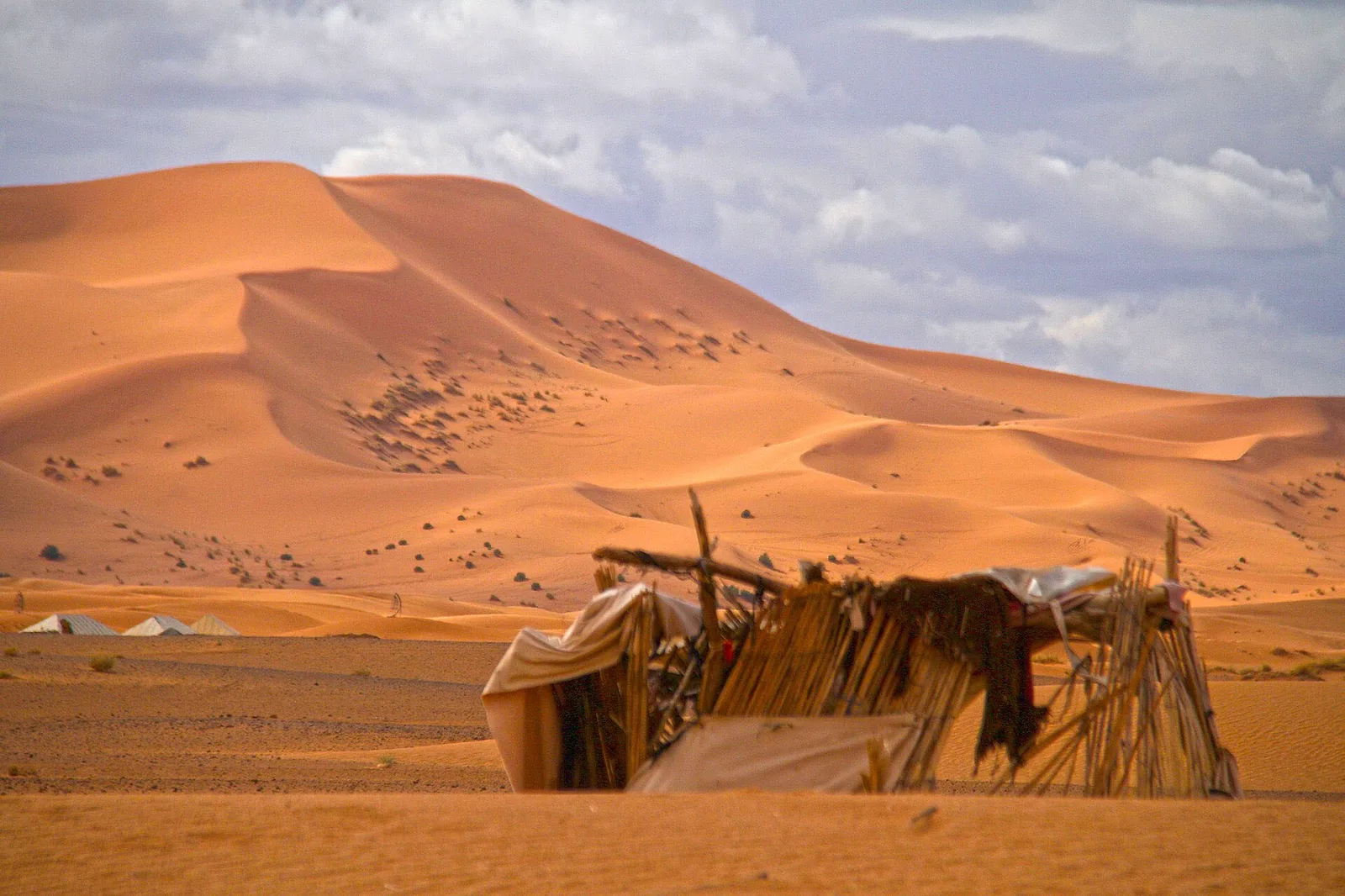
Both kinds in one frame at Erg Chebbi: a traditional tent in front, the white ensuite tents behind. Photo: cattan2011, CC BY 2.0, via Wikimedia Commons.
One operator puts it well: both of its camps sit inside the dunes, the stars and the silence are identical at both, and the difference is purely in how you sleep and shower. That is true of a good operator. It is not true of the market, and the thing to check is not the tent at all. It is the location.
A camp can sit on flat scrub an hour short of the dunes and still be sold as a Sahara camp, and camp location turns out to be the main thing your price is actually buying. Whether the listing names the erg, the camp standard and the tent count in writing is one of the eight things to check before you pay.
My own choice is the standard tier, in the right place, over the luxury tier in the wrong one. The night itself, the cold, the stars and what you actually need to bring, is the next post in this cluster, and I will leave it to that page rather than half-cover it here.
When is the best time for a Morocco desert tour?
October and November, and then late February into early March, because those are the only weeks that avoid all three ways the desert can spoil the trip. The season everyone quotes is October to April, and it is right. Its edges are the trap.
Merzouga’s average daily high runs from 19C in January to 43C in July and 42C in August, and the average low from 6C in January to 29C in July (Weather and Climate, Merzouga monthly averages, read 2 September 2026). Those are averages. The nights in a canvas tent in December run colder than the January average low, and more than one operator warns in its own listing that winter nights can drop near freezing.
The three failure modes are different, and no page I read separates them.
Heat, June to September. A 43C average high means the camel leg happens in the last hour of light and the tent is an oven until midnight. Several operators sell summer tours with air-conditioned camps. That is a real product, and it is a different one from the trip in the photographs.
The tent, December to February. Days are fine. The nights are the problem, in canvas, at 730 metres, with a January average low of 6C and worse on a clear night. Camps supply heavy blankets; they do not supply heating. If you go in midwinter, go as if you were camping in midwinter, because you are.
Sand, March and April. This is the one the season guides skip. Spring is when the hot easterly that Moroccans call the chergui gets up. Winds of the sirocco family peak in March and again in November across the region (Wikipedia, Sirocco), and at Erg Chebbi the traveller reports cluster in spring: a hazy, gritty afternoon is a normal March event rather than a rare one. It is not a reason to avoid spring, which is peak season for good reason. It is a reason to prefer October if you have the choice.
That leaves October and November, and the weeks either side of the turn from February into March, as the only stretches that dodge all three. Which is why late October is my answer. How far ahead you need to book for those weeks, and why April and October sell out, is a booking question, and the booking guide covers the horizon.
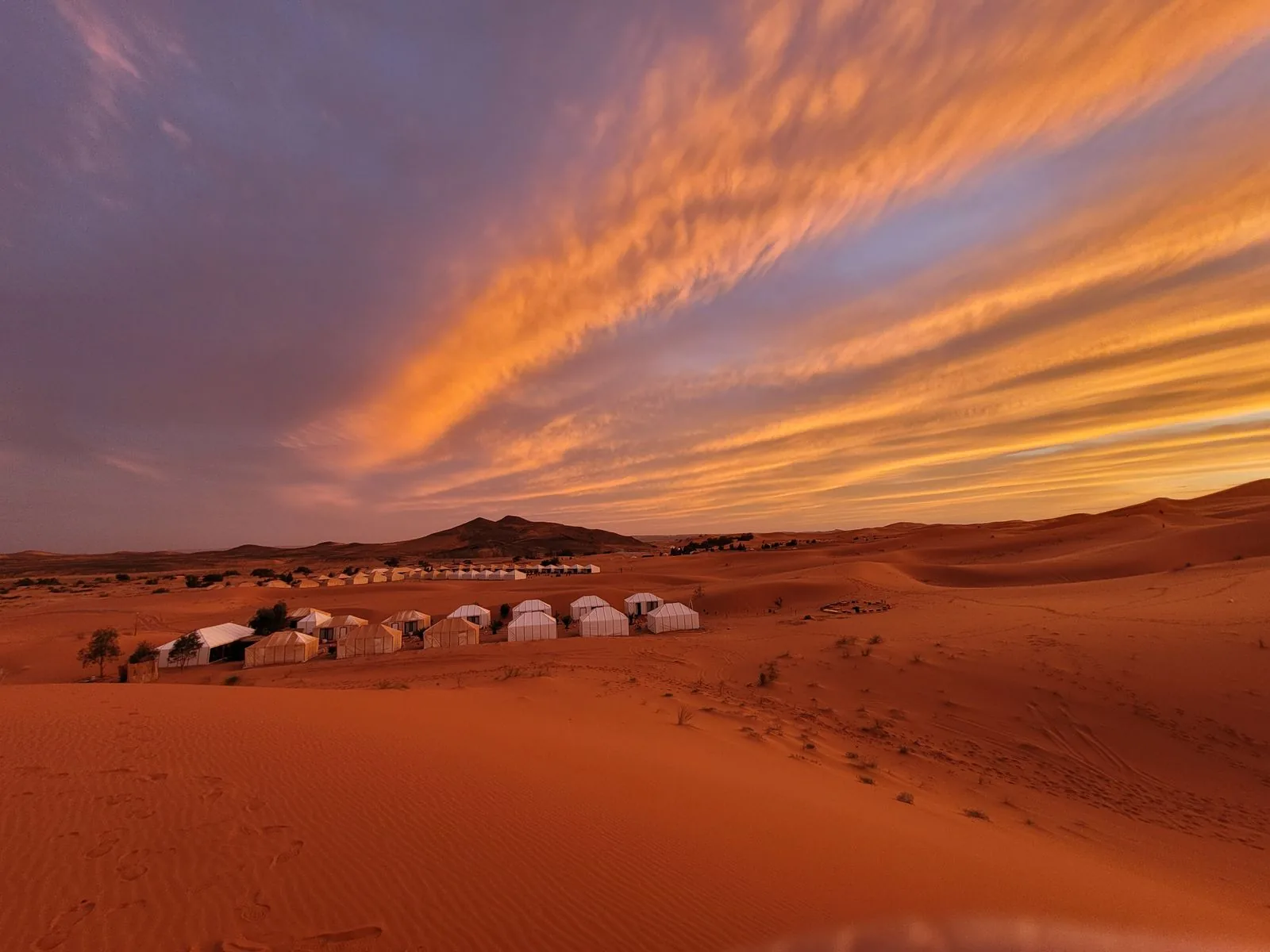
An autumn dusk at the camp. The month is most of what decides whether this is your evening. Photo: Stewart Cameron, Pexels.
Marrakech or Fes: where should the tour start?
Start wherever you already are, and make it one-way if the rest of your route allows. Fes to Merzouga is a single long day south through Ifrane, Azrou, Midelt and the Ziz valley, about seven hours, and it works in either direction.
| Shape | Day 1 | Day 3 ends | What you save |
|---|---|---|---|
| Marrakech loop | Atlas, Aït Benhaddou, Dades | Marrakech, 17:00 to 20:00 | nothing, and you see the same road twice |
| Marrakech to Fes | Atlas, Aït Benhaddou, Dades | Fes, via the Ziz valley and the Middle Atlas | the whole 560 km return, which becomes your transfer |
| Fes to Marrakech | Middle Atlas, Midelt, the Ziz valley | Marrakech, via the Dades and the Atlas | the same, in reverse |
The one-way version is the same product with the worst day removed. All six of the direct operators I read offer it, and it is the shape I would book every time the itinerary has Fes on the far side of the desert.
Whichever end you start from, there is no train. Merzouga and Zagora are road-only, and why the railway stops where it stops is the reason the desert is sold as a tour at all rather than as a destination you reach yourself. Where the tour sits in a whole trip’s budget, against riads, trains and food, is in the Price Index, and how the desert fits a seven-day or ten-day trip at all is in the full Morocco planning guide.
How do the four desert guides fit together?
This page is the shape. Four others carry the detail, and each answers one question. If you only read one of them, read the one that matches where you are in the decision.
- Which dune field? Merzouga or Zagora, four named dune fields, one honest answer: Merzouga vs Zagora
- What should it cost? Ten operators, a median, a collection date, and the walk-away line: Morocco desert tour cost
- What do I check before I pay? The licence register, the booking channel, what the listing must name: Morocco desert tour booking
- What if it goes wrong? The camp swap, the kickback stop, the law and the refund route: Morocco desert tour scams
Two more are coming this month: what a night in a Sahara camp is actually like, and the Marrakech to Merzouga road stop by stop. Everything in the cluster lives under Sahara and Desert.
Frequently Asked Questions
Is a Morocco desert tour worth it?
Yes, on the three-day shape to Erg Chebbi. The honest cost is about 20 hours in a minibus for one night in the dunes, summed from the drive times operators publish on their own listings. The two-day Zagora tour is a different product that reaches a small dune field, not the Sahara in the photographs.
How many days do you need for the Sahara in Morocco?
Three. Day one crosses the Atlas to the Dades valley, day two reaches Merzouga and the camel leg, day three is the 560 km road home. Two days only reaches Zagora. A fourth day adds a night on the return, not a second night in the dunes, on every four-day listing I read on 2 September 2026.
What is included in a Morocco desert tour?
On the ten shared listings I read on 2 September 2026: dinner, the camel leg and hotel pickup on all ten, breakfast on nine. Lunches were excluded on nine of ten. Entry or a guide at Aït Benhaddou was included on two, and only six stated a return time. Drinks and tips are always extra.
What is the best month for a Morocco desert tour?
October or November. Merzouga averages a 43C high in July and a 6C low in January (Weather and Climate monthly averages, read 2 September 2026), and March and April carry the spring sand from the chergui wind. Late February into early March is the other window that avoids heat, cold nights and sand.
Can you do a Morocco desert tour from Fes?
Yes. Fes to Merzouga is one long day of about seven hours through Ifrane, Midelt and the Ziz valley, and every direct operator I read sells the three-day tour one-way between Fes and Marrakech. That shape removes the 560 km return and turns the worst leg of the trip into your intercity transfer.
A Morocco desert tour, in one paragraph
It is a road trip with a night in the middle: roughly 20 hours in the vehicle for one night in the dunes on the three-day shape, seven hours less if you finish in Fes. Two days reaches Zagora, not the Sahara. Four days buys a gentler return. Every listing includes dinner, the camel and the pickup, nine of ten exclude lunch, and fewer than two-thirds tell you when you get back. Go in October or November, or at the turn of February into March, and check the camp’s location before its tent. Everything I counted above was read on 2 September 2026, and I re-read it every 60 days.