Last verified: August 26, 2026. Riad rates are demand-priced, and the tax band a riad sits in is being rewritten under loi 80-14, so both halves of this page move. Every 60 days I re-run the rate windows, re-check the taxes against riads’ own terms and loi 47-06, and re-pull the occupancy figures.
A riad night in Marrakech is taxed harder than a five-star hotel night. Not by accident, and not by a little.
Disclosure: Some links in this guide may earn us a commission, at no extra cost to you. It never changes what we recommend.
Almost every page you’ll find on Marrakech riad prices is written by somebody who rents you one. That’s not a conspiracy, it’s just who bothers to write about riads. But it does explain the blind spot: none of them mention the line of Moroccan tax law that puts a guest house in the top band, above a five-star hotel, and charges it to you in cash at checkout.
So on 26 August I pulled three fixed Booking.com windows on one method, low season, shoulder and New Year, and logged the tax line on all 75 cards. Then I read the statute that produces it. Here’s what a medina night actually costs, what the season really does, and what the number on your bill quietly tells you about the riad you picked.
Key Takeaways
- Median MAD 973 a night for two on Booking.com page one in the medina for a late-September stay, middle half MAD 750 to 1,128, room only
- The tourist tax is legally outside the room price. Marrakech riads publish 15 dirhams communal tax plus 11 dirhams promotion tax, 26 a head a night, cash on arrival. Under-12s are exempt
- A riad is taxed above a four-star hotel. Moroccan law bands guest houses at 15 to 30 dirhams a head a night against 5 to 10 for a four-star, and the gap shows on the booking cards
- Season moves inventory more than rate. Bookable medina riads fall from 816 in January to 481 over New Year, a 41% collapse, while the median rate rises 70%
- Riads are moving from categories to star ratings under loi 80-14, inside a transition that closes around June 2027, so today’s star is not yet an audited one
Table of Contents
How much does a riad in Marrakech cost per night?
Median MAD 973 a night for two, about 90 euros or 105 dollars, for a late-September stay in the medina. I’m converting at 10.78 to the euro and 9.23 to the dollar, the rate on 23 August 2026. That’s page one of Booking.com filtered to riads, 25 properties out of 673 available, read on 26 August 2026. The middle half ran MAD 750 to 1,128. It’s room only: the tax comes on top, and I’ll get to why that matters.
That number is close to the MAD 950 I logged for the identical window on 9 August, which is the useful part. Two pulls, seventeen days apart, same method, 2.4% apart. The instrument holds.
One caveat I have to give you, because nobody else does. Booking’s default sort is promoted inventory, so this describes what a first-page shopper sees, not the market. I also pulled the same window twice in one afternoon and got 17 of the same 25 properties. The medians barely moved. The list did. Treat page one as a sample, never as a shortlist.
For where the room sits in a whole trip, I keep the running numbers in what a Morocco trip costs overall.
How much do Marrakech riad prices move by season?
Seventy percent from January to New Year, measured on the same instrument. The low window, 20 to 23 January 2027, came in at a median MAD 670 a night. New Year, 29 December to 1 January, came in at MAD 1,141. September sat between them at MAD 973.
I want to flag that I had this wrong before. My own Price Index page carries a borrowed figure of “30 to 50%” from secondary sources. Measured across three windows on one method, it’s 70%. The borrowed number was too low, and that page gets corrected at its next refresh.
But the rate is the less interesting half. Look at what happens to supply.
Four in ten medina riads are already unbookable for New Year, and that’s four months out. January, for the same city and the same filter, is wide open at 816. So what’s the real pressure on you? Not that you’ll pay more if you wait. That you’ll be choosing from a bit over half the houses.
That’s a different instruction, and a more honest one. Book early for New Year because the good ones vanish, not because a price is about to run away from you.
One number that looks like a contradiction is worth explaining. City-wide short-let data shows the average daily rate barely moving across the year, from about $144 to $167, while occupancy swings from 28.5% to 50.3% (AirROI, August 2025 to July 2026 data, retrieved 26 August 2026). That flat line is composition, not pricing. Cheap listings sell in the trough and pull the citywide average down.
Does the neighbourhood actually change what you pay?
Not as much as you’re told, and I couldn’t test the split that everyone quotes. The Kasbah, the one Marrakech district Booking treats as a real bounded neighbourhood, came in at a median MAD 940 a night against MAD 973 for the medina as a whole. That’s a 3% difference, on 25 properties out of 66.
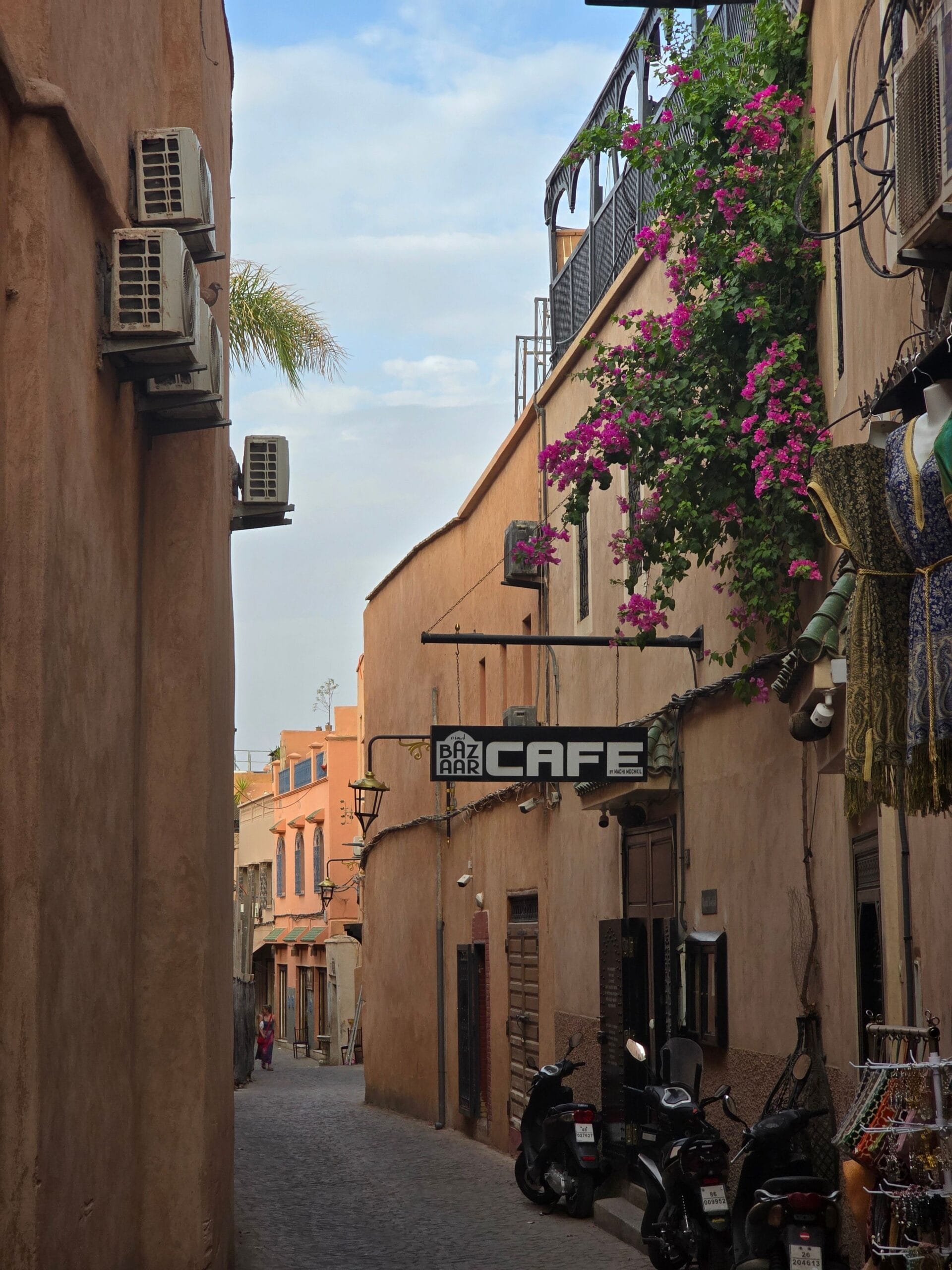
Here’s the awkward part, and I’d rather say it than fake a table. Guide pages will tell you Mouassine runs 250 to 600 euros a night while Bab Doukkala runs 15 to 25% less, at 120 to 300 (Avygeo, 2026). I tried to check that and couldn’t, because the boundaries don’t exist where a reader can test them. Search Booking for “Mouassine” and it resolves to the Mouassine Museum and returns 833 properties, which is most of the medina. Search “Bab Doukkala” and it matches a property called Dar Saada Bab Doukkala, finds nothing, then pads the page with whatever is nearby. Every riad card labels its location simply as “Medina, Marrakech”.
So when someone tells you a sub-district is worth a premium, ask them which boundary they used. On the one boundary the platform actually enforces, that premium is three percent.
What the medina genuinely buys you against Gueliz is a courtyard instead of a pool, and a walk instead of a taxi. It does not buy you a lower price. Four-star hotels in Gueliz and Hivernage came in at a median MAD 1,039 a night, about 7% above the medina riad, which is much closer than the “riads are the budget option” framing suggests. If you’re still deciding where to base yourself, that sits inside the wider Morocco trip planning guide.
What is the tourist tax on a riad, and why is it higher than a hotel’s?
Twenty-six dirhams per person per night in Marrakech, on top of the room, in cash at checkout. That’s 15 dirhams of taxe communale plus 11 dirhams of Taxe de Promotion Touristique, as published in riads’ own terms, for instance Riad O, whose rates are stated as “hors les taxes locales”.
This isn’t the riad being sly. It’s the law. Loi 47-06 on local taxation says the taxe de séjour is levied on tourist accommodation and “vient en sus du prix de la chambre”, comes on top of the room price, at Article 70. A riad is a maison d’hôtes in that text, and Article 73 sets the tariff by establishment type.
| Establishment type, loi 47-06 art. 73 | Taxe de séjour, per person per night |
|---|---|
| Maisons d’hôtes (riads), congress centres, luxury hotels | 15 to 30 DH |
| Hotel, 5 star | 10 to 25 DH |
| Hotel, 4 star | 5 to 10 DH |
| Hotel, 3 star | 3 to 7 DH |
| Hotel, 2 and 1 star | 2 to 5 DH |
| Private clubs | 10 to 25 DH |
| Holiday villages | 5 to 10 DH |
| Tourist residences | 3 to 7 DH |
| Motels, gîtes, relais, other | 2 to 5 DH |
Read that chart again, because it’s the whole point. A guest house is banded at 15 to 30 dirhams a head a night. A four-star hotel? Five to ten. The traditional house you booked for its courtyard is taxed at up to six times the rate of a modern hotel with a pool.
And it shows on the booking pages. Across all 75 riad cards in my three windows, 73 of them, 97%, displayed the tax as a separate line beneath the price. The most common value by a distance was MAD 162 for three nights for two, which works out at MAD 27 a head a night. The four-star Gueliz and Hivernage hotels I pulled for comparison had a median tax line of MAD 104 for the same stay. So the riad is the cheaper room and the dearer tax, by 56%.
Two things soften it. Article 71 exempts children under twelve, so a family of four with two small kids pays for two. And Article 76 requires the invoice to show the tax as its own line, which means you can check it. Bring the cash, because this is one of the charges that reliably won’t take a card. I’ve written up the cash you need on arrival separately, including why the ATM fee makes small withdrawals expensive.
What does the tax on your bill tell you about the riad?
Whether it’s registered as a first or second category guest house. The communal tax is fixed at 15 dirhams. The promotion tax isn’t: it’s 11 dirhams for a first-category maison d’hôtes and 8 for second category. So a bill showing 26 a head is one classification, and 23 is another.
That’s a genuinely useful tell, and it has a short shelf life, because the category system it comes from is being abolished.
In June 2025 Morocco’s Ministry of Tourism announced five arrêtés in the Bulletin Officiel completing the framework of loi 80-14. Guest houses, tourist residences and hotel clubs, previously ranked by category, move to a star system aligned with international standards, and riads and kasbahs are named as joining it (Ministry of Tourism via Maroc.ma, 10 June 2025). Service quality becomes a central criterion, assessed by mystery visits against a grid running to as many as 800 criteria built with UN Tourism. Classification stops being permanent and gets re-examined every seven years, then every five.
Operators were given a 24-month transition to comply, which from June 2025 lands around June 2027. So the sector is inside that window as I write this.
What that means when you’re comparing two listings: the star icon next to a riad today is not yet an audited ministry star. Sometime before mid-2027 it becomes one, and some houses will move. Until then, the review score is doing more work than the star is, and the tax line on the bill is the only classification signal you can actually read.
Is a riad cheaper if you book direct?
You can’t tell, and that turns out to be the finding. I went looking for matched prices, the same room and the same dates on Booking against the riad’s own site, and the comparison doesn’t exist to be made. Riads don’t publish tariffs. They publish booking widgets.
What they publish instead is incentives. Riad Star advertises rooms “from £112” and offers “a 20% online discount for last minute stays within the next 5 days” on direct reservations (Marrakech Riad, retrieved 26 August 2026). Dar Attajmil says direct booking carries “no extra fees for you, or for us” and throws in a free arrival transfer from the airport, station or bus for stays of three nights or more (Dar Attajmil, retrieved 26 August 2026). Neither one gives you a dated number to hold against the OTA.
The pot they’re arguing over is real enough. Booking.com commission runs roughly 10 to 25% depending on the property and the market, around 15% typically, with about 3% more for Preferred Partner placement, and Airbnb moved to a host-only fee near 15.5% in 2026 (Lodgify, 2026). That’s the margin a direct booking is trying to split with you.
So my honest advice is to email and ask, then judge the answer against the number on this page. And treat the platform’s own discount theatre with the same suspicion: 36% of the page-one cards I logged carried a “Getaway Deal” or “Limited-time Deal” badge with a struck-through original price beside it. A permanent discount is a price. Where haggling genuinely applies in Morocco is a separate question, and money going wrong is covered in what actually goes wrong with money in Morocco.
Are Marrakech riad prices going up or down?
Demand is up hard, advertised rates are not, and the two datasets that track it disagree with each other. Marrakech recorded 6.05 million overnight stays in classified accommodation to the end of May 2026, up 10% year on year and a third of the entire national total, with occupancy at 72% and stable (Observatoire du Tourisme, via MAP and Telquel, 12 August 2026). In May alone the city took 1.3 million nights at 78% occupancy.
Now the other side. In the short-let market, where most riads actually sell, AirROI puts revenue per listing down 18.5% year on year, with an average daily rate of $156 and occupancy at 37.6% across 11,363 active listings. AirDNA, measuring the same city, reports 21,986 listings, a $137 daily rate down 7.4%, and occupancy up 3.8% (retrieved 26 August 2026).
Those two are nearly two to one apart on how many listings Marrakech even has. I’m not going to average them and hand you a fake number. Both point the same direction on rate, which is flat to down, and that’s as much as either can honestly support.
Behind it sits a lot of new supply. Morocco is adding roughly 60,000 hotel beds before the 2030 World Cup, about a 20% increase on a base of a little over 300,000, according to tourism minister Fatim-Zahra Ammor speaking to Reuters in July 2026 (Hespress, 20 July 2026). That’s part of a much larger programme I track in the Morocco 2030 build-out.
Put it together and the “book now, prices only go up” line doesn’t survive contact with the rate data. What does survive is the availability argument. Rooms aren’t getting dearer as fast as they’re getting scarcer in the weeks everyone wants.
Frequently Asked Questions
How much is the tourist tax in Marrakech?
Twenty-six dirhams per person per night at most riads: 15 taxe communale plus 11 promotion tax, paid in cash on arrival and legally outside the room rate. Children under twelve are exempt under Article 71 of loi 47-06. Your invoice must show the amount as its own line.
Is a riad cheaper than a hotel in Marrakech?
Slightly, on the room. Medina riads came in at a median MAD 973 a night for two against MAD 1,039 for four-star hotels in Gueliz and Hivernage, both for late September 2026. But the riad’s tax line ran 56% higher, MAD 162 against MAD 104 for a three-night stay, which eats most of the gap.
When is the cheapest time to book a riad in Marrakech?
January. The 20 to 23 January 2027 window returned a median of MAD 670 a night against MAD 1,141 over New Year, a 70% spread. January is also the trough month for short-let revenue city-wide, and it’s when the most riads are actually available.
Do riad prices include breakfast and taxes?
Breakfast usually yes, tax almost never. Most page-one listings I logged included breakfast, but 73 of 75 cards showed the tourist tax as a separate charge on top. Moroccan law is explicit that it “comes on top of the room price”, so budget it separately for every person and every night.
The short version
Riad pricing in Marrakech is more honest than the pages describing it. The rates are visible, the tax is printed on the card if you look, and the law behind it is public.
- The number: median MAD 973 a night for two in the medina in September, MAD 670 in January, MAD 1,141 over New Year
- The charge nobody mentions: 26 dirhams a head a night, cash, on top of the room, exempt for under-12s
- The odd bit: your riad is taxed in a higher band than a four-star hotel, and costs slightly less per night than one
- The real deadline: not price, availability. Four in ten medina riads were already gone for New Year in August
- The thing in flux: star ratings for riads are mid-transition until around June 2027, so read reviews, not stars
Before you take the seasonal numbers to the bank, check the last-verified stamp at the top. I re-pull all three windows on the same method every 60 days, and I’ll say plainly when one of them moves.