Last verified: August 22, 2026. Two exchange-regime changes landed in 2026 alone and the ATM fee position moved with them, so this page shifts faster than most. I re-read the Bank Al-Maghrib instructions and the banks’ published tariffs, and update the date above each time. A further change is due 1 October 2026, when the interchange cap falls.
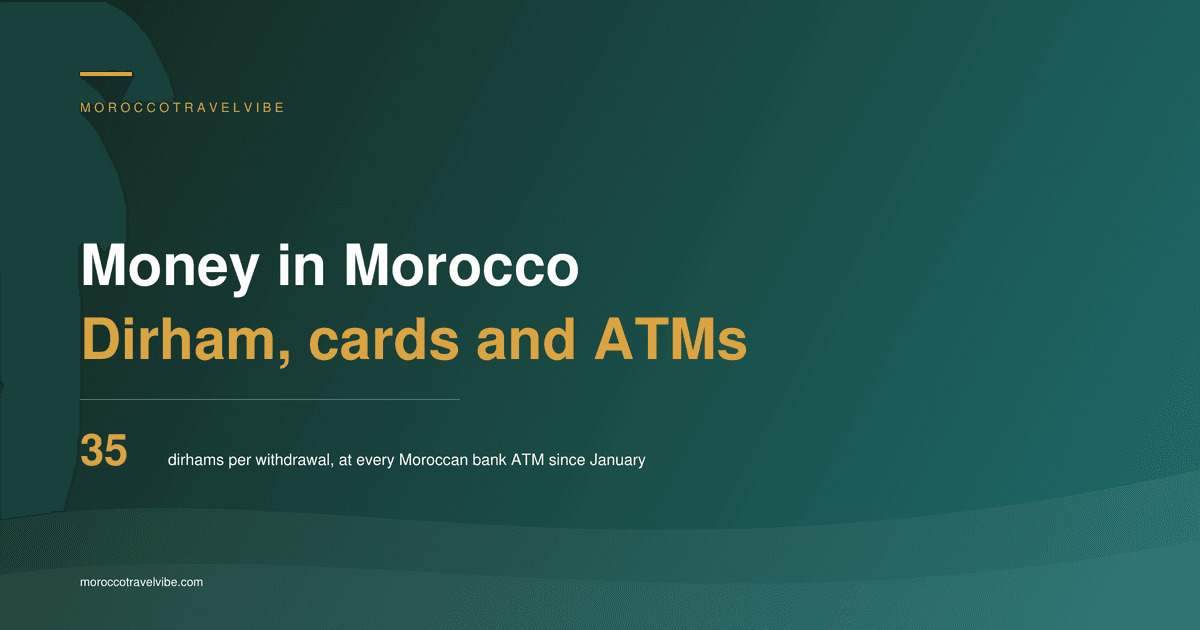
Until January, one bank in Morocco let a foreign card take cash out for free. Al Barid Bank, the post office bank. It started charging about 35 dirhams a withdrawal, and there is now no free cash machine anywhere in the country.
Disclosure: Some links in this guide may earn us a commission, at no extra cost to you. It never changes what we recommend.
Almost every page you’ll read about money in Morocco still recommends that bank. That tells you something about who writes them. Four of the top eight results for this question belong to businesses that sell foreign exchange, and the rest are working from a rulebook Morocco replaced on 1 January.
Because the rules did change, twice, this year. We read both documents on 22 August. Here’s what they say, what a withdrawal actually costs, and which of your leftover dirhams you’re allowed to take home.
Key Takeaways
- The dirham is a closed currency. You can’t buy it at home, and shopping for a better rate is pointless: it’s pegged to a basket that’s 60% euro and 40% dollar inside a 5% band
- No Moroccan bank ATM is free any more. Budget about 35 dirhams a withdrawal, charged by the machine before your own bank adds anything
- Withdraw large, withdraw rarely. A flat 35-dirham fee costs 3.5% on a 1,000-dirham withdrawal and 0.9% on a 4,000-dirham one
- Exchange rates are negotiable by regulation. The office must also display its Office des Changes licence and its daily rates where you can see them
- You can carry 2,000 dirhams out, no more. Changing a bigger surplus back needs the declaration you made on the way in
Table of Contents
What currency does Morocco use, and can you get it before you fly?
The Moroccan dirham, and no, you can’t. It’s a closed currency, so you buy it after you land. That’s not a quirk of your bank. The dirham is administered rather than traded. Bank Al-Maghrib pegs it to a basket weighted 60% euro and 40% US dollar, then lets it move inside a band of plus or minus 5%. That band has been in place since March 2020 (Bank Al-Maghrib).
Which is why waiting for a good rate is a waste of your attention. On 22 August 2026 the dirham sat at 10.78 to the euro, having moved between 10.74 and 10.81 across the previous seven days, and at 9.23 to the dollar (Wise, 22 August 2026). That is the whole range. The rate is set the day you land, and the number that actually moves your budget is the fee, not the rate.
Notes come in 20, 50, 100 and 200 dirhams, with coins up to 10. One thing that catches people out: three note series circulate side by side, from 2002, 2012 and 2023 (Bank Al-Maghrib). An unfamiliar-looking 100 is almost always an older one, not a fake.
What does an ATM withdrawal cost in Morocco?
About 35 dirhams a time, charged by the Moroccan machine before your own bank charges you anything. Al Barid Bank was the last exception, and it started charging in January 2026. There is no longer a fee-free ATM anywhere in the country for a foreign card (reported consistently by travellers and by Morocco Tips, 2026, with the caveat below).
That fee is flat, and flat fees punish small withdrawals. Take 500 dirhams and you’ve paid 7% for the privilege. Take 4,000 and you’ve paid under 1%.
So the rule is: withdraw large, withdraw rarely. Two or three withdrawals per person for a week’s trip, not a daily top-up. Machines cap you anyway. Travellers report per-transaction ceilings of 2,000 to 4,000 dirhams depending on the bank, though like the fee itself that number is unpublished, so read your machine rather than our figure.
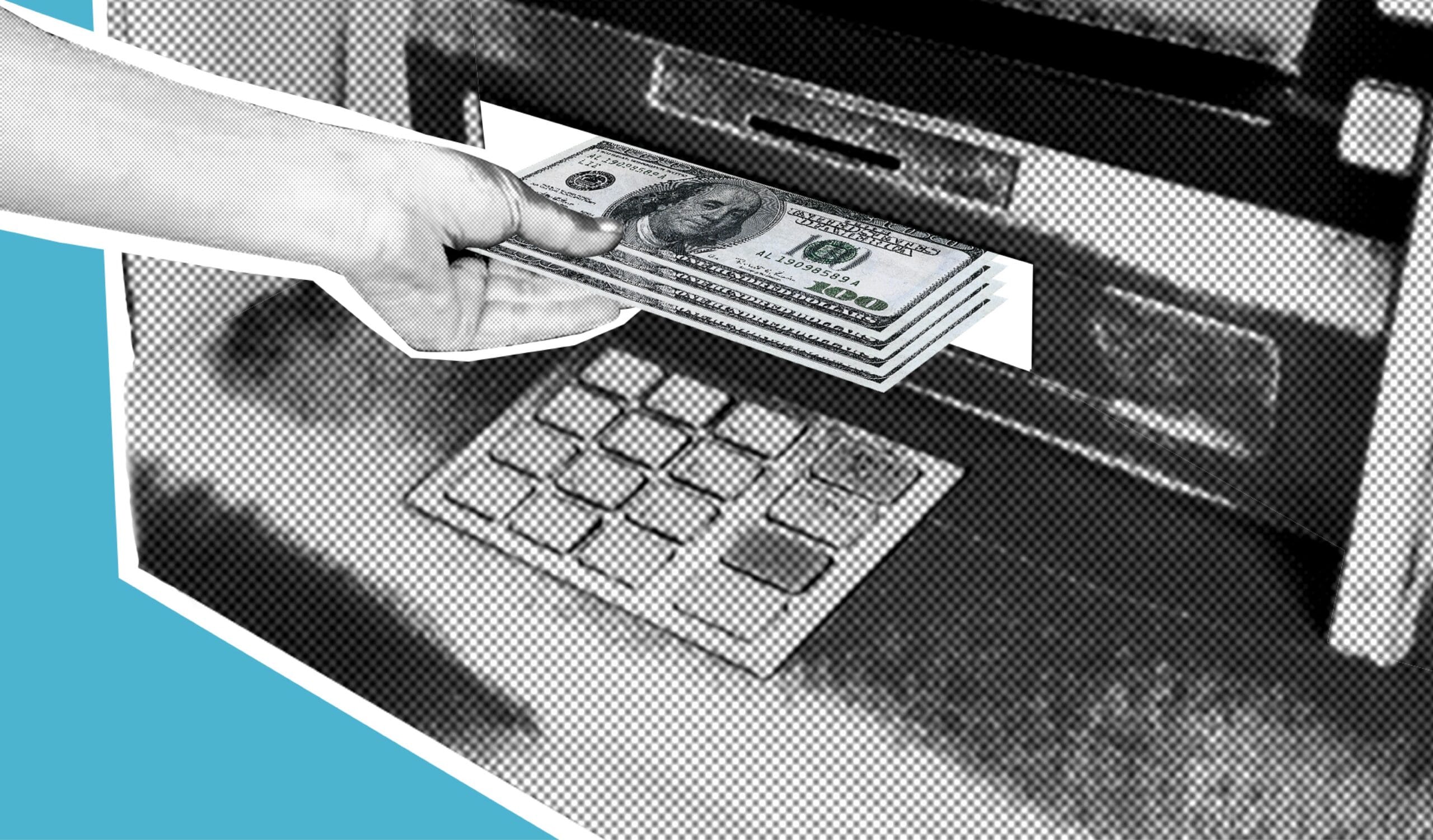
Then there’s the screen that asks whether you’d like to be charged in your own currency. Say no. Every time. That option is called dynamic currency conversion, and the Norwegian Consumer Council measured its markup on top of official Visa rates at 7.6% on average, reaching 12.4% at worst. Those figures are cited in a 2023 study in the Journal of Public Policy & Marketing (Gerritsen, Lancee and Rigtering). It found the choice is presented in ways that push less financially literate customers into accepting it. Choose dirhams and let your own bank do the conversion.
Our finding: no Moroccan bank publishes this fee. We read Al Barid Bank’s own 2026 tariff grid on 22 August 2026. It prices a domestic withdrawal at another bank’s machine at 6 dirhams and says nothing at all about foreign cards. The 35-dirham figure exists on the machine’s screen and nowhere else, which is why every published version of it traces back to travellers rather than to a bank. Treat it as the going rate, not a tariff, and read the screen.
Where should you change cash, and can you negotiate the rate?
At a licensed exchange operator, and yes, you can negotiate, because the regulation says the rate is negotiable. On 15 June 2026 the Office des Changes published a new instruction governing every exchange business in Morocco, replacing a 2018 text. Article 4 is one sentence long and worth the whole section: buying and selling rates for foreign banknotes “sont négociables” (Office des Changes, June 2026). The board on the wall is an opening position.
The same instruction tells you how to spot an office that’s playing by the rules, which takes about ten seconds at the door. Article 9 requires four things on display. A CHANGE sign in several languages outside, the working hours outside, the original Office des Changes licence inside where customers can see it, and rates updated daily and visible to the public. Article 19 adds the one that matters most later: every transaction must produce a bordereau de change generated automatically from the regulator’s own SARF platform, with no erasures or corrections. A handwritten slip is not a compliant receipt.
Article 1 is blunter. Exchanging currency without a licence is prohibited, as is any sign or trading name implying a licence that doesn’t exist. There are four licence classes, and the fourth is the one travellers meet most. Category D covers tourism businesses, so a riad or hotel changing your euros needs its own licence and has to display it in reception.
Look at the width of those bands. Bank Al-Maghrib’s own published banknote rates put the euro anywhere between 10.2182 and 11.8752 (Bank Al-Maghrib, retrieved 22 August 2026). Physical cash is expensive to handle, so a spread exists everywhere. But knowing the mid before you walk in, and knowing the rate is negotiable, changes what you can say at the counter. Ask what they can do on the rate for the amount you’re carrying. Sometimes nothing happens. Sometimes it does.
Do cards work in Morocco, and where do they stop?
They work in hotels, chains, petrol stations and the modern half of any city, and they stop at the medina. That isn’t caution, it’s arithmetic. The whole country had 72,256 card-accepting merchants at the end of 2025, of which 3,847 were online only (Aujourd’hui le Maroc, 2026). For a country of 37 million people, that is a thin net.
The cash side dwarfs it. Cash in circulation hit 491 billion dirhams in 2025, up 18.5% in a year and equal to 28.5% of GDP (Hespress, citing the central bank’s annual report). Meanwhile the ATM network grew by just 201 machines to 8,298 (Medias24, July 2026). Foreign cards did about 15% of Morocco’s roughly 240 million card transactions last year, worth some 32 billion dirhams (Finances News Hebdo).
Why does a café wave you away for a 60-dirham bill? Because acceptance costs the merchant money, and the regulator has been squeezing that cost. The interchange cap drops from 0.65% to 0.50% on 1 October 2026, with a 0.15% rate for small merchants and public bodies (Medias24, July 2026).
Worth knowing, though: Loi 31-08 bans refusing a sale without legitimate reason. Bouazza El Kharrati, who heads the Moroccan Federation for Consumer Rights, reads article 57 of that law as covering shops which turn down a card because the bill is under 100 dirhams (SNRT News). That’s his reading rather than settled case law. Treat it as an argument you can make, not a rule you can enforce on a Tuesday in a bakery.
How much cash should you carry, and in which notes?
Plan on 2,500 to 4,000 dirhams per person for a mid-range week, which is the range we costed from line items in our survey of what a Morocco trip actually costs. The part that guide doesn’t cover is denomination, and denomination is where the friction lives.
Money in Morocco moves in small notes, and machines love handing out 200s. The medina cannot break them. A 200-dirham note is useless to a stall selling a 15-dirham juice or a hammam charging 60. It’s worse in a petit taxi, where a metered city trip runs 15 to 40 dirhams and drivers keep almost no float. “No change” is sometimes a genuine constraint and sometimes a technique, and you can’t tell them apart while holding the only large note in the conversation.
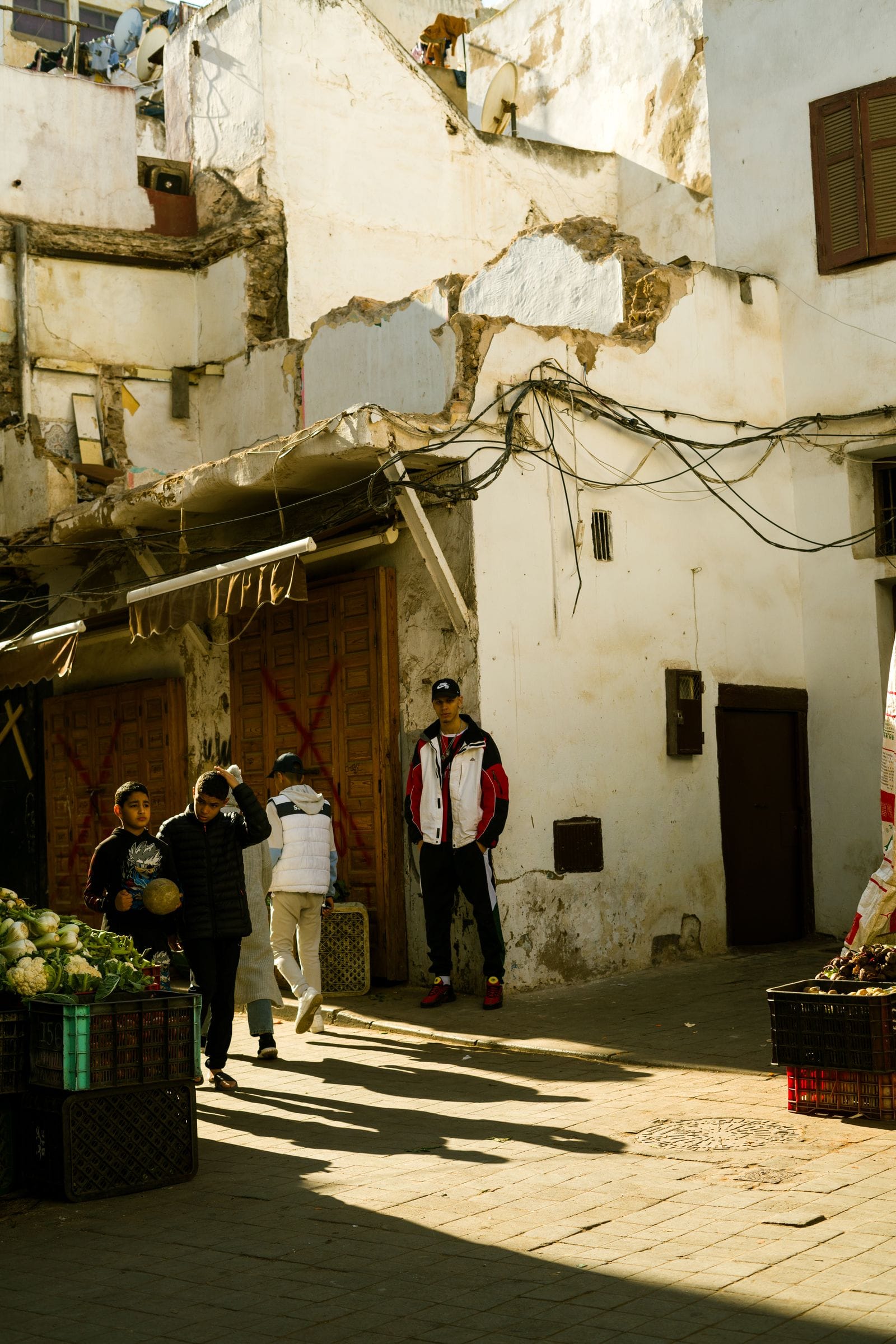
So break notes where breaking is easy and free: supermarkets, petrol stations, chain pharmacies, your riad on checkout. Then hoard 20s and 50s for taxis, tips, entries and hammams. Carry roughly a day’s spending on you and leave the rest in the room safe. What to actually tip, and what a guide’s day rate should be, is a separate collection we publish on 26 September.
Can you take dirhams out of Morocco?
Two thousand dirhams, and not a note more. Morocco prohibits importing and exporting its currency, with one exception written for travellers. You may carry up to 2,000 dirhams in each direction, and the stated purpose is to cover your expenses when you next arrive (Office des Changes, IGOC 2026, in force since 1 January 2026).
Changing a bigger surplus back is where people get caught, because this rule changed in January and every guide still describes the old one.
Our finding: we compared the 2022 and 2026 instructions line by line on 22 August 2026. The 2026 text drops the ATM receipt as proof of where your dirhams came from.
| Changing dirhams back | Rulebook until 2025 | In force since 1 January 2026 |
|---|---|---|
| Proof accepted | Exchange slip, or an ATM withdrawal receipt, or an exchange-machine ticket | The original currency-import declaration from the border, annotated, plus the original exchange slips |
| If you have no declaration | Not addressed | Maximum 20,000 dirhams, against a slip in your name under six months old |
| At a port or airport | Boarding pass only, capped at 2,000 dirhams per passport | Unchanged |
There’s one route that needs no paperwork at all, and it’s the one most visitors will use. At a port or an airport, a bank or exchange operator can change your dirhams back on your boarding pass alone, capped at 2,000 dirhams per passport. The same instruction also sets the customs line. Bring in foreign currency worth 100,000 dirhams or more and you must declare it. Below that the declaration is optional, and it is exactly what lets you take the money out again.
Which produces one practical instruction that contradicts the advice higher up this page, and should. Withdraw large and rarely for most of your trip. Then stop. In the last 48 hours, spend down rather than top up, because a 3,000-dirham surplus and no paperwork is a problem the airport desk cannot fully solve.
What actually goes wrong with money in Morocco?
Four things, and all four are checkable before you hand anything over. None of them requires you to trust a stranger’s honesty, which is the useful part.
The conversion screen is first, at the machine or the card terminal, and it’s the most expensive mistake available to a tourist because it’s dressed as a convenience. Always pay in dirhams.
Second, the exchange counter that shortchanges you on a busy board and hands over a handwritten slip. Both halves of that matter now: under the June instruction the receipt has to be machine generated, so the slip is a compliance failure as well as a bad souvenir. Count the notes at the window before you step away.
Third, the man outside the bureau with a better rate. That’s unlicensed exchange, prohibited outright, and it comes with no receipt, so those dirhams have no documented origin when you try to change them back. He is closer than you think to the unofficial guide economy working the same streets, and the mechanics are identical: an unlicensed intermediary offering a service the licensed version provides with paperwork.
Fourth, the terminal that “fails” and gets tapped twice. Keep the card in sight, watch the screen, check your banking app before you leave the shop. That one sits inside our wider catalogue of Morocco scams alongside the taxi and shopping versions.
Notice the pattern in all four. Every counter is a documented one. The licence is on the wall or it isn’t; the receipt is printed or it isn’t; the screen says dirhams or it doesn’t.
Common questions
Can you buy Moroccan dirhams before you travel?
No. The dirham is a closed currency, pegged to a 60% euro and 40% dollar basket and administered by Bank Al-Maghrib, so it isn’t sold on foreign exchange counters at home. Bring euros, pounds or dollars and change or withdraw after you land. Arrivals halls at both main airports have machines and counters.
How much does it cost to withdraw money in Morocco?
About 35 dirhams per withdrawal at the machine, plus whatever your own bank charges. Al Barid Bank was the last fee-free option and began charging in January 2026. Because the fee is flat, it costs 3.5% on a 1,000-dirham withdrawal and 0.9% on a 4,000-dirham one, so take fewer, larger amounts.
Should I pay in dirhams or my own currency when the screen asks?
Dirhams, always. Choosing your home currency triggers dynamic currency conversion, measured by the Norwegian Consumer Council at 7.6% above official rates on average and 12.4% at worst. Your own bank’s conversion is almost always cheaper. The same rule applies at card terminals in shops and restaurants, not just cash machines.
Can I take dirhams home with me?
Up to 2,000 dirhams. Beyond that the currency cannot legally leave. Changing a surplus back needs the currency-import declaration you made on entry plus your original exchange slips, or a maximum of 20,000 dirhams without it. At the airport you can change back 2,000 dirhams per passport on your boarding pass alone.
Is it better to change money at the airport or in town?
In town, but change enough at the airport to get there. Rates are negotiable by regulation, so the number on the board is a starting point. A city office competing with three others on the same street has more reason to move than one holding a captive arrivals hall. Check the licence is displayed either way.
The short version
Money in Morocco is a cash system with a card layer bolted on the modern half of it.
- Get your dirhams in Morocco. Closed currency, administered rate, nothing to shop for at home
- Withdraw large and rarely. About 35 dirhams a time at every bank now, so 4,000 costs you a quarter of what five 800s would
- Say no to the screen offering your own currency. That’s 7.6% on top on average, and up to 12.4%, every time
- Change cash where the licence and the daily rates are on display, take the printed receipt, and ask what they can do on the rate
- Spend down before you fly. 2,000 dirhams out, and the airport desk can only take back 2,000 on a boarding pass
Everything else we’ve measured, priced and dated sits in Real Costs.