Last verified: October 10, 2026. On 10 October I read the data prices of nine travel eSIM sellers and two Moroccan operators on their own pages, in one sitting. I converted dirhams at that day’s rate. Coverage comes from Opensignal’s report on January to March 2026. Mobile data prices move often, so I re-check them every 30 days.
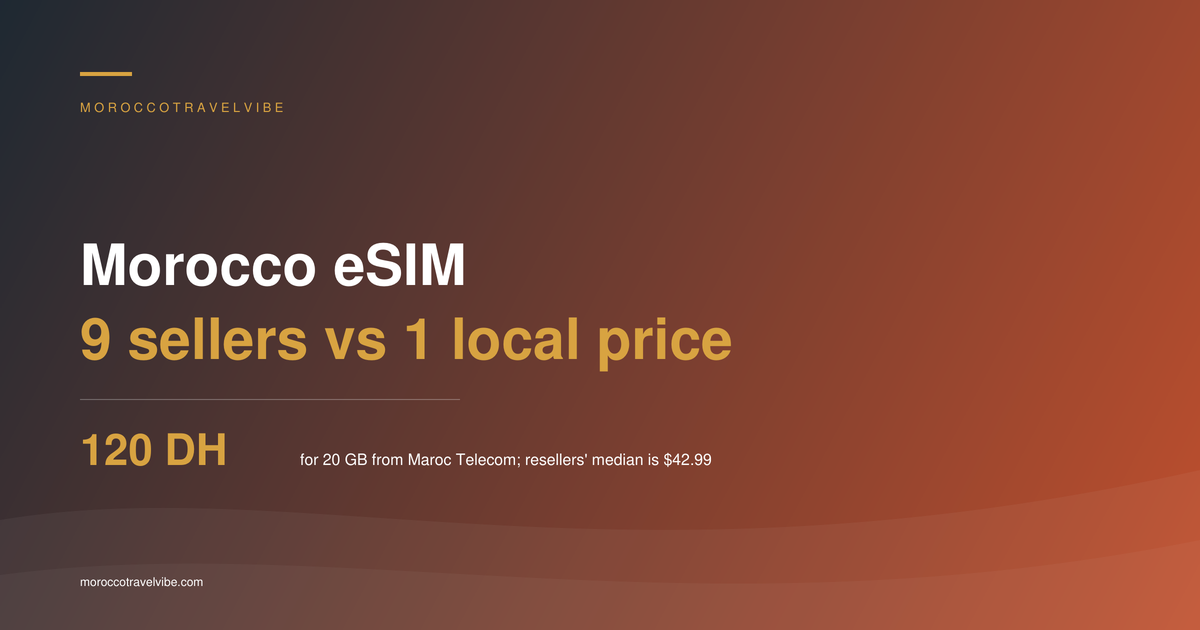
A Morocco eSIM from the country’s best-covered network costs 120 dirhams for 20 GB, about $12. The same 20 GB from a travel eSIM reseller has a median price of $42.99. And half of the resellers that say which network they use put you on the one with the weakest coverage score.
Disclosure: Some links in this guide may earn us a commission, at no extra cost to you. It never changes what we recommend.
Almost every guide that tells you which eSIM to buy for Morocco is written by a company that sells one, and each prints its own prices. So I priced them side by side: nine sellers and the operators themselves, read on one day, per gigabyte, with the network each one actually runs on.
Key Takeaways
- Maroc Telecom’s visitor eSIM: 120 DH (about $12) for 20 GB over 30 days
- 72% under the reseller median of $42.99 for the same 20 GB
- Half the resellers that name a network use Orange only, the lowest coverage score (7.8 against 9.2)
- It activates after a first call in Morocco; I haven’t tested buying it from abroad
- Roaming costs most: $84 a week on Verizon
Table of Contents
What does a Morocco eSIM cost?
On 10 October 2026, a Morocco eSIM with 20 GB for 30 days cost 120 DH (about $12.06) from Maroc Telecom and $25.00 to $54.88 from five resellers. The reseller median was $42.99, so the operator’s own eSIM came in 72% cheaper. Per gigabyte, that is $0.60 against $2.15.
Here is the whole read. Prices are what each seller’s Morocco page showed in US dollars on 10 October. I converted dirhams at 9.95 to the dollar, the rate open.er-api.com gave that day.
| Seller | Network named on the page | 10 GB, 30 days | 20 GB, 30 days | Per GB at 20 GB |
|---|---|---|---|---|
| Maroc Telecom visitor eSIM | Maroc Telecom | not sold | 120 DH (about $12.06) | $0.60 |
| Nomad | Orange | $21.00 | $25.00 | $1.25 |
| Yesim | Maroc Telecom, inwi, Orange | $21.60 | $32.40 | $1.62 |
| Ubigi | Maroc Telecom, Orange | 23 (currency shown inconsistently) | not sold | n/a |
| eSIMCard | in a pop-up I couldn’t read | $31.40 | $54.88 | $2.74 |
| Saily | not named | $33.99 | $42.99 | $2.15 |
| Airalo | Orange | $34.00 | $43.00 | $2.15 |
| aloSIM | Orange | $44.00 | not sold | n/a |
At 10 GB the seven resellers run from $21.00 to $44.00, with a median of $31.40. The spread between the cheapest and the dearest is about two to one, for the same gigabytes in the same country. Two more sellers, Holafly and Maya, sell only unlimited plans: seven days cost $32.50 and $19.99. The FAQ below covers what “unlimited” means here.
One caution on the table. Ubigi’s eight Morocco pages title the prices in dollars and render a euro sign beside the same number, so I can’t tell you which currency it charges. It doesn’t move either median. This is one day’s read, and any of these prices can change by next week. Data is a small line in what the rest of a Morocco trip costs.
Can you buy a Moroccan eSIM before you fly?
Maroc Telecom’s own page says yes: in October 2026 its E-SIM Visiteurs offer listed four tiers from 70 to 320 DH, sold on its e-boutique, with the QR code sent by email. I have not tested the checkout from abroad, so I can’t confirm a foreign card goes through.
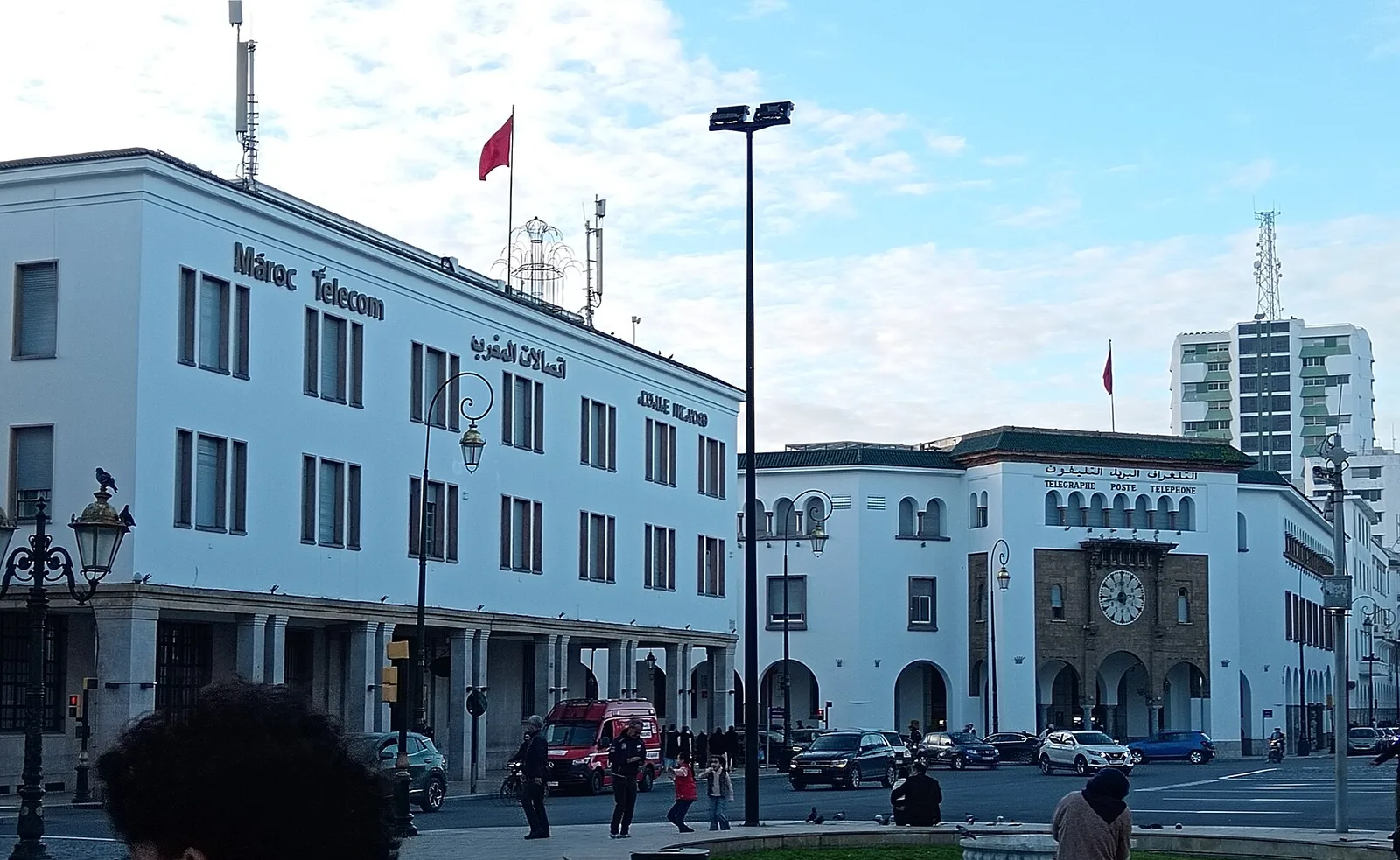
A Maroc Telecom building, photographed in 2026. Photo: CAPTAIN RAJU, CC0, via Wikimedia Commons.
These are the four tiers, as the French version of the page prints them:
| Tier | Price | What you get | Valid |
|---|---|---|---|
| Essentiel Social Media | 70 DH | 1 GB, unlimited social apps, 1 hour of national calls | 30 days |
| Essentiel | 120 DH | 20 GB | 30 days |
| Essentiel Plus | 200 DH | 45 GB | 30 days |
| Essentiel Max | 320 DH | unlimited internet, 9 hours of calls, 100 SMS | 14 days |
Every tier also carries 20 DH of credit, usable for national and international calls and for data, valid three months. The English page disagrees with the French one on two tiers, labelling them “Copy of Essential” with the wrong volumes, so I’ve gone with the French.
There is one catch, and the page states it plainly. Once you’re in Morocco, you have to “effectuer un premier appel” (make a first call). That activates the line and releases the data. So you install it before you fly and switch it on after you land. If your phone takes two lines, keep your home SIM in for bank codes.
I can’t simply say “buy this”. Morocco has required every mobile line to be registered to an identity document since April 2014. The regulator then banned self-registration: identification goes through a seller or an operator agent (Medias24, September 2014). How the online visitor eSIM checks your identity, the page doesn’t say. If it needs a counter visit, the advantage shrinks. Paying for it works like any card payment abroad; paying in Morocco covers the card side.
The other two operators are thinner. Orange Maroc’s eSIM page lets you order a prepaid line as an eSIM. It names no visitor product. inwi’s site wouldn’t load for me on 10 October, by script or in a browser, so I have no inwi prices.
Is a local SIM card cheaper than an eSIM?
About the same as the operator’s own eSIM, and far cheaper than a reseller. Maroc Telecom’s *3 data pass gave 20 GB for 100 DH in October 2026, on a promotion that doubles the volume. That works out at about $0.50 per GB, close to the visitor eSIM’s $0.60.
This is Maroc Telecom’s *3 grid as it stood on 10 October. Every tier above 25 DH was marked “Promo”, with the normal volume printed beside it at half:
| *3 pass | Data (promo) | Normal | Valid |
|---|---|---|---|
| 30 DH | 6 GB | 3 GB | 14 days |
| 50 DH | 10 GB | 5 GB | 1 month |
| 100 DH | 20 GB | 10 GB | 1 month |
| 200 DH | 40 GB | 20 GB | 1 month |
| 300 DH | 60 GB | 30 GB | 2 months |
The page prints no end date for the promotion. If it ends, 100 DH buys 10 GB and the physical SIM becomes the dearer local option. Orange sells a physical SIM for 20 DH with 20 DH of credit. Its *3 page only says the volumes run “de 500 Mo jusqu’à 200 Go” and doesn’t list the tiers. I found no bare SIM price on Maroc Telecom’s site.
When does the physical SIM win? When your phone can’t take an eSIM, and on long stays, because the 300 DH and 500 DH passes run two and three months. Otherwise the two cost about the same, and the eSIM is the one you can try to set up before you fly.
Which network has the best coverage in Morocco?
Maroc Telecom, narrowly ahead of inwi, with Orange third. In Opensignal’s report on January to March 2026, Maroc Telecom scored 9.2 out of 10 for Coverage Experience, inwi 9.1 and Orange 7.8. Maroc Telecom also had the fastest typical download, 27.5 Mbps.
Opensignal’s Morocco report measures what users’ phones actually record, not what operators claim. Coverage Experience, in its own definition, reflects coverage of populated areas on a scale of 0 to 10. Here are the three operators on the measures that matter most for a traveller:
| Measure (Jan to Mar 2026) | Maroc Telecom | inwi | Orange |
|---|---|---|---|
| Coverage Experience (0 to 10) | 9.2 | 9.1 | 7.8 |
| Download speed (Mbps) | 27.5 | 22.8 | 23.7 |
| Reliability (100 to 1,000) | 791 | 815 | 744 |
| Time with a signal | 94.6% | 95.0% | 95.5% |
The three networks are close on time with a signal. The gap is in coverage, where Orange sits 1.4 points behind. As a country, Morocco is fast enough for anything a visitor does. Ookla’s Speedtest Global Index put the median mobile download at 69.70 Mbps in August 2026, 64th in the world.
Does the network matter? In Marrakech or Fes, hardly. On a long road through the mountains, it’s the one number worth checking.
Which network does your Morocco eSIM use?
Three of the six resellers that name a network on their Morocco page use Orange only: Airalo, Nomad and aloSIM. Ubigi lists Maroc Telecom and Orange; Holafly and Yesim list all three. Saily and Maya don’t say on the page, and eSIMCard’s is in a pop-up I couldn’t read.
Put that beside the coverage table and a pattern shows. The cheapest reseller per gigabyte in my read, Nomad at $1.25, lists Orange on every Morocco plan that names a network in its page data. So does Airalo. A travel eSIM is a roaming arrangement with a local network, and the seller decides which.
The practical step is to read the network line on a seller’s page before buying. If it says Orange only and your trip stays in the cities, it hardly matters. If the trip crosses the Atlas to the desert, weigh a lower price against the network that scored lowest on coverage.
Does your phone work in the desert and the Atlas?
The national measures say coverage is high on the strongest network, but no operator coverage map for the dunes was readable, so I won’t promise a signal in camp. Maroc Telecom’s 9.2 Coverage Experience in early 2026 measures populated areas, not empty desert.

The High Atlas, on the road to Merzouga. Photo: Karimachalhi, CC BY-SA 4.0, via Wikimedia Commons.
My Morocco travel guide says it in one line: the coverage is better than you’d expect, right up until the desert. Nothing I read on 10 October contradicts that. What I can add is the order of the networks, and that half the resellers that name a network put you on the third.
Here’s what I’d do on the long roads between cities, which the guide to getting around Morocco covers in full. Download offline maps before you leave. Save the camp’s number and WhatsApp before the last town. And keep the eSIM’s 20 DH of call credit for an actual phone call.
How much does roaming cost in Morocco?
Verizon’s TravelPass costs $12 a day in Morocco in October 2026, with 5 GB at high speed and then slower data. A seven-day trip comes to $84, seven times what Maroc Telecom charges for a visitor eSIM that lasts a month.
Verizon’s TravelPass page lists Morocco at $12 a day. T-Mobile’s roaming plans include 5 to 15 GB at high speed in “215+ countries”, then 256 Kbps. Its Morocco result page didn’t load for me, so I can’t confirm Morocco is on the list. I couldn’t read AT&T’s day pass price. Vodafone UK puts Morocco in its Zone D, with no daily price shown on the page.
Roaming does one thing the others don’t: it keeps your own number live for bank codes. You can get that anyway by keeping your home SIM in the phone for texts and running data on an eSIM.
What should you ask at an airport SIM counter?
Ask which pass you’re buying and check it against the operator’s own grid, because Maroc Telecom publishes one national price list. Bring your passport: Morocco’s 57.06 million mobile lines are all meant to be registered, and the regulator says it’s still cleaning up unregistered ones in 2026.

Marrakech Menara, Terminal 1. Photo: 瑞丽江的河水, CC BY-SA 4.0, via Wikimedia Commons.
ANRT’s mobile report for the first quarter of 2026 counts 57.059 million lines, 85.4% of them prepaid. It puts the quarter’s fall partly down to identification work on the subscriber base. The minister told parliament in 2023 that operators alone are responsible for identifying every subscriber (Hespress). So expect a passport scan and a form.
Do airport counters charge more than town? I didn’t measure it, and I found no dated, first-hand source that did. What I can tell you is what the operator publishes, so ask for the pass by its name and price (for example “*3, 100 DH”) and compare.
Frequently Asked Questions
Can I buy a Moroccan eSIM before I travel?
Maroc Telecom lists one on its own site: the E-SIM Visiteurs, from 70 DH, with 20 GB for 120 DH over 30 days. The QR code arrives by email and the line activates after a first call made in Morocco. I haven’t tested whether its checkout accepts a foreign card.
Which network has the best coverage in Morocco?
Maroc Telecom, by a small margin. Opensignal’s report on January to March 2026 scored it 9.2 out of 10 for Coverage Experience, against 9.1 for inwi and 7.8 for Orange. Maroc Telecom also had the fastest typical download, at 27.5 Mbps.
Is a local SIM cheaper than an eSIM in Morocco?
It’s far cheaper than a reseller eSIM and about the same as the operator’s own. In October 2026, Maroc Telecom’s 3 pass gave 20 GB for 100 DH on a promotion, and its visitor eSIM gave 20 GB for 120 DH. Five resellers had a median of $42.99 for 20 GB.
Do I need a passport for a SIM card in Morocco?
Yes. Every mobile line in Morocco has had to be registered to an official identity document since April 2014, and a foreign visitor’s is the passport. The regulator’s 2026 figures show it is still removing unregistered lines, so expect a scan and a form at the counter.
Is an “unlimited” Morocco eSIM really unlimited?
Usually not at full speed. On 10 October 2026, Airalo, Saily and aloSIM slowed to 1 Mbps after 3 GB a day, and Nomad after 2 GB. Holafly says speed may be reduced for up to a day. Maya was the only seller I read that stated no cap at all.
Morocco eSIM: the short answer
Which Morocco eSIM should you buy, then? If your phone takes an eSIM, try Maroc Telecom’s own visitor eSIM first: 120 DH for 20 GB, on the network that scored best for coverage. If its checkout won’t take you from abroad, buy a SIM at an operator counter and add a *3 pass. Treat a reseller eSIM as the convenience price, and roaming as the emergency price.
- Cheapest per gigabyte: the operator, at about $0.50 to $0.60.
- Reseller median for 20 GB: $42.99, and half the resellers that name a network use Orange alone.
- Best coverage: Maroc Telecom, 9.2 out of 10.
- Dearest: roaming, $84 for a week on Verizon.
If you’re staying long enough to work from Morocco, the phone ends up being the reliable connection rather than the flat’s fibre; the digital nomad guide covers that side.