Last verified: September 12, 2026. Every menu price on this page was read on the date above: 66 restaurant menus on a delivery app in Marrakech and Fes, five Marrakech restaurants’ own published menus, three supermarkets and three fast-food branches. A sixth published menu, a chain’s with no city named, was read and left out. The inflation figures are the HCP’s latest monthly release at that date. I re-read the menus and the index every 30 days and move the date each time.
A mint tea cost 25 dirhams on the median Marrakech delivery menu when I read the menus on 12 September 2026, and 25 on the median medina terrace menu too. A litre of still water cost 2.72 dirhams in a supermarket pack and 40 on a terrace card. That second gap, not the first, is the honest story of food prices in Morocco.
Disclosure: Some links in this guide may earn us a commission, at no extra cost to you. It never changes what we recommend.
The food-price guides I read print the same three lines: street food is cheap, restaurants cost more, budget so much a day. Almost none of them says where a dish price came from, or when it was read. So what does a plate actually cost, and where does the markup really sit?
I read the menus instead. Same six items on five tiers, four of them measured, from the supermarket shelf to the medina roof, with the sample size printed next to every number.
Key Takeaways
- Food prices in Morocco are falling. The HCP’s food index was 3.7% lower in July 2026 than a year earlier, while shop prices for bottled water, soft drinks, and packeted tea and coffee edged up in the month
- A terrace adds just over a quarter to a delivery-menu tagine. The median chicken tagine was 90 dirhams on 17 Marrakech delivery menus and 115 on four medina terrace menus
- Tea is not marked up from delivery menu to terrace. Water is marked up the moment it leaves the shelf. A mint tea sat at 25 dirhams on both kinds of menu, while a litre of water went from 2.72 on a supermarket pack to 30 on a delivery menu and 40 on a terrace card
- Delivery menus are most likely a ceiling, not the counter price, and no counter price is published online. The street figures here are reported ranges, labelled that way
- A Big Mac menu costs 68 dirhams on McDonald’s delivery pages in Marrakech, Fes and Casablanca alike. The chain prices nationally, while one tagine ran from 50 to 143 in a single city
Table of Contents
What do food prices in Morocco look like, from street to terrace?
Cheap at the bottom, ordinary at the top, and the steepest rung is the bottle. On 12 September 2026 I read the same six items on four measured tiers in Marrakech: a supermarket, 50 restaurants on the Glovo delivery app, five medina restaurants’ own menus and one fast-food chain. The fifth tier, the street, carries reported ranges. Every measured figure below is a median in dirhams, with its sample size.
| Item | Supermarket shelf | Street counter, reported | Delivery menu, Marrakech | Medina terrace, own menu |
|---|---|---|---|---|
| Chicken tagine | not sold | 30 to 50 | 90 (n=17) | 115 (n=4) |
| Harira | not sold | 5 to 8 at a local café | 40 (n=14) | 55 (n=3) |
| Mint tea | not sold | 5 to 15 | 25 (n=6) | 25 (n=5) |
| Still water, per litre | 2.72 to 6.00 | not listed | 16.67 (n=13) | 40 (n=2) |
| Msemen or harcha | not sold | 5 to 10 | 4 and 10 (n=2) | not listed |
| Big Mac Best Of menu | not sold | not sold | 68 on McDonald’s delivery pages, all three cities | not sold |
Three method notes. The delivery column comes from every store under Glovo’s Moroccan cuisine filter, one price per store per dish, with bundles and two-person plates excluded. The terrace column comes from restaurants’ own published menus, each linked below. The street column is the one I cannot measure without ordering, so it carries reported ranges from published food guides and is never mixed into a median.
Nothing here was ordered or quoted to me in person. These are advertised prices, the same method as every round on this site. No menu says whether a mint tea is a glass or a pot, so I compare tier against tier and never a glass against a pot. What none of it can tell you is what anyone paid at the till.
Why are food prices in Morocco falling, and does a visitor feel it?
In July 2026 Morocco’s food index fell 1.9% in a single month and stood 3.7% below July 2025, while the headline index was 0.6% lower on the year (HCP, consumer price index for July 2026). Food prices in Morocco really are coming down. The detail inside that month shows how little of it reaches a visitor’s table.
What fell was the market basket: vegetables down 7.6% in the month, fish 3.9%, fruit 3.7%, meat 1.2%. What rose came in a bottle or a packet. Mineral water, soft drinks and juices went up 0.3%, and coffee, tea and cocoa 0.2%. Those are small moves, and they track shop prices rather than café prices. Whether cheaper vegetables ever reach a menu card is something one day of reading menus cannot show.
Marrakech’s overall index posted the largest monthly fall of any city, 1.7%. The next re-read of the same menus will show whether any of them moved with it. Whether all this makes the whole trip dearer or cheaper is a separate calculation, and what the whole trip costs carries it.
What does street food cost, and why can nobody measure it?
Reported, not measured: about 30 to 50 dirhams for a hole-in-the-wall tagine, 5 to 8 for a bowl of harira at a local café, and 5 to 10 for a msemen or harcha flatbread, according to published food guides. The standard loaf is the exception, because the state aims to hold it at 1.20 dirhams.
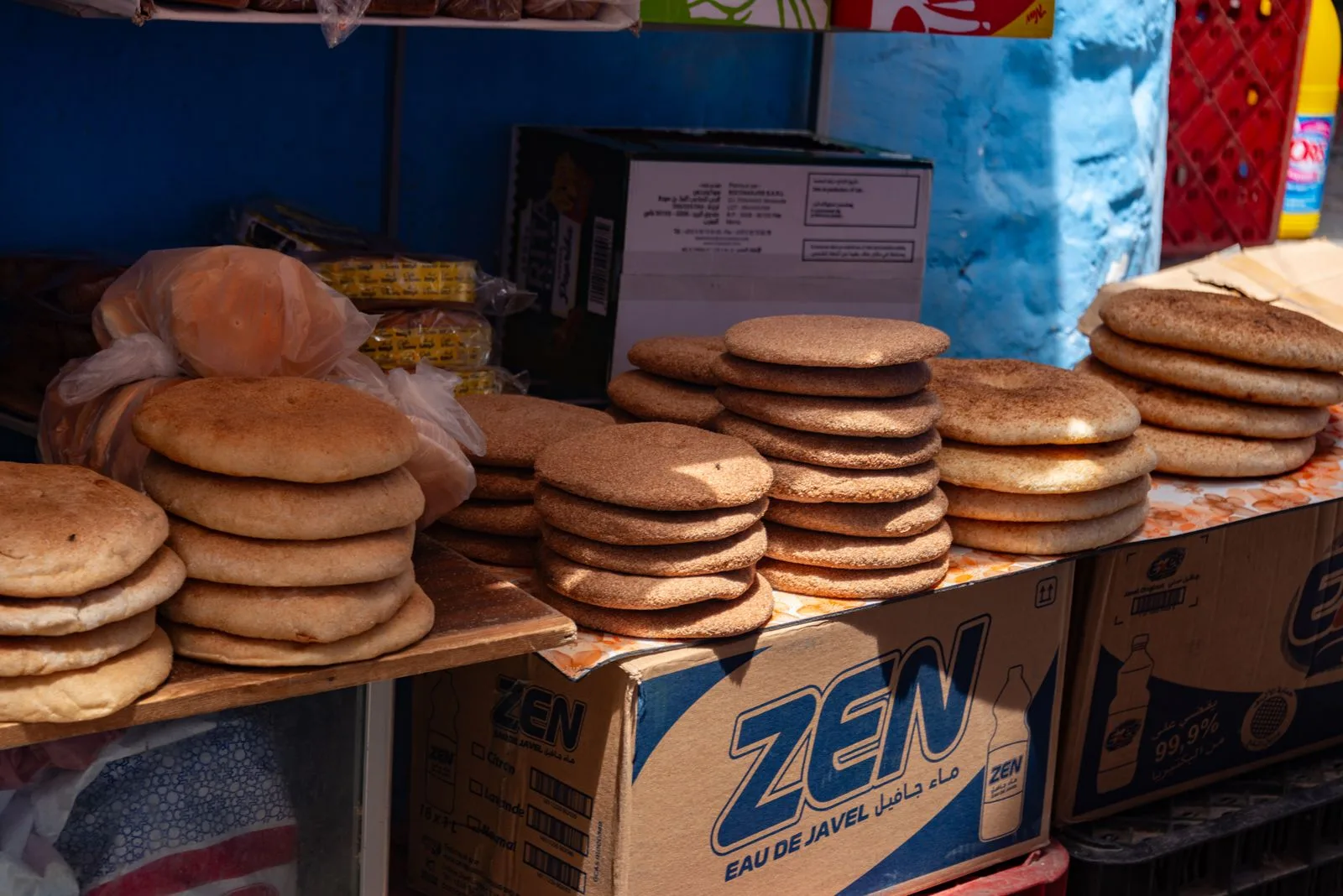
Bread has a paper trail. The compensation report attached to the 2026 finance bill budgets 13.77 billion dirhams to subsidise butane, sugar and soft-wheat flour, and the import aid on wheat is there to keep bread at 1.20 (Telquel, on the 2026 finance bill, October 2025). Nothing else at a street counter has one.
No stall publishes a menu online, and I did not stand at a counter and order. This is the one tier on the page built from reported ranges, and I keep it out of every median. One published guide puts harira at 15 to 20 at tourist-facing places, roughly two to four times the café price for the same bowl.
The biggest food gap on the ladder is very likely between the counter and everything above it. It is also the one gap nobody can show you with a sample size. Water, as a later section shows, is the steepest single line. The delivery menus below are the closest measurable thing to the counter, and on the tagine and harira even they sit well above it. Treat any precise street price that comes without a source the way I treat these.
What does a tagine cost on Moroccan delivery menus?
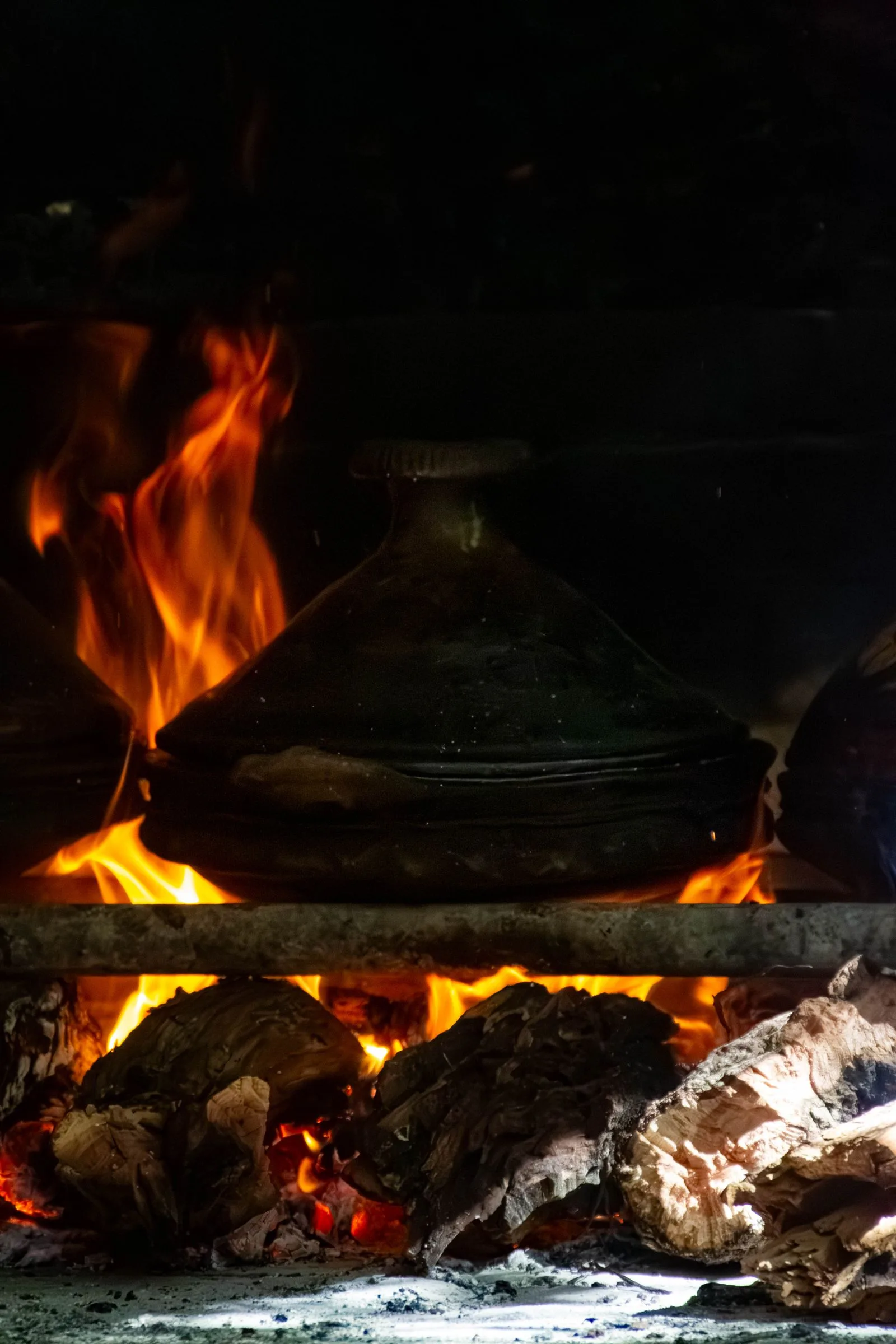
On Glovo’s Moroccan cuisine listing for Marrakech, 17 of the 50 restaurants sold a single chicken tagine, and the median price was 90 dirhams. The middle half ran from 66 to 109, and the full range from 50 to 143 (Glovo, Marrakech, Moroccan restaurants, read 12 September 2026). Harira had a median of 40 across 14 menus, and mint tea 25 across six.
A delivery menu is not the price at the counter. Glovo was reported in 2021 to charge Moroccan restaurants a 31% commission before tax (le360, July 2021). Its own 2024 guide for restaurant partners warns that high prices on the app deter orders, and that customers blame the restaurant (Glovo for Partners, Maroc, March 2024).
One example from my own sample shows how far apart the two can sit. One Marrakech kitchen listed its Tajine Poulet Citron at 121 dirhams on the app. Terrasses des Arts, a rooftop in the medina, prints the same dish on its own menu at 95. A delivery price can be higher than a terrace with a view. So I read the 90-dirham median as a likely ceiling for what a neighbourhood restaurant charges at its own tables, not as that price.
What does a medina terrace add, dish by dish?
About a quarter on the tagine, more than a third on harira and nothing on tea, measured against delivery menus. On the menus Marrakech medina restaurants publish themselves, the median chicken tagine was 115 dirhams across four terraces, against 90 on delivery menus. Harira was 55 against 40 across three, and mint tea 25 against 25 across five. That is 1.28 times on the tagine and 1.38 on the soup, from the restaurants’ own pages read on 12 September 2026.
| Restaurant, own menu | Chicken tagine | Harira | Mint tea | Still water |
|---|---|---|---|---|
| Terrasses des Arts | 95 | 55 | 25 | 20, size not stated |
| Café des Épices | 100 | 40 | 15 | 15 or 25, sizes not stated |
| Le Jardin | 130 | 65 | 20 | 15 small, 25 large |
| Nomad | 130 | seasonal soup only | 40 | 30 for 0.75 L |
| Taj Medina | 120, listed as chicken with lemon and olives | not listed | 30 | 20 for 0.5 L |
Nomad’s chicken tagine appears on its French menu only, served on a plate with candied pears, cashews and aubergine, and its 40-dirham tea is a hot green tea with local herbs and fresh mint. Taj Medina lists its dish under mains without the word tajine, so it appears here but stays out of the tagine median.
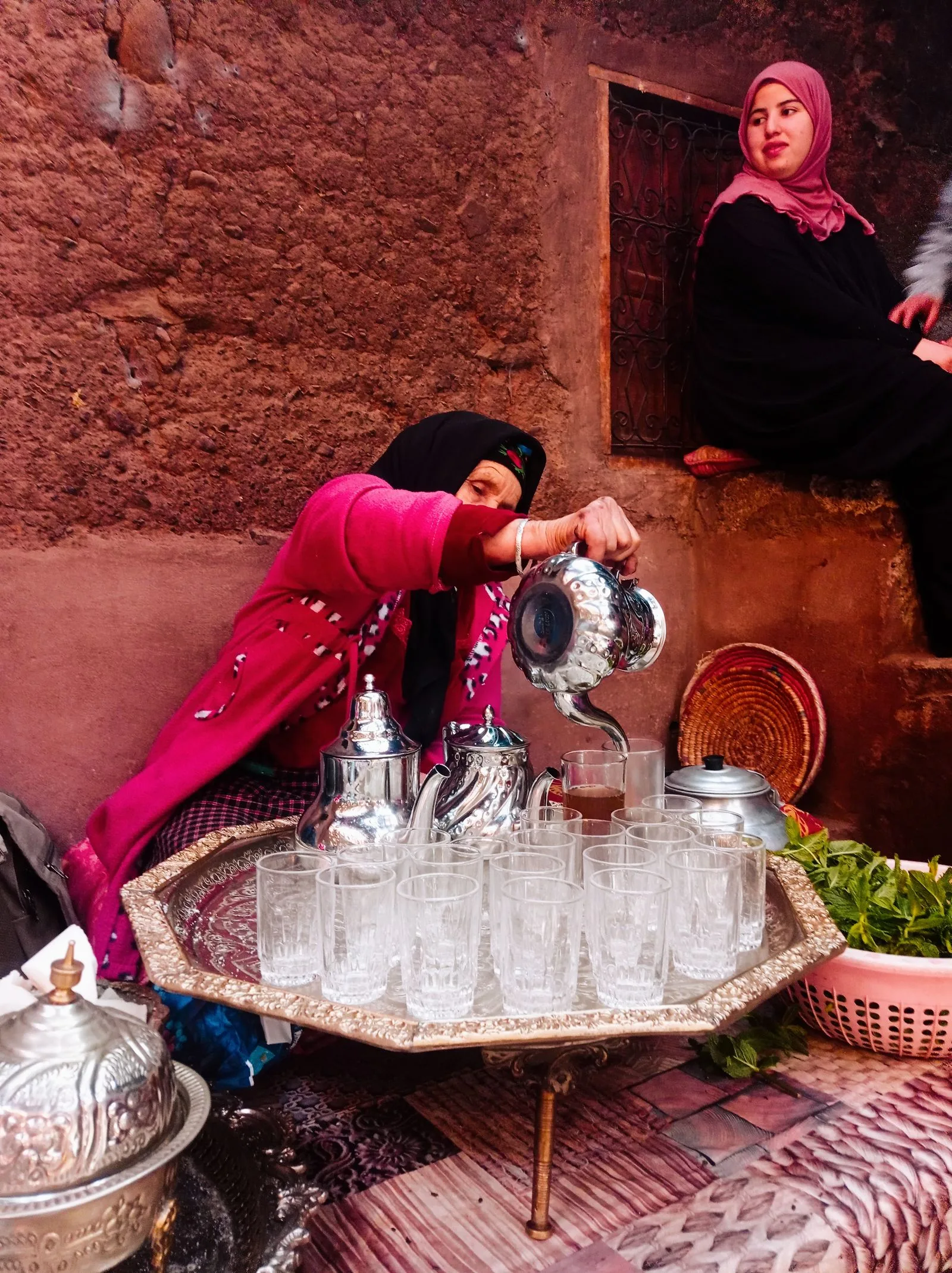
So is the terrace the trap? Not on the tagine. Against a delivery menu it adds about a quarter, and it throws in the roof, the view and a printed price. Against the reported counter band of 30 to 50, the same terrace tagine costs two to four times as much, very likely the food gap that matters most. The line that runs away fastest is not a terrace line at all: it is the bottle of water, from the shelf to any table.
Water is the most marked-up line on the menu
It costs almost nothing on the shelf. On 12 September 2026 a six-pack of 1.5-litre Ain Saiss cost 24.50 dirhams at Carrefour Market in Marrakech, which is 2.72 a litre. The two terrace menus that price a small bottle by size charge 40 a litre. Nomad filters its water in-house, but Taj Medina’s bottled half-litre comes to 40 on its own. That is about 15 times. Against a 2-litre Sidi Ali on the same shelf, at 6.00 a litre, the terrace is still almost seven times higher.
The delivery menus sit in between. Across 13 Marrakech menus, a 1.5-litre bottle had a median of 25 dirhams, or 16.67 a litre. The half-litre bottle had a median of 15 across 23 menus, which is 30 a litre. Taj Medina’s 1.5-litre bottle, at 35, works out at 23.33 a litre, so a big bottle softens it even on a terrace. Three other terrace menus give no bottle size at all, so I leave them out of the per-litre figure rather than guess.
The fix is dull. Buy a six-pack at a supermarket and carry a bottle from it. Against two half-litre bottles at the delivery-menu median of 15, or 20 on the one terrace card that sizes it, a litre from the pack costs about 3: roughly 27 to 37 back on every paid day. A single 2-litre bottle, at 6 a litre, still saves 24 to 34.
Is it cheaper to eat in Fes than in Marrakech?
Probably, as an indicative reading only. Glovo’s Moroccan filter showed 16 restaurants in Fes against 50 in Marrakech, and four of the Fes ones sold a single chicken tagine, at a median of 80 dirhams against Marrakech’s 90. Harira came in at 29 across four Fes menus, mint tea at 15 and 16 on two, and a half-litre of water at 10 across six. Every one of those sits below the Marrakech figure.
Fewer Fes restaurants appear under the app’s Moroccan filter, though a filter count is not a census of a city’s kitchens. No Fes restaurant I tried publishes a priced menu I could read, so this page has no Fes terrace tier at all. I would rather print that gap than borrow a figure to fill it.
One published guide puts a Fes tagine lunch at 40 to 60 dirhams against 70 to 100 in Marrakech (Heerby, 2026), without a source or a sample. Every Fes delivery tagine I read cost 68 or more. For the record, the Big Mac menu on McDonald’s delivery pages is 68 in both cities, and in Casablanca.
How much should you budget for food per day in Morocco?
About 210 dirhams for a paid day at delivery-menu prices and about 260 at terrace prices. On a seven-night trip with five riad nights and two desert nights, that comes to about six paid days, not seven, because your riad and your tour already cover some meals. The table shows the day; the count comes after it.
| Day | Lunch | Dinner | Two mint teas | Water with the meals | Total |
|---|---|---|---|---|---|
| Delivery-menu prices | harira 40 | tagine 90 | 50 | two 0.5 L at 15, 30 | about 210 |
| Medina terrace prices | harira 55 | tagine 115 | 50 | two 0.5 L at 20, 40 | about 260 |
| Street counter, reported | harira 5 to 8 | tagine 30 to 50 | 10 to 30 | a litre of shop water, about 3 | about 50 to 90 |
The delivery row uses measured medians. The terrace food cells are medians too, but its water cell is one card, Taj Medina’s. The street row uses reported ranges, so read it as a floor rather than a figure. Carrying a litre from a supermarket six-pack instead takes about 27 off the first row and 37 off the second.
Now the count. Most page-one riad listings I logged in Marrakech included breakfast, which is why the riad round sums it up as breakfast usually included, tax almost never. The desert inclusions matrix found dinner included on all ten desert tours I checked, and breakfast on nine. A two-night tour spends one night at camp and one in a hotel on the way.
Twenty-one meals, less five riad breakfasts, less two tour dinners and two tour breakfasts, leaves 12. The table above already leaves breakfast out, so against it the saving is the two tour dinners: about six paid days on a seven-night trip, not seven.
Expect to pay cash at counters and small cafés. Where a card is taken, pay in dirhams, for the reasons in why dirhams, not your home currency, at the card terminal. The whole-trip total, food included, lives on the trip-cost page.
How to avoid a surprise on the bill
Read a printed price before you sit down. Morocco’s consumer protection law, Loi 31-08, requires prices to be displayed (WIPO Lex, Loi n° 31-08, Article 3). A menu without them is the opening move of the menu with no prices.
A printed price is also fixed. Restaurants, cafés and street food are not negotiated, which is why where haggling applies, and why restaurants are not on the list leaves them off. Bread, olives and water that arrive unasked are different. Unless someone says they are free, assume each is on the bill, and send back what you do not want.
Two habits close most of the rest. If you are sitting down anyway, take your tea with the view, because the terraces charged the same 25 as the delivery menus. And carry your own water. Whether to tip, and how much, is a separate question with its own answer, and so is how opening hours change during Ramadan. On hygiene, one rule is enough here: eat where the food turns over fast. The rest, from tap water to what a pharmacy charges for rehydration salts, is in the health in Morocco guide.
Frequently Asked Questions
How much does a meal cost in Morocco?
A chicken tagine had a median of 90 dirhams on 17 Marrakech delivery menus and 115 on four medina terrace menus I read on 12 September 2026. At a simple street counter, published food guides put the same dish at 30 to 50. A mint tea adds 25 on either kind of menu.
How much is a tagine in Morocco?
It depends on the rung. About 30 to 50 dirhams at a hole-in-the-wall, reported rather than measured; a median of 90 on Marrakech delivery menus and 80 on four in Fes; and 95 to 130 on the own menus of Marrakech medina restaurants, with a median of 115 across four.
Is food expensive in Marrakech?
Not on the plate, once you are sitting down. The terrace median for a chicken tagine was 115 dirhams, about a quarter above delivery menus, and harira was 55. Water is the exception: up to 40 dirhams a litre on a terrace card, against 2.72 for a supermarket pack.
How much should I budget for food per day in Morocco?
About 210 dirhams for a paid day at delivery-menu prices and about 260 at terrace prices, covering lunch, dinner, two mint teas and water ordered with the meals. Carrying water from a supermarket six-pack takes 27 to 37 off that. Breakfast already sits outside that day, usually covered by the riad, and two desert-tour dinners bring a seven-night trip to about six paid days.
Is it cheaper to eat in Fes than Marrakech?
Slightly, on a small sample. Four Fes delivery menus had a median chicken tagine of 80 dirhams against 90 on 17 in Marrakech, and harira, tea and water were cheaper too. Fes listed 16 restaurants under the same filter against Marrakech’s 50, so treat the gap as indicative rather than conclusive.
The short version
Food prices in Morocco climb a ladder, and the rungs are not where people put them. From a delivery menu to a medina terrace, the tagine gains about a quarter and a mint tea gains nothing. Water gains about fifteen times from the supermarket pack to the terrace card, and it is the line nobody reads. The food gap from the street counter up is very likely the biggest of all, and it has no sample size.
Three things to carry away. Take your tea with the view if you are sitting down anyway. Carry your own water. And count your paid meals before you budget, because your riad and your tour have already bought some of them.
What I did not measure: what anyone paid at a till, any street counter directly, restaurant prices in Casablanca, or a Fes terrace menu. Delivery prices are advertised prices and a likely ceiling, not the counter. Every figure above carries its date, and I move the date at the top of this page each time I re-read the menus. The rest of the cost picture is in the Real Costs archive.